DAILY STRATEGY: Two Main Points Today – Several clients asked us why UST yields have not moved lower post the more dovish than expected CPI/PPI data. We cover that first. The second main point is on AI Capex expectations as part of our Weekly AI Update. Investors we surveyed expect the level of Hyperscaler capex in 2027 (median $1.1T) will support the AI buildout trade. The implication being Hyperscaler earnings over the next few weeks, which should come with some indication on 2027 AI Capex, COULD be a support to the Price Momentum basket.
UST Yield Points – Near term inflation risk, that would have led to tighter financial conditions has been lowered post CPI/PPI, but it is not gone. The Retail sales report indicated real personal consumption expenditures are running at +2%. As Gerard noted yesterday (HERE), there is a positive launch effect for Q3. The launch indicates real consumption will stay at +2% for 3Q. In short, the combination of +2% Real consumption and strong capital spending (~1% contributor to GDP growth) suggests economic growth is strong enough that inflation RISK will remain elevated. The above is why a September hike is still a coin flip and expect 10yr yields to hover around the 4.5% level for now. A slowdown in economic growth or labor market is necessary for 10yr yields to move much below 4.5%.
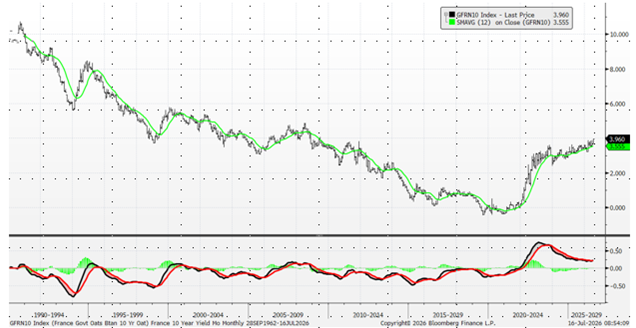
Rest of World Influence on UST Bonds. As John Roque pointed out yesterday, French 10-year yields are at their highest level in 17 years. John notes that G-7 bond yields trend homogeneously over time. The move in G7 bond yields reflects a broader shift to a higher-rate regime, driven by persistent inflation risks, large fiscal deficits, elevated government bond issuance, and stronger-than-expected economic growth rather than a temporary country-specific story. In short, don’t expect a sharp move lower in UST yields when the rest of G7 yields are moving in the opposite direction.
Weekly AI Segment: What Hyperscalers say about AI demand, free cash flow in the future and Capex plans will be important for AI demand beneficiaries. What all other companies say about AI related value creation – is the average small and mid-cap stock indicating positive margin outlooks and productivity gains related to AI – is also important. Investors seem increasingly focused on this, so we ran an investor survey to assess expectations. Results below.
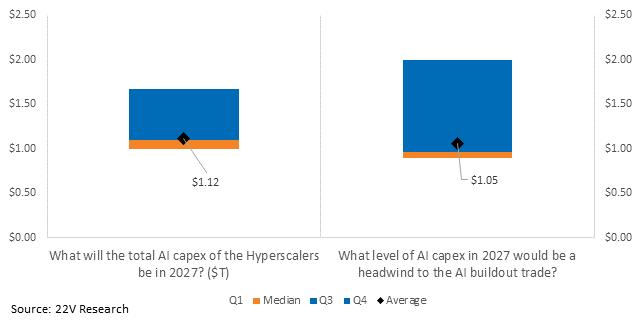
Bottom line – most investors expect the level of Hyperscaler capex in 2027 (median $1.1T) will support the AI buildout trade.
Investor estimates for 2027 Hyperscaler capex range from $1T to $1.7T, with a median estimate of $1.1T. Investors have a wide range of estimates for what level of capex would be a headwind to the AI buildout trade, ranging from $900B to $2T. The median estimate is just under $1.1T.
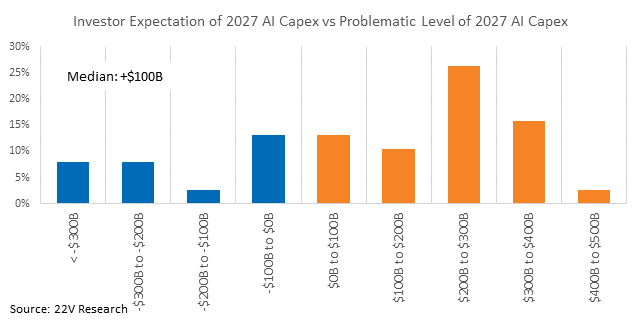
Comparing individual estimate to individual estimate provides a more accurate sample of the modal outcome for capex relative to the level that is a headwind. 68% of the investors we polled have a higher estimate for capex than the level they think is a headwind. 32% think the level they expect is below the threshold. The median estimate is +$100B higher than the level that’s a headwind.