

There is a slight tension between my overall macro view and my take on the implications of today’s employment report. For example, my take on the inflation situation is much closer to Mary Daly’s than to, say, Kevin Warsh’s. Daly says that inflation should moderate but that there is some uncertainty around that take, I assume in part, because inflation is high — and for reasons we do not fully understand. We ought not dismiss data we do not fully understand. Indeed, such data are the most incremental. And what we know is that inflation has recently been accelerating, for reasons that cannot be related just to tariffs or to the Iran conflict.
There is little question that the job gains part of the employment report were weak. I tend to pay less attention to the distribution of the job losses than others do, in part because I am never quite clear which sector we are supposed to view as the “good” or “important” one. If the data show that the labor income proxy missed, then the job weakness was not likely in low wage sectors, or at least that did not dominate.
Nice tight story, too bad it’s wrong
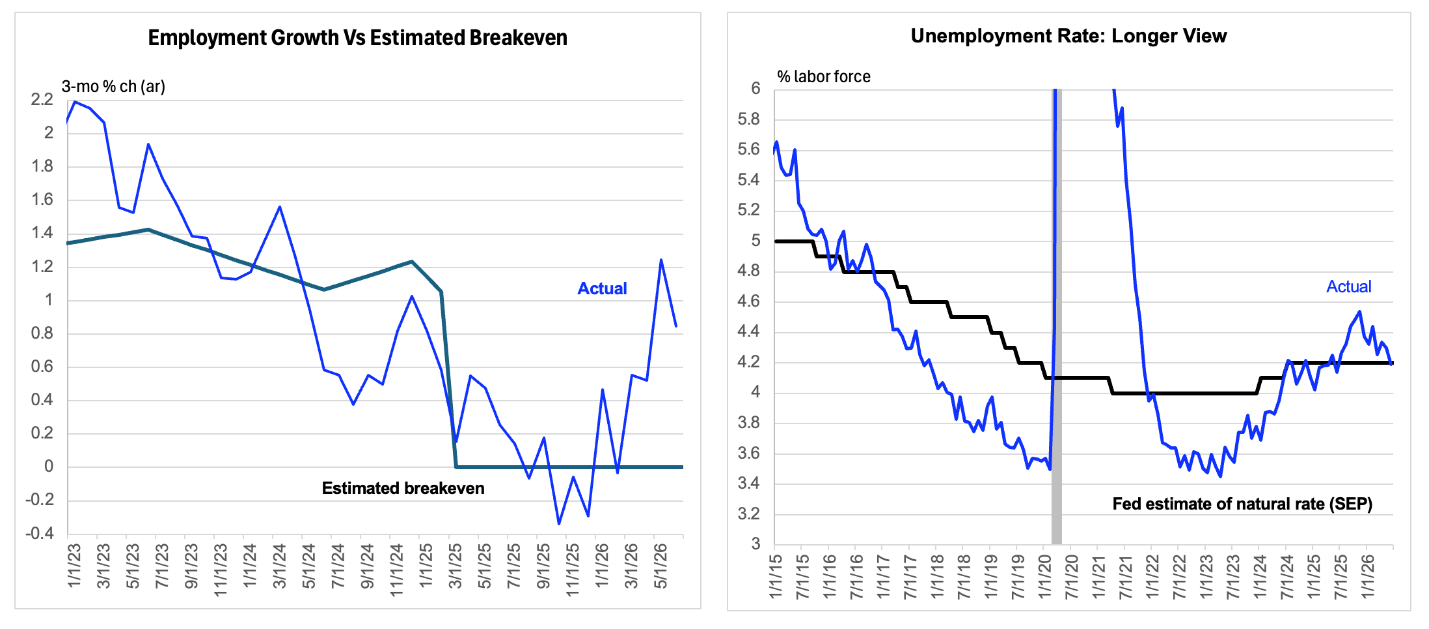
Labor market data are actual to June 2026.
What is more debatable and controversial this morning is how to think about the combination of the decline in the unemployment rate and employment/population ratio. The decline in the employment/population ratio was much steeper than the decline in the unemployment rate, so even if we think the unemployment rate is the better measure (which I don’t, especially at short horizons), then the net net would probably be that the labor market eased, against an expectation of a slight tightening, before rounding.
Let’s start with the relatively hawkish interpretation. In recent months overall employment growth has been meaningfully positive in an environment in which the estimated breakeven employment growth rate has been around zero, although with some hair on that estimate. And accordingly, the unemployment rate has been dutifully declining. If we step back and take these trends over a year window, we see the following. The unemployment rate is roughly unchanged with establishment employment growth running at 0.3%. That would tend to confirm that the breakeven has fallen a lot, although we can argue about 30 bps. And in June in isolation, the unemployment rate did fall 11 basis points, which is actually more tightening than would be expected if both the employment breakeven growth rate were zero and actual employment growth were precisely measured. So, that is the labor market tightened perspective. And it is quite coherent, if I may say! 😉
The problem with this nice tight story is the labor market tightening is being driven entirely by the labor force participation rate collapsing. Sometimes, the collapse is in one age cohort that we might want to dismiss. And sometimes it is in another, as this month, which we might also want to dismiss. But what we cannot dismiss is this straight line decline in the employment population ratio. During June the trend continued with the e/pop dropping 0.36%, not percentage points. Even if half this decline is structural, reflecting early retirement or whatever, we still wind up with a huge decline of the cyclical component of the participation rate, which by definition means the labor market eased, subject only to the cyclical share assumption being correct. So, on the balance of the evidence, I do with ease. Separately, with positive employment growth the labor market is supposed to tighten.
Even if this is only half cyclical, it still trumps lower UR
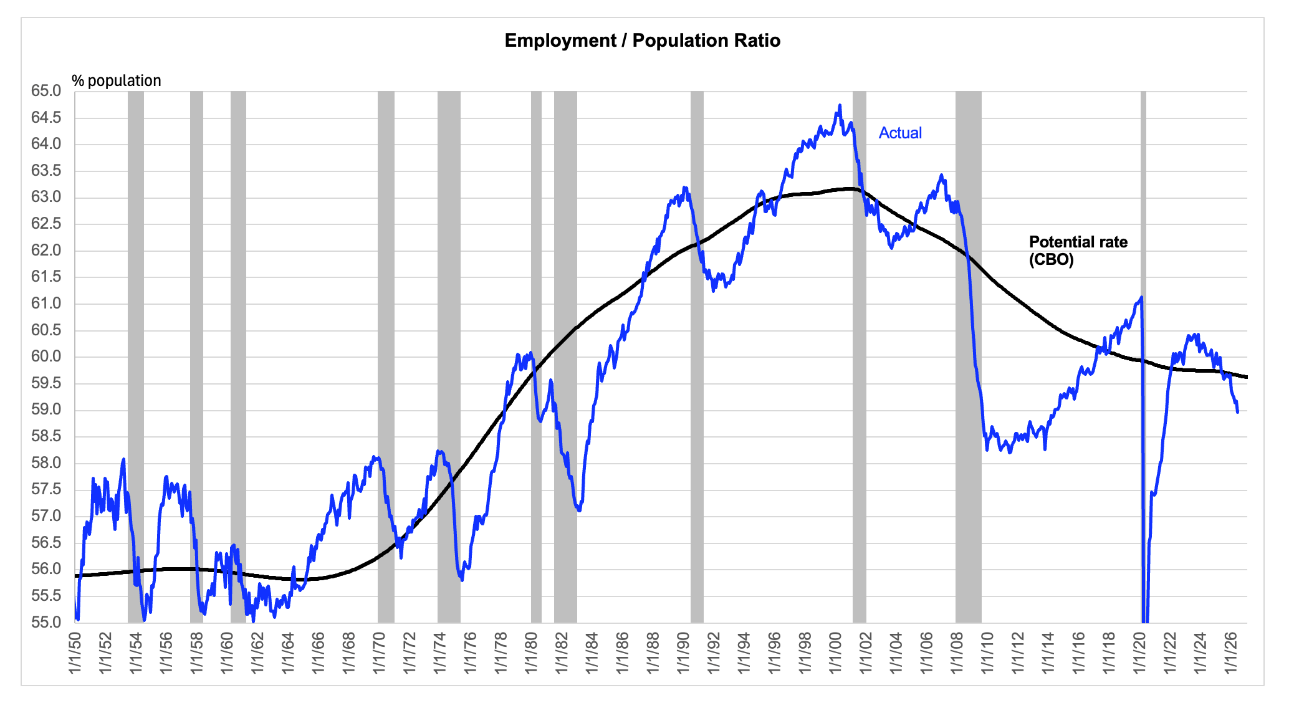
Labor market data are actual to June 2026.
Some folks like to focus on developments in the prime age slice, both because these workers matter more for being relatively-high wage/productivity and because short run swings here are less likely to be noise. I am sympathetic with that take, while sticking as always to the mosaic approach which emphasizes the importance of being less wrong. This month, the employment / population ratio among prime age fell twice as steeply (in %, not ppt) terms) as the overall. So for those leaning particularly heavily on this slice, the development on the month was even more extreme. These data are volatile month to month, so it is easily conceivable that there is some noise here in the level and / or that this softening actually occurred a bit earlier and is just being picked up now. But it seems pretty obvious that the mean of the probability distribution describing our sense of tight / loose in the labor market moves toward the looser side in the wake of these data. It does not overturn the basic macro story, but on jobs day it might be good to start with the incremental new news. I guess Mr. Market figured this out pretty quickly.
Concentrated in the part folks are less inclined to dismiss
Note that employment / population ratio is shown on reverse scale
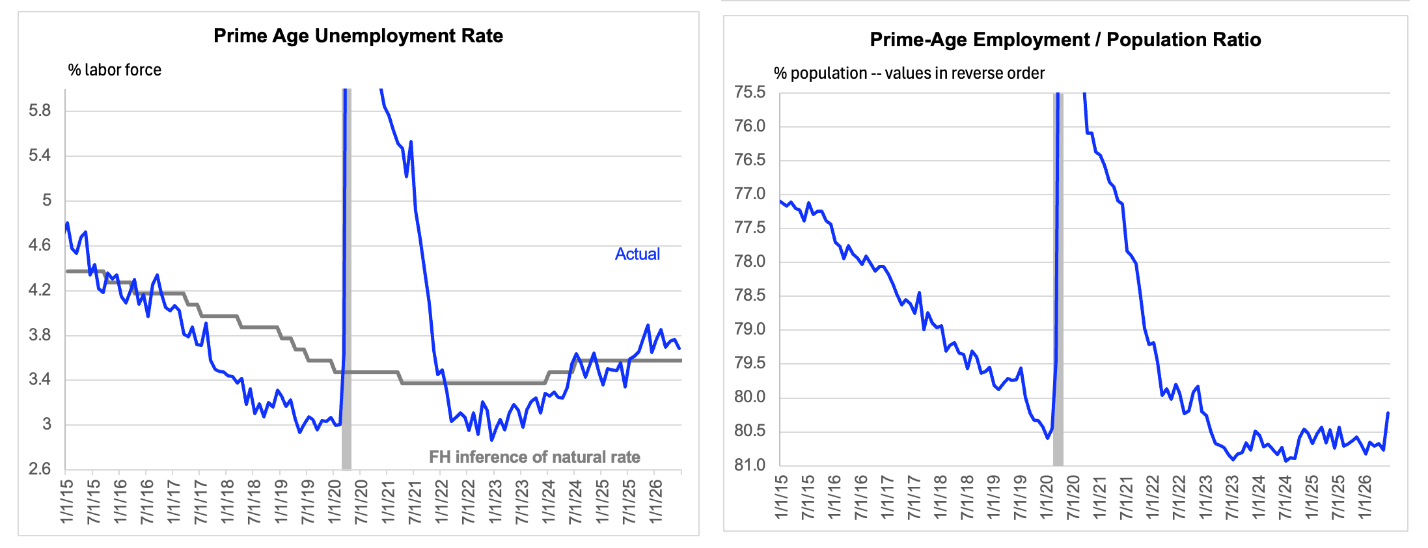
Labor market data are actual to June 2026.
My point is not that the expansion is at risk. Prospective growth is determined more from the speed limit than from the demand side. And evidence of increased slack does not imply a weaker speed limit. This is more about the incremental news for rates.

