Back Economics

Final look at informed consensus for May PCE Prices

Published on June 16, 2026

∙ Download the PDF Report

By

Gerard MacDonell

The informed consensus did not change its best guess for the May Core PCE Price Index in response to the detail in this morning’s Import Price Index. International airline fares came in roughly as implied by the PPI. There is some dispute across the analysts about how to treat this item, but the import price index did not seem to resolve any of it. Still, there was some minor movement after the release of the PPI, on which I have not yet commented. And one of the more reliable analysts who was quite high initially has reduced his best guess by 4 bps, not because of new data but just on a reconsideration of the data in hand. So, I figured a quick update would be appropriate here.

The informed consensus has the Core PCE Price Index rising 32 basis points (false precision throughout). That is another unnervingly high reading, but about 8 basis points of this is due to an add from portfolio management and advisory fees, which is just a noisy reflection of the performance of the stock market, particularly at short horizons. So, it is probably better to focus on the implied consensus for the Market Price Only (MPO) version of the Core. That is expected up 24 basis points or just under 3% at a sequential annualized rate.

While non-market prices provided a big lift to the Core in May, this has not been an issue over the past year taken in aggregate. The 12-month change of the standard Core is on track to print at 3.38%, while the MPO version in on track to 3.15%. However, the MPO typically runs below the conventional core because non-market prices tend to rise relatively quickly over time. Correcting for this bias, the MPO actually points to a marginally higher underlying inflation rate than does the conventional Core. Or more realistically, the two approaches give reads that are so close that the distinction can safely be ignored.

One interesting twist this month is that Core Goods Price Index is expected to be down 10 bps. That is consistent with the notion that the tariff impetus peaked – even in level terms – a while ago, although we probably never relate one month’s result to a macro theme. It might also be evidence that the lift from the AI buildout, which would logically be less transitory and more worrying than the tariff effect, might be a bit smaller than we previously imagined.

The heat this month was in so-called Supercore Services, that is, Core Services excluding housing. That index is on track to be up 49 bps on the month. But keep in mind that the stock market effect is particularly concentrated there. So, the MPO version is on track to rise a more moderate, although still quite warm, 35 basis points.

Meanwhile, we basically know that housing or rents was up 33 basis points. That is quite a bit quicker than my proxy of marginal rents which is rising at just 12 bps a month. I make less of this distinction that I did before because the gap between the levels of marginal and average rents has closed, which I think means that precision trumps lead here. In other words, I am less inclined to just swap out the average rents in favor of the marginal.

Nevertheless, we can complete the thought by doing the arithmetic with a somewhat dovish set of assumptions. Let’s assume that the post-tariff and post-globalization trend in core goods prices is zero. And let’s assume – quite dovishly – than housing or rent inflation is headed to 1.5% sequentially. To get to 2% inflation under these assumptions, we would need SuperCore services to run at 3%. But it is currently running at about 3.7%, which I infer from observing the MPO SuperCore and then adding back the structural downward bias there. So, it is running 70 basis points too high. Or equivalently, its current rate maps to a Core PCE inflation rate of 2.4%, 40 bps above target, under the conditions mentioned above. To the extent the assumed conditions have a slight dovish bias, the issue here is a bit more serious.

It is by no means a disaster. But with the labor market within measurement error of full employment, conventional monetary policy would require some sacrifice of employment to get the underlying inflation rate lower. So, this continues to fit my view that the speed limit on growth is 2% or perhaps lower. Chair Warsh’s presumed preference for the Trimmed Mean may affect this slightly, but it cannot overturn it, because his preference is not widely shared across the committee, for good reason in my view.
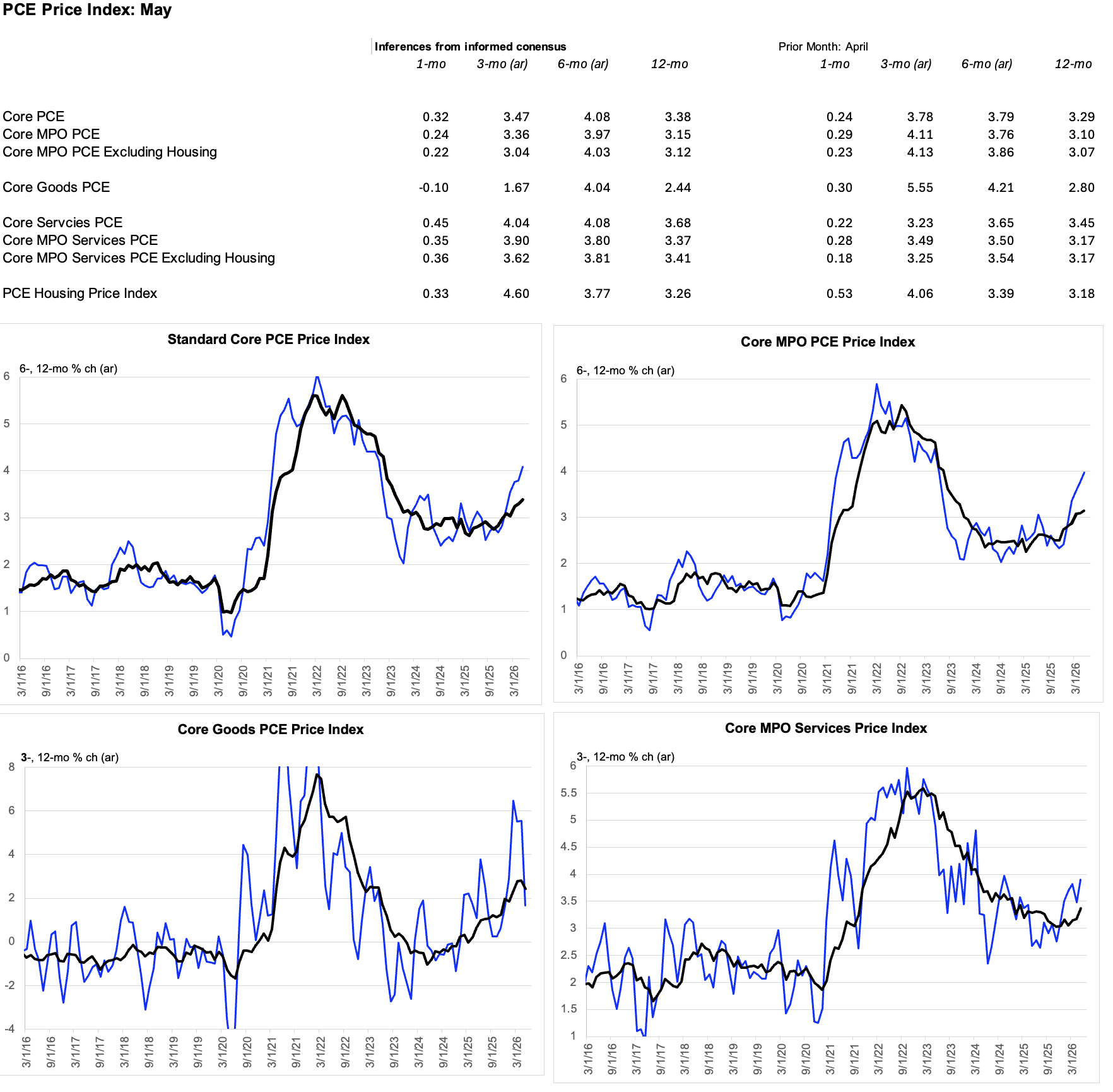
A screenshot of a graph

AI-generated content may be incorrect.
Source: BEA, FH inferences from informed consensus and calculations
Data are actual to April and consensus for May.

DISCLOSURES AND DISCLAIMERS

Analyst Certification

The analyst, 22V Research Group, primarily responsible for the preparation of this research report attests to the following: (1) that the views and opinions rendered in this research report reflect his or her personal views about the subject companies or issuers; and (2) that no part of the research analyst’s compensation was, is, or will be directly related to the specific recommendations or views in this research report.

Analyst Certifications and Independence of Research.

Each of the 22V Research analysts whose names appear on the front page of this report hereby certify that all the views expressed in this Report accurately reflect our personal views about any and all of the subject securities or issuers and that no part of our compensation was, is, or will be, directly or indirectly, related to the specific recommendations or views of in this Report.

22V Research (the “Company”) is an independent research provider. The Company is not a member of the FINRA or the SIPC and is not a registered broker dealer or investment adviser. 22V Research has no other regulated or unregulated business activities which conflict with its provision of independent research.

22V Research, LLC is a professional services and independent publication organization. 22V Research, LLC is not a securities broker-dealer, not a member of the Financial Industry Regulatory Authority (FINRA), not a registered investment advisor (RIA) and not a member of SIPC.

Securities transactions, when offered, are offered by 22V Securities, LLC through LPS Capital, LLC. Certain employees of 22V Securities, LLC are dually registered as securities representatives of LPS Capital, LLC or Analyst Hub Securities, LLC. 22V Securities, LPS Capital and Analyst Hub Securities are members FINRA, SIPC.

https://brokercheck.finra.org/

Current Ratings Definition.

SECTOR OUTPERFORM: An “outperform” rating anticipates the company will outperform the S&P Regional Banking Index (peer group).

SECTOR PERFORM: A “market perform” rating anticipates the company will perform in line with the S&P Regional Banking Index (peer group).

SECTOR UNDERPERFORM: An “underperform” rating anticipates the company will underperform the S&P Regional Banking Index (peer group).

Limitation Of Research And Information.

This Report has been prepared for distribution to only qualified institutional or professional clients of 22V Research Group. The contents of this Report represent the views, opinions, and analyses of its authors. The information contained herein does not constitute financial, legal, tax or any other advice. All third-party data presented herein were obtained from publicly available sources which are believed to be reliable; however, the Company makes no warranty, express or implied, concerning the accuracy or completeness of such information. In no event shall the Company be responsible or liable for the correctness of, or update to, any such material or for any damage or lost opportunities resulting from use of this data. Nothing contained in this Report or any distribution by the Company should be construed as any offer to sell, or any solicitation of an offer to buy, any security or investment. Any research or other material received should not be construed as individualized investment advice. Investment decisions should be made as part of an overall portfolio strategy and you should consult with a professional financial advisor, legal and tax advisor prior to making any investment decision. 22V Research Group shall not be liable for any direct or indirect, incidental or consequential loss or damage (including loss of profits, revenue or goodwill) arising from any investment decisions based on information or research obtained from 22V Research Group.

Reproduction And Distribution Strictly Prohibited.

No user of this Report may reproduce, modify, copy, distribute, sell, resell, transmit, transfer, license, assign or publish the Report itself or any information contained therein. Notwithstanding the foregoing, clients with access to working models are permitted to alter or modify the information contained therein, provided that it is solely for such client’s own use. This Report is not intended to be available or distributed for any purpose that would be deemed unlawful or otherwise prohibited by any local, state, national or international laws or regulations or would otherwise subject the Company to registration or regulation of any kind within such jurisdiction.

Copyrights, Trademarks, Intellectual Property.

22V Research Group, and any logos or marks included in this Report are proprietary materials. The use of such terms and logos and marks without the express written consent of 22V Research Group is strictly prohibited. The copyright in the pages or in the screens of the Report, and in the information and material therein, is proprietary material owned by 22V Research Group unless otherwise indicated. The unauthorized use of any material on this Report may violate numerous statutes, regulations and laws, including, but not limited to, copyright, trademark, trade secret or patent laws.
