

The Productivity and Cost report is seldom market moving. And this morning’s revision to the first quarter data is an example of that. However, the data allow us to monitor slowly moving themes, with the main value added here probably being more a matter of interpretation than of what the newly released figures show. I will be brief.
The underlying trend of productivity growth in the nonfarm business sector continues to run at about 2.1%. That is false precision but it results from passing a trend line through the level of the productivity series, with points of inflection there being subjective but not especially controversial.
No change today in the apparent trend, unsurprisingly
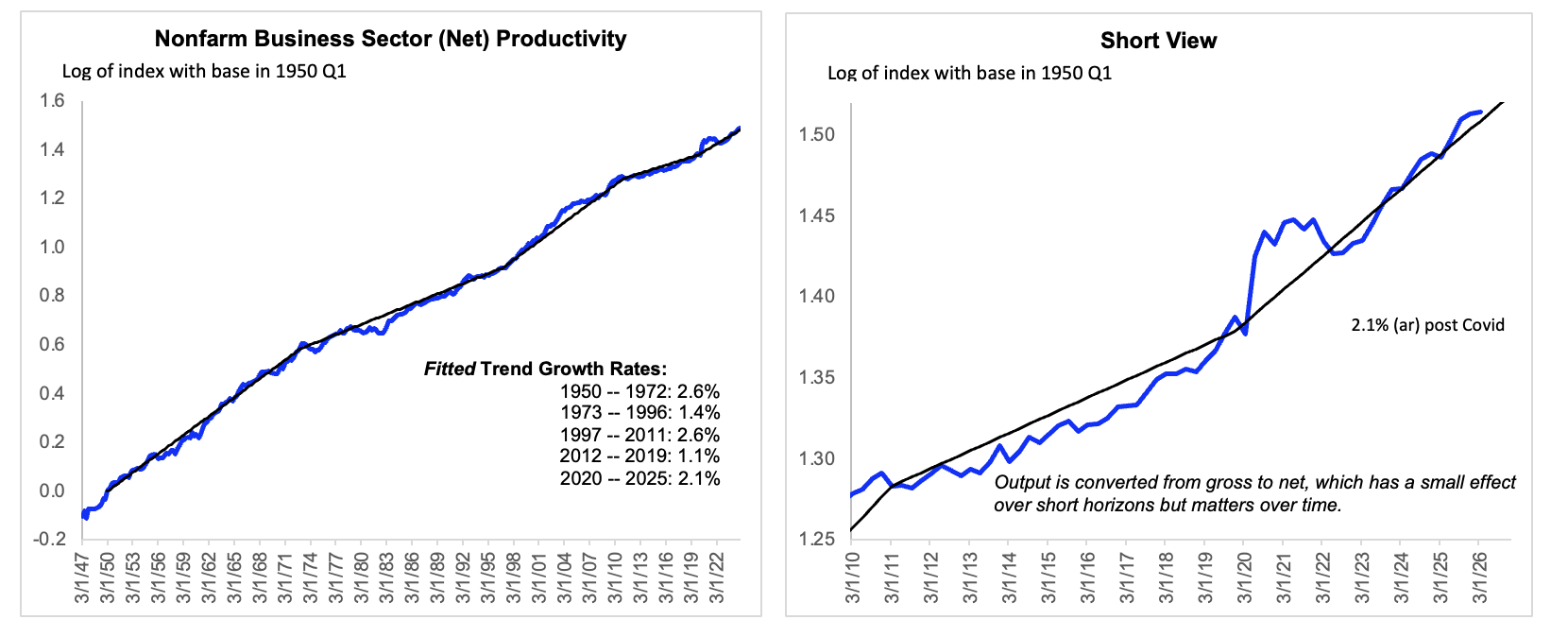
Data are actual to 2026 Q1.
While the recent apparently doubling of trend productivity growth has been impressive, this fits into my view that the speed limit for overall GDP growth for the next few quarters is likely to be 2% or lower. If non-farm business sector productivity growth is running at 2.1%, then economy-wide is probably closer to 1 ¾%. Meanwhile, potential employment growth is apparently quite low because of the demographics shift, although this will be an issue around which we will have to keep an open mind. (The recent data seem to involve insufficient labor market tightening for the consensus estimate, of zero potential employment growth, to hold.) Meanwhile, the Fed will want to avoid a renewed tightening of the labor market with the economy already within measurement error of full employment and with underlying (e.g., ex-tariff) inflation, even generously interpreted, running at least ½ a percentage point above target.
ECI suggests that underlying AHC growth is around 4%
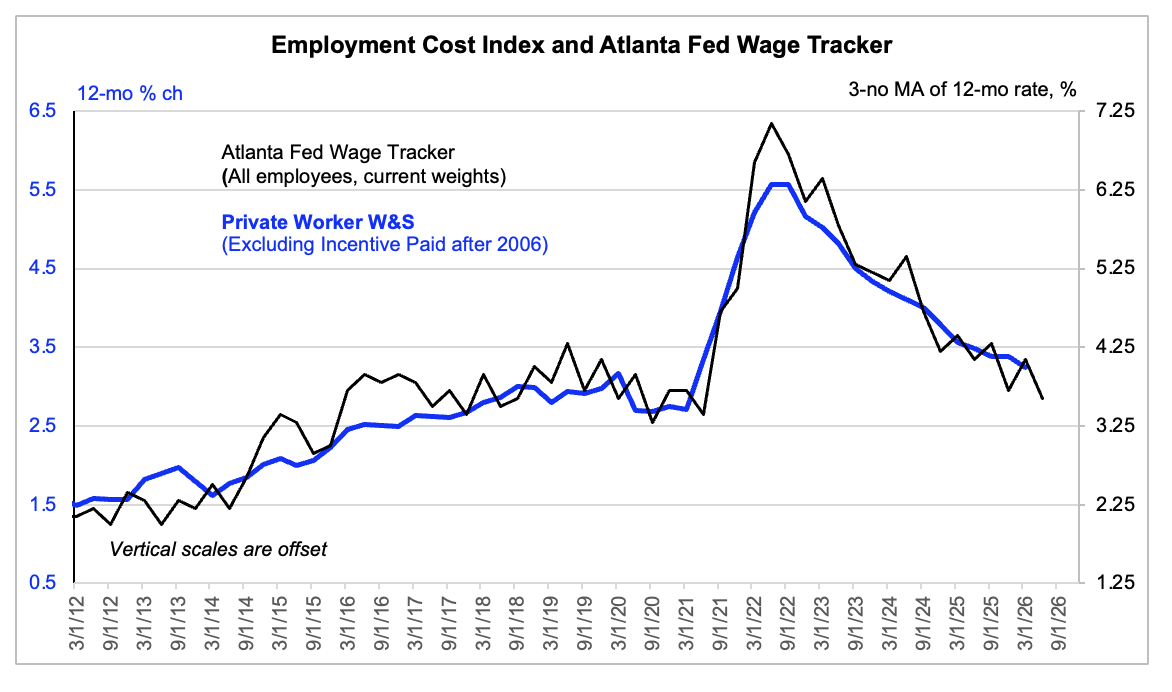
ECI is actual to March. The Wage Tracker is actual to April and is shown for reference, suggesting ECI may still be slowing.
This morning’s data show that measured unit labor cost (ULC) inflation ran at just 0.5% during the four quarters ending in March. There is a sense in which that is quite relevant, as I will get to below. However, the measured ULC inflation data are extremely noisy because both measured productivity and measured average hourly compensation (AHC) are noisy even when measured at a 4-quarter rate. It is probably best, then, to think of the underlying trend of AHC inflation implied by the Employment Cost Index (ECI) and then subtract trend productivity growth from that. Core ECI inflation is apparently running at just over 3%, which would map to 4% growth in trend AHC, given that AHC tends to rise almost a percentage point quicker over time than the ECI. That implies underlying ULC growth of 2%, which fits quite neatly into a very wide range of data suggesting it is very difficult to trace the current inflation overshoot to the labor market or to the Phillips Curve construct more generally. But just because the inflation does not fit the standard model does not mean it is necessarily transitory.
Labor share at record low
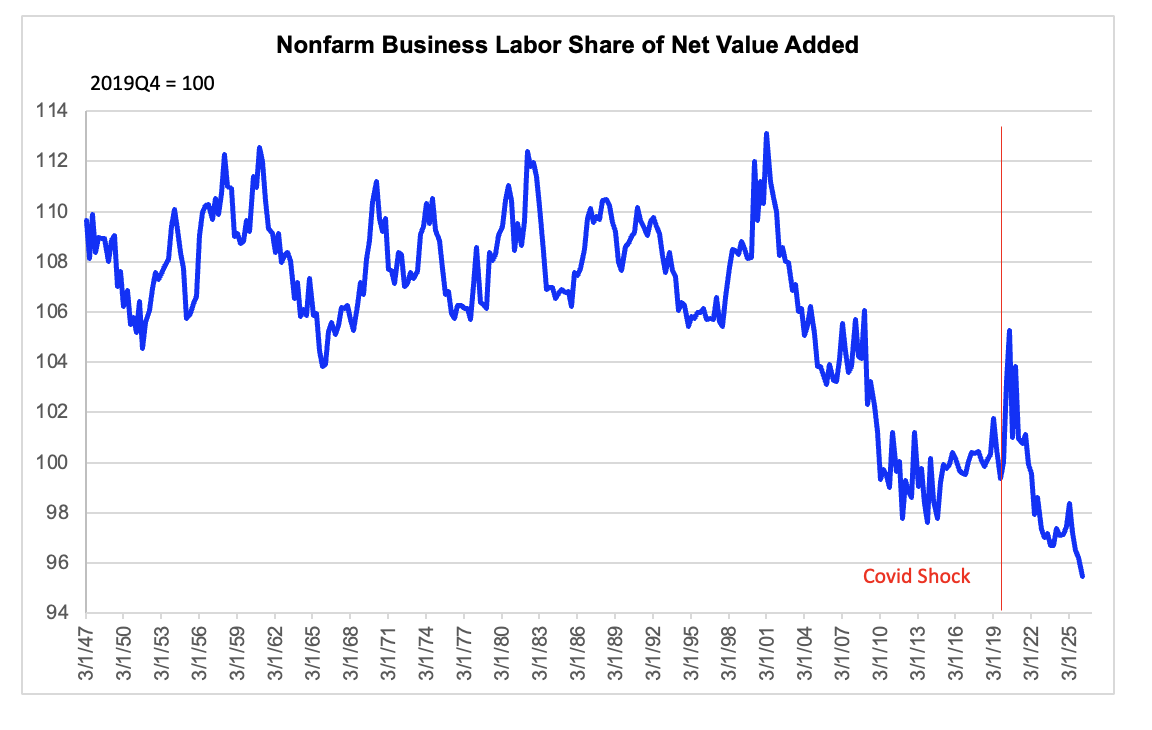
Data are actual to 2026 Q1.
While the measured ULC data are too volatile to allow us to infer an underlying inflation trend from their behavior, the ratio of ULCs to the value added deflator in the nonfarm business sector is – by definition – an index of the labor market share. To see this, just multiply both the nominator and the denominator there by real output. And when this is expressed in level terms it would seem to contain very relevant information. To wit, the labor share has fallen steeply in recent quarters, including since the Covid shock, and is now at a record low.
There are two ways of interpreting this. First, it may be evidence that there is room for businesses to absorb higher labor costs into margins rather than passing them on in the form of inflation – were higher labor costs to develop. Second, looking more strictly backward, this has been the main force driving the after-tax profit margin in the nonfinancial corporate sector to an all-time high, as we saw confirmed in last week’s revised National Accounts. Back in the day, the bears used to warn about profit margin mean reversion. But people have pretty much given up on that idea, which I would view as an advance, because structural changes in the economy can affect the “mean” to which margins would presumably revert.
Record wide margins on domestic operations
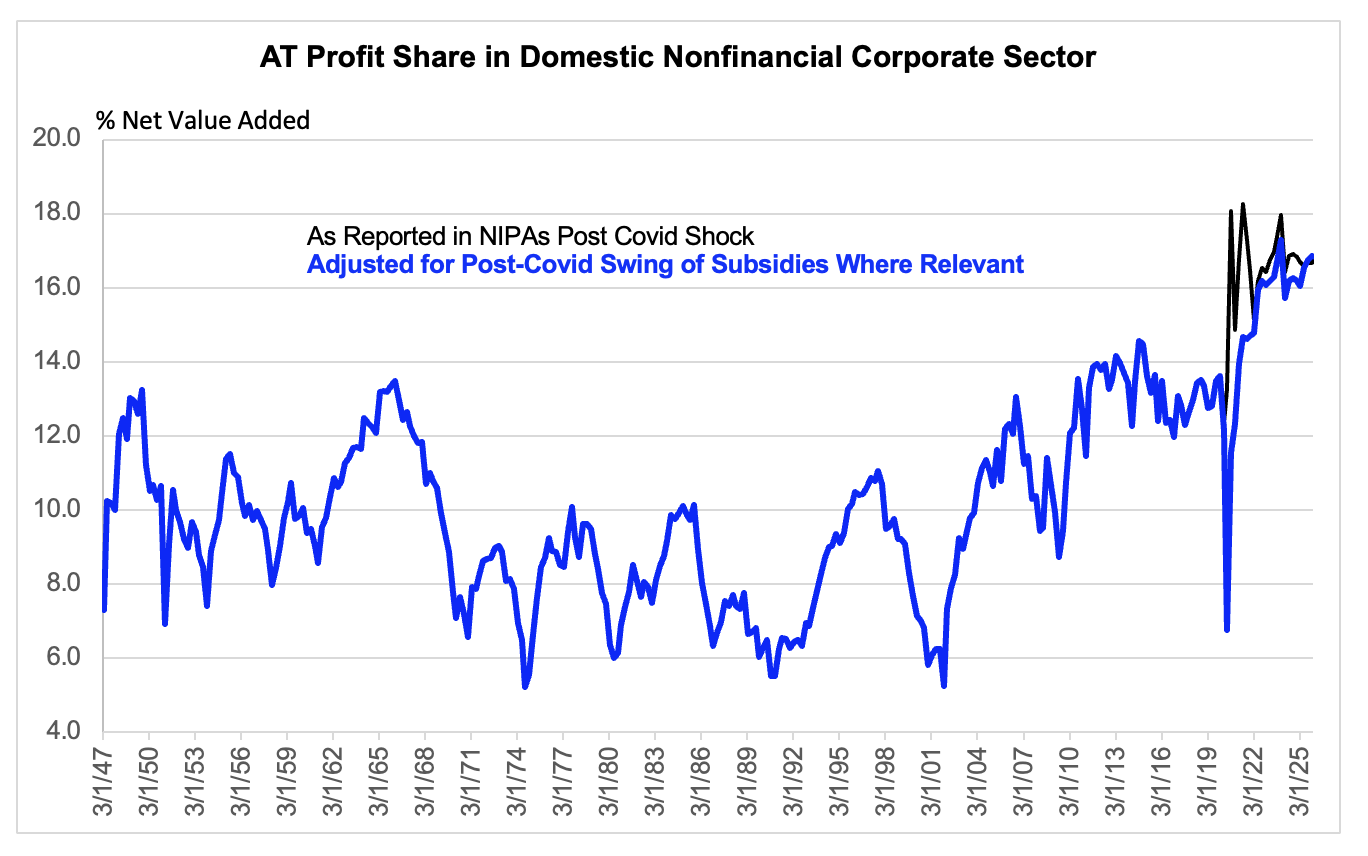
Data are actual to 2026 Q1.

