April economic data show that the slowdown in China’s Q2 growth that we have been expecting (see HERE, for example) has finally arrived. All headline measures of activity – industrial production, fixed asset investment, retail sales – came in below consensus and substantially slower than in March.
Because exports in April were still very strong (14.1% y/y in dollar terms), this is largely a story about the weakness of domestic demand:
- As we have been warning, the fiscal stimulus that supported growth to start the year continues to fade. Fixed asset investment in infrastructure slowed from 8.9% y/y in Jan–March to only 4.9% y/y in Jan–April.
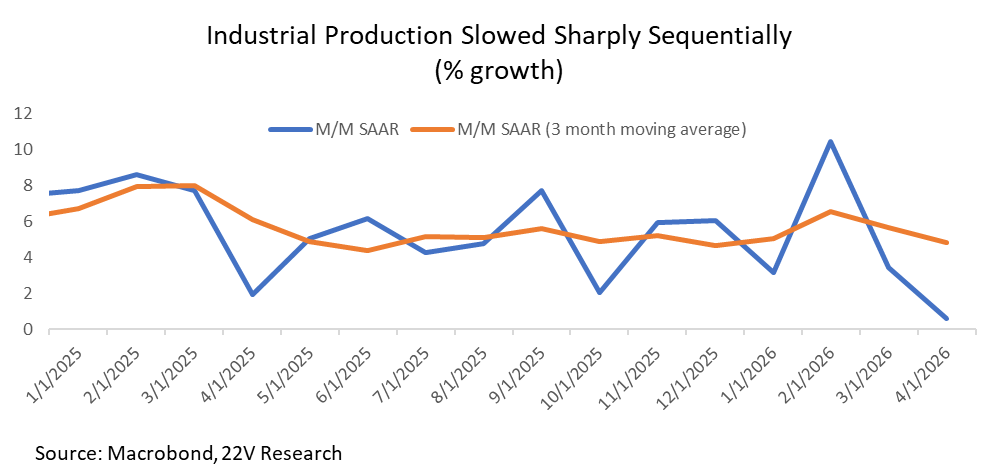
- The impact of higher energy prices from the Iran conflict is also starting to weigh on demand. Industrial production grew 4.1% y/y (from 5.7% in March) and showed a particularly sharp decline sequentially (see chart below). This is partly due to Iran-related supply disruptions in some sectors (such as chemicals) but weakening domestic demand seems like the bigger culprit.
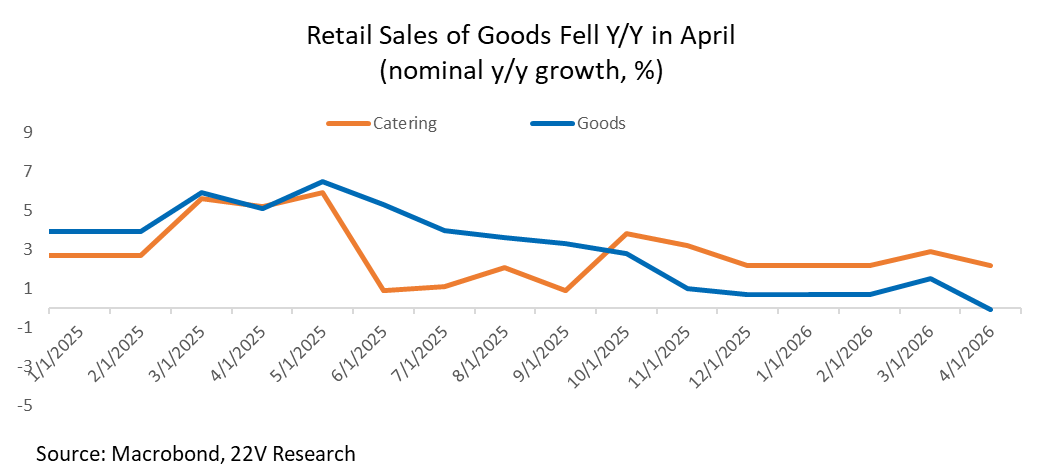
- Finally, consumption remains soft as households stay cautious amid a weak labor market. Real retail sales fell by 1% y/y in April, the weakest print since China was just exiting Covid. Households have sharply pulled back spending on discretionary items, particularly autos (-15.3% y/y nominal) and home appliances (-15.1% y/y nominal), both of which benefited last year from the temporary boost from the consumer rebate program.
We see three main takeaways for the outlook:
First, fading fiscal stimulus shows that this slowdown is, to a significant extent, a policy choice. In theory, Beijing could quickly reverse course and ramp up stimulus. However, we expect the policy response to lag behind the curve, as we assume that:
- Beijing will wait to see what happens next in the Iran conflict before deciding on the appropriate fiscal response.
- The further easing of US-China trade relations during Trump’s China visit (see our take HERE) reduces Beijing’s sense of urgency to support confidence.
- Under President Xi’s directive of fiscal and financial discipline (“high quality development”), officials will deliver only as much fiscal stimulus as necessary to meet the annual growth target (4.5-5%). This means a preference to wait until Q3 or Q4 to announce new measures.
- All the above implies that the next watchpoint for stimulus will be the end-July Politburo meeting on the economy. Signs that the Iran conflict is persisting or beginning to slow China’s exports – the key source of growth momentum – would be the main triggers for a prompt stimulus response in July.
Second, the latest data reinforce our skepticism that the recent pickup in China’s PPI is the start of durable, broad-based reflation. Our concern has been that PPI inflation induced by an energy price shock will lead to demand destruction and thus prove transitory. Sustainable reflation, in our view, requires a recovery in domestic demand, for which aggressive fiscal stimulus would be the key catalyst.
Third, we are skeptical that China’s property sector has reached a decisive bottom. Property price declines continued to moderate in April, with a particular improvement in existing-home prices. However, the strength remains concentrated in Tier-1 cities, which not only have the strongest fundamentals but also the fiscal strength to push through recent property support measures, whose impact may be transitory. More broadly, we find it hard to be optimistic about a recovery in property amid such a weak macroeconomic backdrop, and especially with households so reluctant to spend.