

Today Israel announced airstrikes had killed the Basij militia commander Gholamreza Soleimani and the country’s most senior security official Ali Larijani. These strikes, against leaders who will have actively tried to hide, once against shows Israel’s remarkable intelligence penetration of Iran’s top political echelons and as such represents important tactical successes. Both figures were also directly involved in the planning of the deadly crackdown on protesters earlier this year, and ought hence not be missed. At the same time, however, their killings will not likely lead to any immediate undermining of Iran’s power and decision-making structure, as replacements will be named though possibly of course of less capable caliber.
With the removal of especially Larijani, Iran’s war time leadership looks likely to become even more militarized and dominated by the IRGC, which might in the very near-term make the options for a negotiated solution smaller. The targeting of Larijani could therefore have been an attempt by Israel to avoid a “Delcy Rodríguez scenario” in Iran, in which a deal could be struck by the United States with a “credible insider”, facilitating the continuation of the Iranian regime. It might also of course just be Israel reacting rationally to suddenly available intelligence about the whereabouts of a high priority target. The fog of war prevails once more.
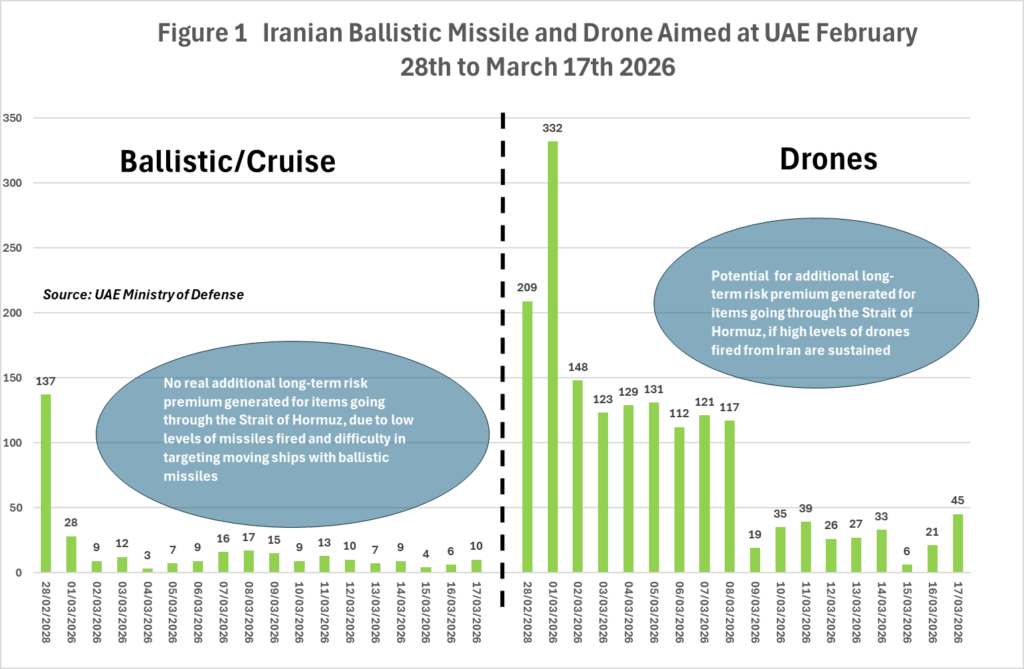
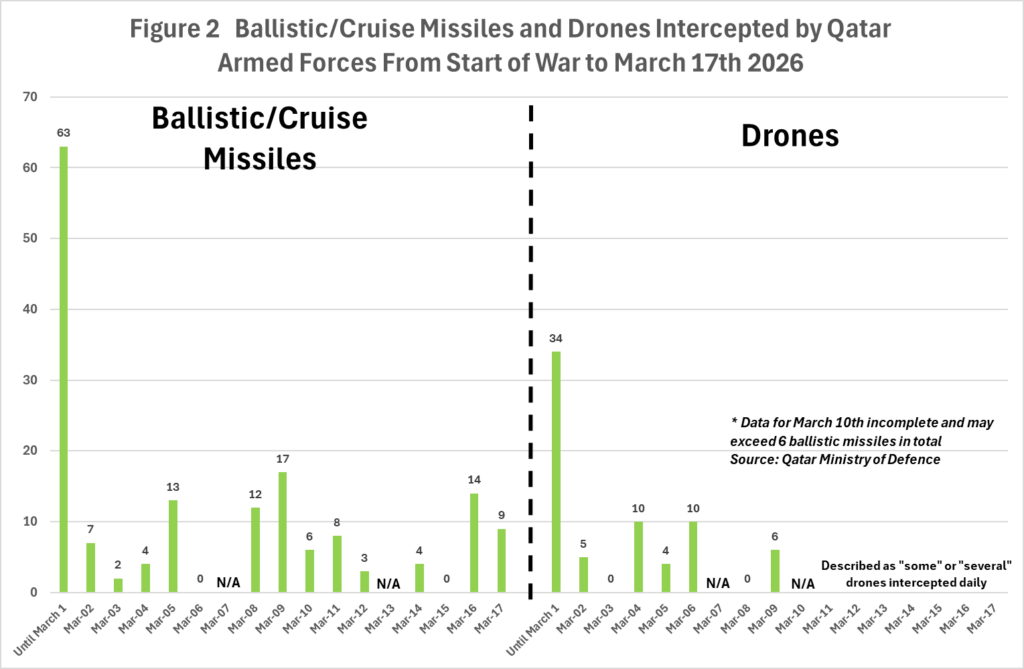
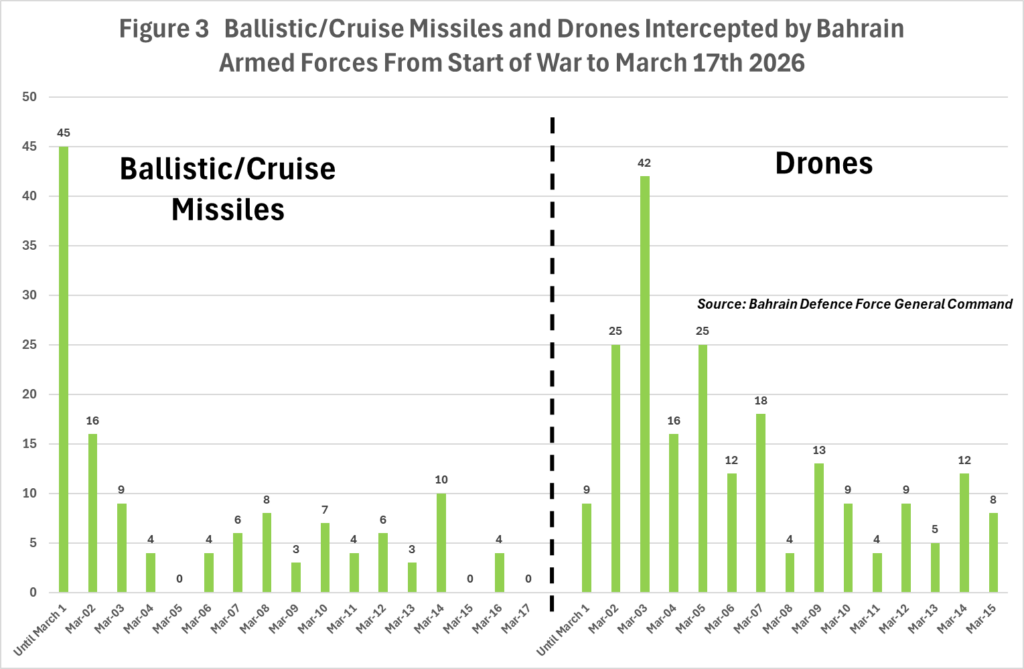
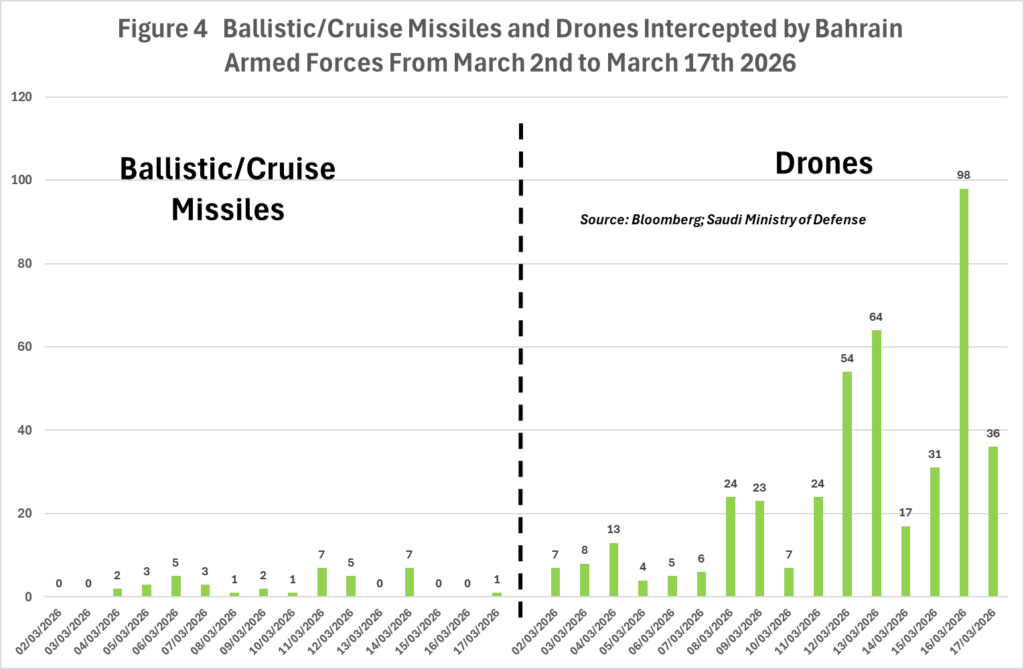
Iranian retaliation has again in recent days proven potent and included targeting the UAE’s Fujairah port on the Gulf of Oman, evidently showing that Iran can and will target facilities that try to “circumvent the Strait of Hormuz”. Relying on reported Iranian strikes on Saudi Arabia from Bloomberg (Hat-tip Damon Vance/Glencore for pointing me to the source) and updating them with today’s attacks announced individually by the Saudi Ministry of Defense, figures 1-4 show how Iranian drone strikes on Saudi Arabia have been increasing in recent days, while remaining relatively low in UAE, Qatar and Bahrain, even as today saw the most drones (45) launched at UAE since March 8th.
The announced departure from the Red Sea and returning to a port on Crete in Greece for more than a week of the aircraft carrier Gerald Ford, following a reported fire onboard, highlights both the inevitable “wear and tear” of deployed ships to a warzone, and perhaps also that the number of targets over Iran are beginning to drop in numbers, allowing an aircraft carrier to depart the immediate theater without materially affecting the air campaign. Gerald Ford’s departure though also suggests that the Trump Administration is not planning on launching a further escalation in the air war over Iran in the coming days. President Trump in other words appears in no hurry to bring the war to a conclusion.
The continued lack of urgency in bringing the war to an end, despite the mounting political and economic costs – even if these are more keenly felt around the world than in the United States, diesel prices have now pierced $5/gallon and gasoline prices are also significantly up – continues to confound analysis of the President’s war strategy based on traditional election year expectations. Faced with rising costs of an unpopular war, President Trump would be expected to either proceed to “declaring victory”, despite not having met all his announced war goals, or relatively risklessly escalate the air war over Iran to try to bring the war to a more satisfactory and expeditious conclusion. Neither appears to be the strategy chosen.
At the same time, oil futures prices have been more or less flat since reaching $95 on March 9th, indicating that financial markets have remained relatively forgiving, despite as noted rising prices on various refined products, offering President Trump some respite. Under these still relatively benign political and economic circumstances, a president evidently reluctant to either pursue a negotiated solution or escalate the war, may have another third war option become available.
Trump and the coalition (Israel will surely support such a shift) may change the emphasis of its targeting away from probably a declining number of available military industrial type targets towards a more focused targeting of the Iranian regime’s street level enforcers, police units and other security forces. Such a strategy could easily take several weeks to bear any real fruits, given the sheer number of Iranian security forces deployed around the country, and the need for the coalition to avoid hitting purely civilian targets. It would likely have a two-fold goal of ultimately weakening the regime’s grip on power and ability to repress the Iranian population perhaps facilitating eventual regime change, but could also have the nearer-term effect of convincing the regime that it needs to end the war or risk losing power from the attrition of its security forces. This could see it accept more of President Trump’s and the Gulf region’s demands in any negotiations, and leave the regime materially weakened from such a longer conflict.
In a scenario where economic and thereby political pressure (e.g. mostly through rising oil and oil product prices) on President Trump to end the war does not increase as much as perhaps expected today, it no longer looks implausible that an air campaign first and foremost targeting Iranian regime security forces could go on for perhaps 2-3 more weeks, before Tehran might be compelled to sue for peace, face a budding popular revolt, or another unforeseen event coaxes Donald Trump towards a negotiated solution. Such a “path of least resistance” scenario where Donald Trump is not compelled by oil and other financial markets to end the conflict sooner, could therefore see the war go on for a total of perhaps 5-6weeks, as the coalition (having already by now likely largely destroyed Iran’s known military industrial capacity) gradually strives to weaken the Iranian regime’s domestic coercive power.
A considerably longer war than I had initially expected, though one at least partially enabled by relative range-bound commodity prices and still at say 5-6weeks duration hardly a “quagmire” (I continue to consider U.S. ground troops in Iran as an implausible escalation) might not generate a dramatic broader macroeconomic setback to at least the U.S. and other large economies with strategic oil reserves available, the economic capacity to pay temporarily higher commodity prices, and attract the physical supply of various oil products from available non-Gulf region alternative sources. The adverse impact would instead materialize in typically poorer countries, with a high degree of traditional dependency on supplies from the Gulf region, facing more urgent physical shortages of various fossil fuel products. Major advanced economy central banks might still decide in such a scenario decide to “look through the impact of such a range bound commodity price shock”.
The outlook for the war in Iran remains overwhelmingly dependent on President Trump, and hence highly uncertain. Longer scenarios of up to 5-6weeks must however now clearly also be considered.
Jacob

