

Over the weekend, both the U.S.-Israeli coalition and Iran escalated the scope of the war in a controlled manner. The coalition hit a number of oil storage facilities and Iranian domestic refining locations around Tehran, in the hope of inducing a more general fuel shortage in the capital and hence increase the political and not least economic pressure. Iran retaliated by firing against what appears to be similar type targets, e.g. oil storage facilities and refining facilities, in both Kuwait and Bahrein and may also unsuccessfully have targeted them in other Gulf countries.
This is a deliberate escalation from the coalition, though it remains a controlled and calibrated one that does not include direct strikes at Iran’s crude oil export facilities, but is intent at raising the domestic economic pressure on the Iranian government. The coalition could at any moment choose to destroy Iran’s crude oil export facilities on for instance Kharq Island, but refrains from doing so, due to the risk of Iranian retaliation in kind against the Gulf and the direct impact of removing Iranian crude exports on global oil prices. This situation looks likely to persist, as no part in the conflict has any interest in targeting core crude oil export installations.
There has been a number of other press reports concerning other types of escalatory strikes – Iran accused the coalition of bombing a desalination plant, and reserved the right to respond in kind, strikes on desalination plants in Bahrain have been reported, and even a claimed Emirati strike inside Iran. No video or other verification of any of these alleged strikes have to my knowledge emerged, and great care should be taken when assessing them. Disinformation will continue to be a key part of this conflict, especially in the current phase of controlled escalation and ongoing military strikes. It remains the case that controlled escalation in the conflict is ongoing.
Militarily, the weekend has brought no major changes. Coalition airplanes continue to pound Iran, which retaliate in scale with a limited number of missiles and mostly drones against Israel and Gulf targets. Daily data from UAE suggests no change in the level of drone attacks, and even a modest increase in the scope of Iranian ballistic missile attacks (figure 1).
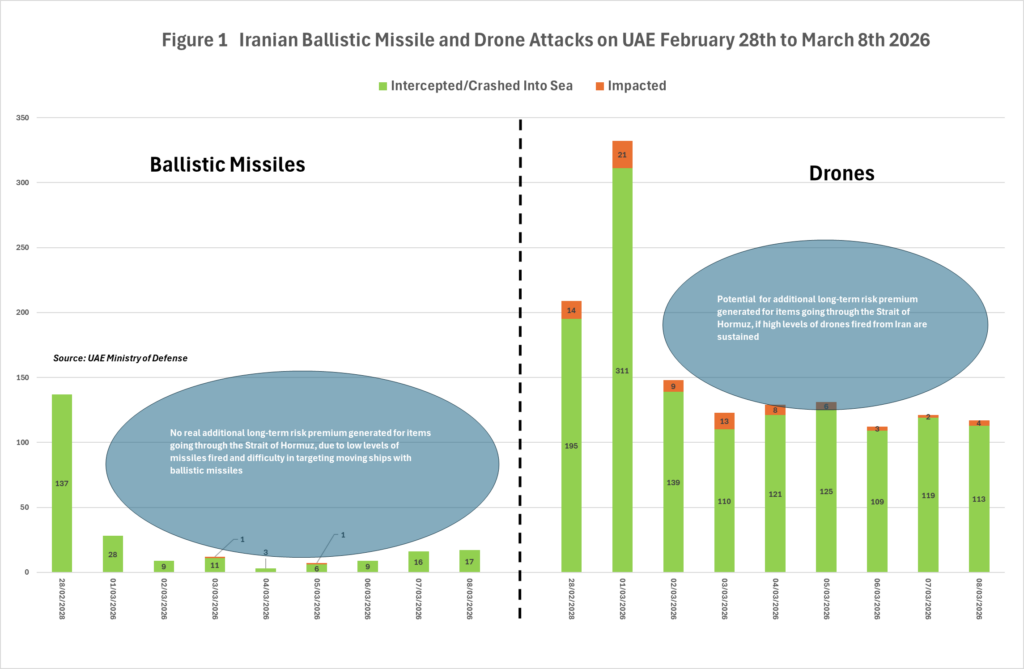
Consequently, the assessment must remain that Iran retains the military capacity to strike also against shipping in the Strait of Hormuz, and that coalition attacks have not managed to reduce this threat materially. The fact that there is to date no announced practical preparations for US naval escorts of tankers through the Strait, despite it being now four days since President Trump first mentioned the option, suggests clearly that my earlier assessment that such escorts were likely within a few days was wrong. Instead, it seems probable that the US Navy is at present not willing to commence such escorts, when facing the current level of threat from Iran inside the Strait. Had the US Navy been willing to do so, enough time has now surely passed for public preparations to have been made.
Judging from the stability of reported drone attacks on UAE, there is moreover no indication that the threat from Iranian drones also in the Strait of Hormuz is being materially reduced by coalition air strikes. As such, it no longer seems likely that US naval escorts of tankers through the Strait of Hormuz are imminent in the coming days. The Strait looks likely to remain de facto closed, putting upward pressure in the coming days on commodity prices linked to transit through it.
Per figure 1, it is also increasingly likely that a more permanent risk premium will be attached to transit through the Strait of Hormuz, given that it at least as of today looks less and less likely that coalition airstrikes will militarily succeed in dramatically reduce the risk from Iranian drone strikes on shipping. Diplomatic efforts may achieve this outcome, but even the intense bombing seen looks less likely to, leaving Tehran with a possible long-term coercive tool in their hands.
Diplomatically, as discussed in earlier notes, some public feelers have been made by Iran’s (not very powerful) president towards deescalation with Iran’s Gulf area neighbors. So far, nothing has come from this and no decrease in indiscriminate Iranian strikes across the region has been seen (figure 1). While we await the alleged imminent announcement of the next Iranian Supreme Leader to succeed Ali Khamenei, it nonetheless looks likely that some sort of process spearheaded by Iran and its regional neighbors will be the path forward towards an eventual end to the fighting.
At present though, the military, economic and political pressure on Tehran from ongoing bombing of Iran, as well as the economic and political impact of likely continuingly rising global fossil fuel prices will have to rise further for possibly successful diplomatic effort to materialize. This looks likely to take several more days, taking us towards the end of the coming week at the earliest for plausible diplomatic solutions to emerge. The accumulating effect of rising fuel prices in the United States looks likely to be a key underlying political driver of any successful diplomatic effort, and it remains a risk that more open disagreement soon emerges between the war aims of President Trump and Israel.
Jacob

