

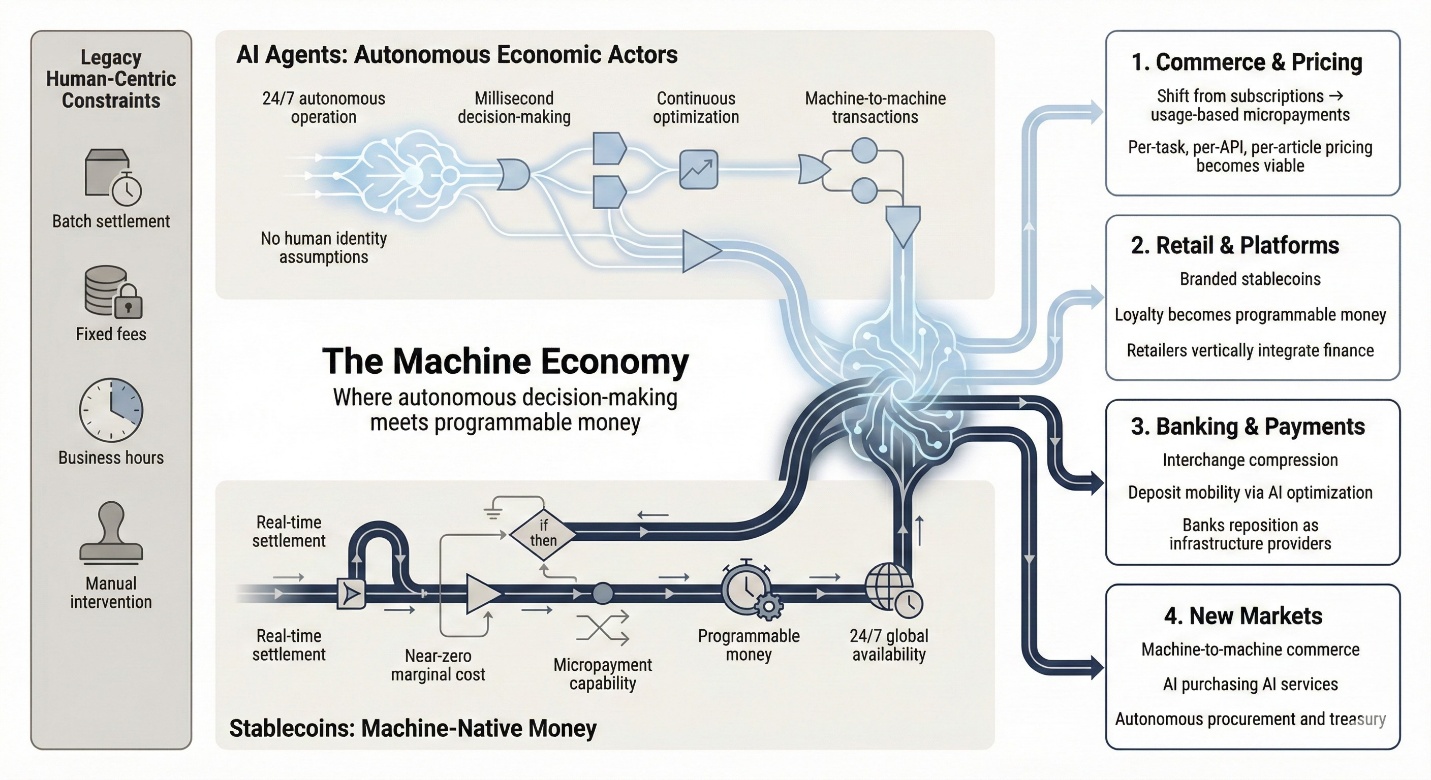
The infrastructure mismatch nobody planned for
Here is a simple thought experiment. Imagine a factory that operates around the clock, making thousands of decisions per hour, optimizing every input and output in real time. Now imagine that factory can only receive raw materials between nine AM and five PM on weekdays, with deliveries taking two to three days to confirm. The mismatch would be absurd. Yet this is precisely the situation emerging as autonomous AI agents encounter our legacy banking infrastructure.
For decades, financial infrastructure evolved to optimize trust, compliance, and human decision making, accepting delay, batching, and friction as unavoidable trade offs. The next phase of commerce optimizes for verification, speed, and automation. When economic actors shift from people to software, the properties we require of money change as well. What looks like crypto experimentation through a human lens becomes basic infrastructure through a machine one.
In 2025, stablecoin transaction volume reached roughly 33 trillion dollars, rivaling the combined throughput of Visa and Mastercard. This figure reflects settlement throughput rather than economic profit. It measures how quickly value already moves across these rails, and its relevance becomes clear only once one considers what kind of economic actors require money to move continuously.
Most investors still file this under crypto speculation. That is a category error. The convergence of autonomous AI agents and programmable digital dollars is not a crypto story or an AI story. It is an infrastructure story about which financial rails will carry the next decade of commerce. The timing matters. With the CLARITY Act now nearing completion in Washington, the debate around stablecoins has shifted from whether they will exist to how they will be governed, even as most investors still treat the topic as peripheral.
The stakes are substantial. Banking industry estimates suggest trillions of dollars in traditional deposits could migrate into stablecoin based ecosystems as this infrastructure matures. Understanding why requires grasping a fundamental architectural incompatibility that no amount of incremental bank modernization can resolve.
Why Legacy Rails Break Down
AI agents are software systems capable of reasoning, planning, and executing multi-step tasks without human intervention. They negotiate bills, cancel unused subscriptions, route payments across accounts, manage treasury liquidity, and increasingly make purchasing decisions. These aren’t occasional activities. They’re continuous, iterative, and time-sensitive.
Traditional banking infrastructure was designed for humans. Payments are grouped into batches, reconciled over hours or days, and settled during business hours. Exceptions require manual handling. Fees are structured to cover fixed operational costs regardless of transaction size. These features are reasonable when most transactions are infrequent, relatively high value, and consciously initiated by a person.
AI agents invert every one of these assumptions. They operate continuously across time zones. They require immediate confirmation because each transaction informs the next decision. Many of their transactions are tiny, fractions of a dollar, reflecting granular usage rather than bundled consumption.
Consider the economics. Card networks typically charge around thirty cents plus 2.9 percent per transaction. Processing a two-cent payment would cost more than the payment itself. This isn’t a temporary inefficiency awaiting a software update. It’s a structural impossibility. Entire categories of machine-driven commerce, paying a few cents for an API call, a single article, a dataset query, a momentary allocation of computing power, simply cannot exist on legacy rails.
Stablecoins resolve these constraints not as an overlay on existing systems but by redefining the properties of money itself. A stablecoin is simultaneously a unit of account, a settlement mechanism, and a programmable object. It moves globally in seconds at marginal costs approaching zero. It operates continuously. Most importantly, it can execute conditional logic without external reconciliation.
This programmability transforms money from a static medium into an active element of the software stack. Payment released automatically upon cryptographic verification of delivery. Loyalty points that appreciate if used during off-peak hours. Treasury funds automatically swept into yield-bearing instruments until the precise moment liquidity is needed. For AI agents, money becomes another variable in a computational system, something to reason about, optimize, and deploy dynamically.
The Market Reality
This is not theoretical. The infrastructure is operational and scaling rapidly.
Stablecoin market capitalization exceeded $300 billion by late 2025, growing roughly 49 percent year over year. More telling than the stock is the flow: transaction volumes grew significantly faster than market cap, indicating that usage rather than speculation is driving adoption.
A functional bifurcation has emerged among stablecoins. Circle’s USDC led transaction activity with $18.3 trillion in volume, suggesting it has become the preferred vehicle for commercial utility and smart contract interaction. Tether’s USDT maintained larger circulating supply but lower velocity, functioning primarily as a store of value and trading pair. This divergence is exactly what one would expect if machines, rather than humans, are increasingly selecting the rails.
The participants tell the story as clearly as the numbers. Mastercard launched its Agent Pay protocol, with Citi and US Bank piloting technology that allows cardholders to authorize AI agents to spend on their behalf. J.P. Morgan continues advancing its Kinexys platform, formerly JPM Coin, positioning programmable deposit tokens for institutional settlement. PayPal’s stablecoin grew from $1.2 billion to $3.8 billion in late 2025, growth fueled largely by DeFi integrations offering yields around 3.7%. That yield has attracted pointed regulatory scrutiny for contradicting the spirit of recently enacted stablecoin legislation, a tension explored below.
Perhaps most significantly, major retailers are reportedly building their own stablecoin ecosystems. Walmart and Amazon, which pay billions annually in interchange fees, have strong incentives to bypass card networks entirely. A transaction settled in stablecoins costs fractions of a cent compared to the percentage-based fees of credit cards. An AI agent programmed to optimize for total cost will route to the lowest-fee rail automatically. Retailers can split the savings with consumers, offering discounts for stablecoin payment while recapturing transaction data currently captured by banks and card networks.
How Commerce Changes
The implications extend well beyond payment processing costs.
Micropayments become viable at scale for the first time. Content can be priced per article rather than per subscription. APIs can be monetized per call. AI services can charge per task, per second, or per outcome. The x402 protocol, reviving a long-dormant HTTP status code, enables AI agents to pay for resources in real time through HTTP headers, settling on high-performance blockchains in roughly 200 milliseconds at costs below a hundredth of a cent.
This capability threatens business models built on consumer inertia. Subscription services with low engagement become vulnerable as AI agents automatically cancel unused plans. Value migrates toward services delivering consistent, measurable utility. Over time, this reallocation reshapes industries from media to software to professional services.
Loyalty programs face particular disruption. Historically, these programs profited from “breakage”, the percentage of points that expire unredeemed or are forgotten. AI agents will manage loyalty wallets with ruthless efficiency, ensuring points never expire and are always redeemed for maximum value. To counter this, brands are shifting toward programmable loyalty: stablecoin-based point systems incorporating dynamic rules where points appreciate in value if used during off-peak hours or depreciate if not used by a specific date, but are auto-redeemed by the agent before loss occurs.
Winners, Losers, and Pivoters
The transition creates a distinct set of beneficiaries and casualties.
Stablecoin issuers like Circle and PayPal stand to control the settlement layer of an AI-driven economy. Their strategic imperative is navigating regulatory constraints around yield while focusing on utility, cross-border flows, and business-to-business integration. Success depends on their stablecoins becoming the default variable in agent code.
Large retailers emerge as potential winners, recapturing billions in interchange fees while gaining deeper customer lock-in through proprietary ecosystems. They effectively become financial technology companies, closing the loop on both data and money.
Regional banks face elevated risk. Without the scale to build programmable infrastructure or the innovation culture to partner effectively with fintechs, they confront deposit flight to higher-yielding digital alternatives. The cheap funding that underpins their lending models erodes as AI agents automatically sweep idle funds into better-yielding instruments.
Card networks are pivoting rather than surrendering. Visa’s Trusted Agent Protocol creates a registry of verified agents, allowing merchants to distinguish legitimate commerce bots from malicious actors. Mastercard’s Agent Pay embeds legacy card credentials into agentic workflows. Their strategy: become the identity and trust layer rather than just the settlement layer. They sell verification in an increasingly automated market.
Subscription-based businesses face structural pressure as AI agents aggressively cancel unused services. The imperative is pivoting toward usage-based pricing or demonstrably high-value offerings that survive agent optimization.
The Regulatory Catalyst
The GENIUS Act, signed into law in July 2025, established the foundational U.S. framework for stablecoin issuers, mandating reserve backing with high-quality liquid assets and monthly public attestations. Critically, it prohibits issuers from paying interest on stablecoins, a provision designed to protect banks but creating a loophole where third-party platforms offer rewards that function as de facto yield.
This loophole has triggered an active regulatory battle. More than 3,200 bankers have directly urged the Senate to close what they characterize as a backdoor threat to the deposit franchise. PayPal’s PYUSD, with its 3.7% yield delivered through third-party DeFi protocols, has become the poster child for the conflict, growing rapidly precisely because it contradicts the spirit of the GENIUS Act while technically complying with its letter. Banking trade groups argue that pass-through yield creates shadow banks siphoning deposits without community lending obligations. Coinbase has threatened to withdraw support from the follow-on CLARITY Act if yield restrictions tighten. This isn’t regulatory housekeeping. It’s a live fight over whether $6.6 trillion in bank deposits remains captive or becomes contestable. The outcome will shape adoption velocity significantly.
Globally, the European Union’s MiCA regulation provides legal certainty with stringent requirements. The UK is piloting tokenized deposits that preserve the banking system’s structure while adding programmability. The Bank for International Settlements is exploring unified ledgers for cross-border wholesale payments. Regulation is shaping pace, not direction.
The Temporal Arbitrage
Markets largely price stablecoins as crypto infrastructure and AI agents as productivity tools. The systemic transformation emerging at their intersection remains underappreciated. This mispricing creates what I believe is the most compelling temporal arbitrage in financial markets today.
Consider the second-order effects. Every stablecoin transaction requires a wallet. Every AI agent managing money needs on-chain infrastructure. The $33 trillion in stablecoin volume processed last year didn’t just move value, it opened millions of wallets, onboarded new users, and pulled fiat currency into the digital economy. This is a self-reinforcing flywheel: more agent activity drives more stablecoin demand, which drives more wallet creation, which expands the addressable market for every digital asset.
The macroeconomic implications run deeper still. Caitlin Long, the former Morgan Stanley managing director who has spent a decade at the intersection of banking and blockchain, identified the core insight years ago: fractional reserve banking wasn’t invented because leverage was inherently good. It was invented because settlement was slow. The system created velocity through debt because it couldn’t create velocity through technology. Now it can.
Return to Irving Fisher’s equation of exchange: MV = PY. Money supply times velocity equals nominal GDP. For decades, declining velocity offset monetary expansion. What happens when programmable money and autonomous agents push velocity structurally higher, not through more debt, but through faster settlement and continuous optimization? You get GDP growth without proportional money printing. That’s the non-inflationary unlock that makes this convergence macroeconomically significant, not just technologically interesting.
This is why I believe Bitcoin will be the best-performing major asset in 2026. Not because of speculation or narrative momentum, but because of plumbing. Stablecoins are the on-ramp infrastructure for the digital economy. As that infrastructure scales, processing tens of trillions annually and growing, it systematically expands the pool of participants with wallets, exchange accounts, and comfort transacting in digital assets. Bitcoin sits at the apex of that ecosystem as the established store of value with the deepest liquidity, the longest track record, and now, unprecedented institutional access through spot ETFs.
The question for investors isn’t whether commerce migrates to programmable rails. It’s whether portfolios are positioned for what happens when money finally moves at the speed of information and billions of dollars in trapped capital break free.
And the next chapter hasn’t even begun. Tokenization promises to pour trillions in dormant real-world assets, real estate, private credit, infrastructure, into this same velocity machine. That’s a story for another paper. But the infrastructure being built today is what makes it possible tomorrow.
AI has been called the new electricity because it touches everything every company, every workflow, every competitive advantage. The same is now true of programmable money. The financial guardrails that have governed commerce for decades are being rewritten in real time. This isn’t a future trend to monitor. It’s an operational reality processing tens of trillions of dollars today. Analysts modeling company fundamentals, strategists allocating capital, economists forecasting growth all are working with frameworks built for a financial system that is actively being displaced. The irony of this transformation is that it’s happening at machine speed. Those who wait for consensus will find themselves analyzing yesterday’s economy. The change is here. The only question is whether you’re keeping pace.

