

It is almost always, when considering the prospects for the EU and euro area economy, important to get neither too excited nor too pessimistic about the growth outlook. As discussed in earlier notes, the most recent high frequency data for EU and euro area growth has shown a – to me – surprising resilience in the face of continued war in Ukraine, political instability in France and some other member states, and trade tension with both the United States and China. This steady situation looks increasingly likely to continue into 2026, suggesting that the EU and euro area economy will next year continue to grow at roughly the levels of 2025, meaning at an annual rate of around 1.3 percent, a level essentially equal to the EU and euro area potential growth rate.
Absent new unforeseen economic or political shocks, Europe is hence in 2026 likely to maintain very strong labor markets, in the aggregate near neutral fiscal policy, stable debt levels and an ECB almost certain to stay on the sidelines until at least the end of the year. 2026 hence looks like a(nother) decent economic year, where both exuberance and excessive pessimism will prove misguided. There are several reasons for this forecast.
First, EU export levels have remained globally robust to Donald Trump’s tariffs, while continued the gradual post-Covid19 lockdown decline in China. The machinery and transportation categories, too, show a high degree of stability outside of China, at once underlining the competitive challenge European producers face here, but also illustrating that simply writing off as doomed European export competitiveness in cars and other manufactured goods remains unwarranted. This relative stability is illustrated in figures 1A-C, which are, with the charts using nominal data, even more pronounced, as the visible increasing trend in 2022-23 can be partly attributed to a combination of Covid19 rebound and elevated inflation levels.
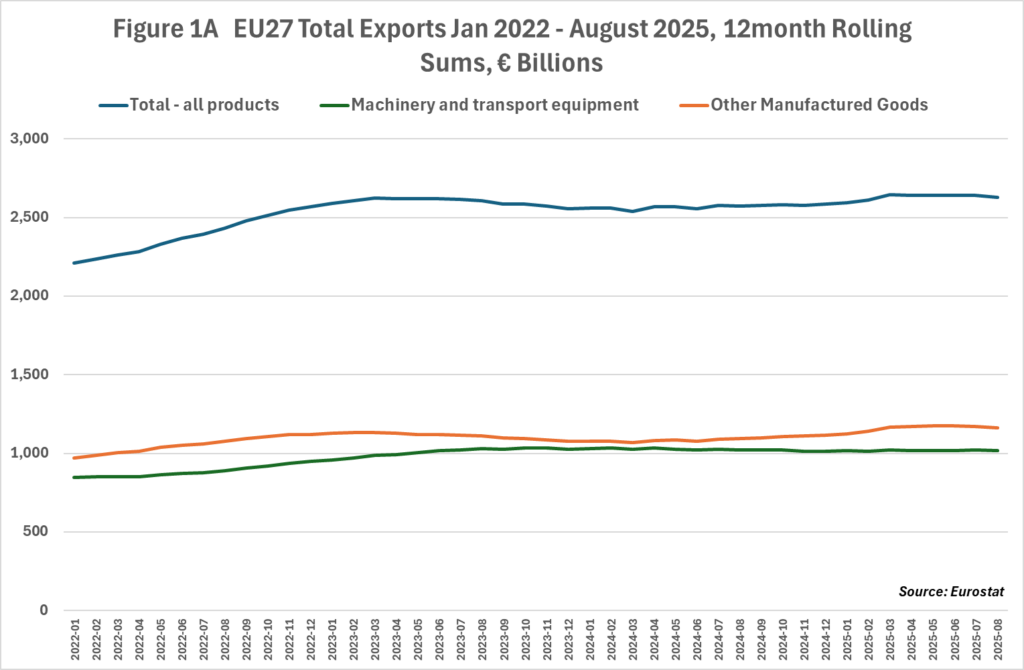
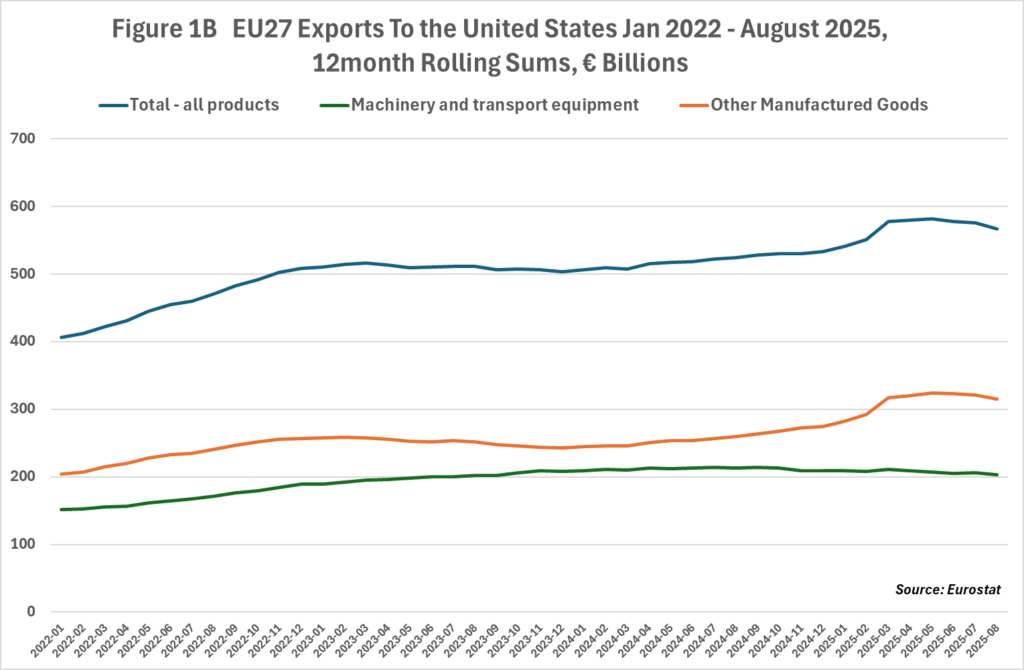
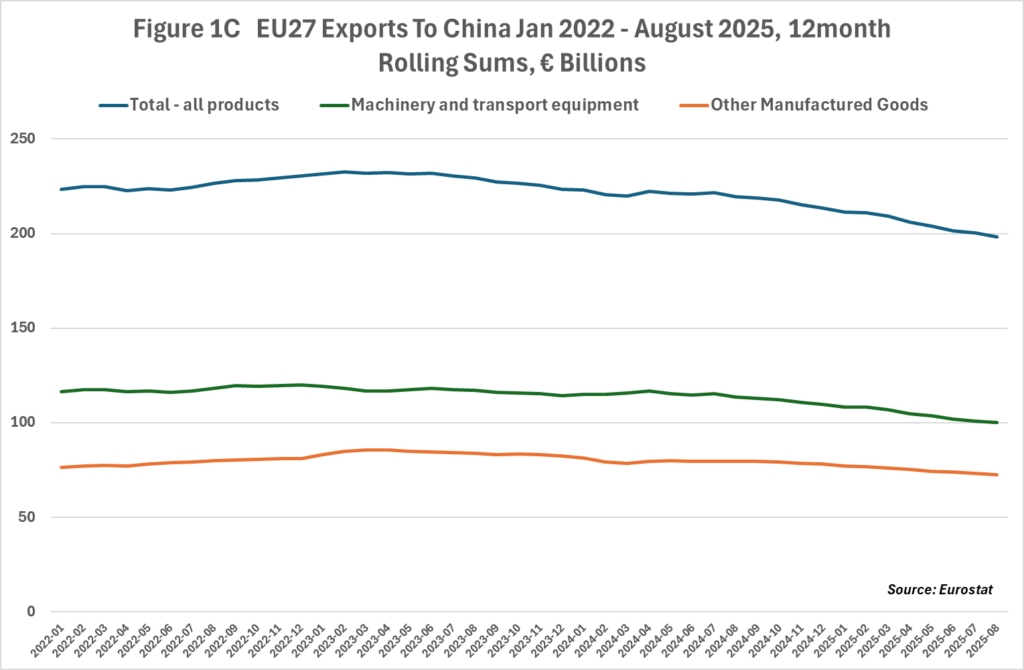
While the possibility of renewed transatlantic trade conflict remains constant with Donald Trump in the White House, given the faltering prospects for IEEPA tariffs before the Supreme Court and the generally more constructive transatlantic cooperation on Ukraine that includes ongoing European weapons purchases from the United States, a macroeconomically relevant deterioration in trade relations should not be the base case. The EU meanwhile continues to pursue an aggressive bilateral trade liberalization agenda with important third countries, including the likely ratified by the end of the year EU-MERCOSUR FTA, a recent new deal with Indonesia and possibly also this year with India, providing continued policy support for EU exports around the world. FTAs, especially meaningful ones that actually liberalize bilateral trade, tend to take a while to be fully implemented, but it should nonetheless remain the base case that EU external trade will remain robust also in the coming years. Continued export challenges for EU industries in the Chinese market meanwhile reflects the ongoing capability improvements and competitiveness advances among local firms, as well as China’s persistently high levels of government industrial subsidies. Neither are likely to abate in the near term, though ongoing EU anti-subsidy investigations and trade policy remedies (e.g. tariffs on Chinese exports to the EU) may blunt the impact on EU net trade with China. Chinese firms’ ongoing technological advances and prospective competitiveness improvement also in third markets is among the main reasons why trade can only be a neutral contributor to future EU and euro area economic growth. Yet, with a current account surplus stuck at at least 2.5 percent of GDP and structurally declining fossil fuel imports, trade is not likely to be a drag on EU growth prospects.
Secondly, while as discussed in last week’s note the euro area household savings rate is unlikely to start falling materially before the war in Ukraine ends in a satisfactory manner for Kyiv, gradually nominalizing nominal wage growth – estimated by the ECB to be around 2.7 percent in both 2026 and 2027 – combined with likely HICP slightly undershooting the ECB’s 2 percent target in the coming years should provide for real household disposable income growth of roughly one percent. The tax burden will shift in some member states, but is unlikely in a general political climate in the EU dominated by concerns over “cost of living” to rise materially in the aggregate, protecting real wage gains for households. With low unemployment and high employment rates expected to remain, real income growth will support private consumption and growth at a range-bound level also in 2026. Yet, savings rates will remain high and for EU or euro area growth rates to exceed 1.5 percent and possibly approach 2 percent annually, they must start really declining, which in turn requires that the war ends.
Thirdly, the German fiscal stimulus and continued rising defense spending in a number of particularly Northern European countries should help push the aggregate EU fiscal impulse back towards essentially neutral if not mildly positive in 2026. Consolidation in France will, as discussed earlier, likely not really happen, pushing in the same direction. It is though here worth noting that with also French growth rates showing a striking resilience, government revenues in France may also surprise on upside, either generating a lower deficit in 2026, or – more likely perhaps – help facilitate the passage of a 2026 budget requiring less new taxes and less spending cuts. In the aggregate, increased Northern European spending looks likely to counter the effects of required budget consolidation elsewhere.
In sum, with household consumption likely to continue to be a steady contributor to growth, exports to remain resilient and net exports hence likely having a neutral impact on growth and fiscal policy the same, the principal uncertainty about whether EU and euro area growth will be say 0.8 percent for the year or in my base case around 1.3 percent lies with investment levels in both the private and public sectors. Here I am for several reasons likely to be on the optimistic side of the spectrum. Investments in defense related sectors and infrastructure (now relabeled as “military mobility enablers”) will remain high. Meanwhile as only a fraction of the pro-investment initiatives proposed in the Draghi Report are likely to be implemented in the coming year(s), the EU on the other hand does look likely to begin to roll back some of the worst excesses in terms of regulatory and compliance burdens on especially small and medium sized businesses. The so-called “Sustainability Omnibus” is likely to pass the European Parliament in the coming weeks, rolling back a material amount of especially climate related reporting and compliance requirements for most EU businesses. The political process here matters, as this Omnibus will almost certainly pass relying on an “alternative majority” in the European Parliament consisting of the center-right and other parties further to the right, but not including the traditional centrist liberal and center-left parties.
This is normal parliamentary arithmetic in democracies, but unheard of in the European Parliament, where legislation has traditionally always been carried by a wide centrist coalition. This political necessity has historically tended to add to the overall regulatory burden coming from the EU, as the centrist political coalition would typically be held together by all the different centrist political parties adding their specific regulatory demand to a new law (remember – the European Parliament cannot tax or give tax cuts, only regulate, so that is what they do!). Now, it will become possible for alternative and potentially deregulation-minded majorities to emerge in Brussels/Strasbourg. This gives hope that further deregulation efforts will succeed in the coming years. This in turn should help improve the EU business environment going forward and – together will ongoing relative price shifts in favor on renewable energy – help boost EU investment levels, pushing growth up, too, in the process.
Jacob

