

The European Commission has announced its suggested 19th sanctions package on Russia, highlighting the incremental nature of the EU’s economic pressure on Vladimir Putin but also underlining that the direction of this pressure will continue to rise. Tough negotiations with member states will now commence until a decision might be taken at the informal meeting of EU leaders on October 1, but the suggested sanctions package reveals Brussels’ intent to maintain cordial economic and political relations with both Washington and Beijing, while adding pressure on Russia.
Donald Trump recently called upon “Europe/NATO members” to stop buying Russian oil and gas and joining the United States in implementing dramatic tariffs on imports from the main buyers of Russian fossil fuels in China and India. The EU will not follow the latter policy, as it generally – unlike President Trump – regards tariffs as bad economic policy, and will not want to risk a broader trade war with China or jeopardizing a possible new FTA with India. At the same time, EU policymakers will note that by far the largest regional importer of Russian fossil fuels is today non-EU member Turkey, though will welcome any political pressure from the Trump Administration on the EU’s two remaining importers of Russian oil – Trump-leaning Hungary and Slovakia – to end their practice.
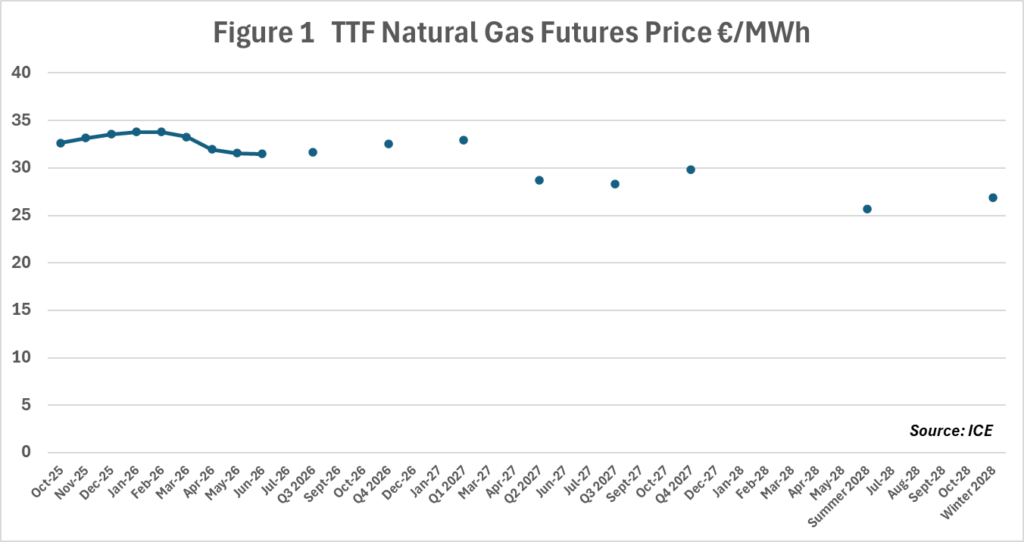
Reflecting the flat forward pricing curve for LNG in Europe (Figure 1) and expectations of rising global LNG supply in coming years, the European Commission want to ban the import of Russian LNG to the EU no later than Jan 1 2027. It will now be up to member states to decide if such a ban comes into effect, and if so when – several members will likely push for it to come already in 2026. This action will seek to accommodate Trump’s pressure for stopping EU fossil imports from Russia, while safeguarding the EU’s own economic interests by taking this action only when price signals suggest that the region’s energy intensive industries may not suffer material associated higher energy costs.
The EU is further targeting another 118 Russian shadow fleet tankers, Rosneft and Gazpromneft, and an unspecified number of oil and petrochemicals companies in third countries, including China. In addition, the Commission intends to target select, again including Chinese, entities facilitating or directly participating in Russia’s armament industry. Expanding the sanctions first used in the 18th sanctions package, this will see EU secondary sanctions hitting additional Chinese banks and equipment makers active in the Russian market. Chinese retaliation to such EU actions seems certain, though likely to be calibrated to China’s continuous interest in maintaining the most open access to the EU market possible.
It does, however, seem likely that China will maintain economic and political pressure on the EU by for instance continuing its practice of slow-moving/restricting access for EU firms to Chinese critical minerals export licenses. This is a kind of below the radar screen administrative measures that can – as witnessed in April in the confrontation with the Trump Administration – be very effective in hurting the economic interests of the EU, and against which the EU has very few defensive mechanisms in the short and medium-term. The EU is therefore going to take additional sanctions measures against Chinese entities in part to please the Trump Administration (ironically at a time when the US president is engaging in securing a general economic rapport and a summit with China’s president Xi Jinping), but will refrain from taking actions that fundamentally jeopardize the EU-China trade status quo.
With regards to India, measures beyond earlier actions taken against Russian co-owned refining facilities in India look likely to be quite limited in scope, as the EU is seeking to conclude a potentially far-reaching FTA with Delhi in the final months of 2025.
More pointedly, the EU’s incremental sanctions process reflecting both the need to secure consensus among 27 members and the need for politically sustainable economic sanctions to inflict more economic pain on Russia than on the EU itself, is in especially the energy sector being increasingly complemented by direct European support for Ukraine’s long-range drone and missile program. At the most recent meeting in the Ukraine Defense Contact Group (UDCG) of willing bilateral military supporters of Kyiv in NATO both Germany and the U.K. pledged significant financial support and offered to help manufacture long-range drones for Ukrainian strikes inside Russia and in recent weeks on the Russian energy sector in particular. EU and NATO member states in other words are focusing on a “dual strategy” to reduce Russian energy exports, focused on both gradually more sanctions against Russian fossil fuel exports and assistance to Ukraine’s military strikes against the Russian energy sector. In the short-term, the scarcity of Russian air defenses and improving Ukrainian long-range strike capabilities makes Ukrainian military efforts likely to have the largest effect on the Russian energy sector, while a potential EU LNG import stop will only materialize at some point possibly in 2026, and no later than January 1, 2027.
In the aggregate, the EU strategy to address Russian military aggression and assist Ukraine financially and militarily in the coming months (if not years) looks to reflect the “transatlantic mid-point equilibrium” where the Trump Administration will not expend economic and diplomatic resources to sanction the Russian economy, but will continue to sell weapons to Ukraine paid for by willing European nations and will continue to provide Ukraine with ongoing intelligence sharing. As discussed in a previous note, Commission President Ursula von der Leyen today confirmed that a concrete proposal will come “soon” for an EU “reparation loan” based on the cash balances (i.e. including the underlying Russian assets and hence up to $200bn) available from immobilized Russian assets in European financial institutions. This will enable the EU to continue to ensure that the Ukrainian war effort is fully financed also without US participation and with minimal additional G7 financial support.
As the decisive war effort swings away from an increasingly stagnant frontline towards a mutual strategic bombing campaign against each other’s economy between Russia and Ukraine, the EU is moving to make Ukraine’s ability to continue to defend itself increasingly independent of the effects of Russian bombing. Were Russian attacks against Ukrainian infrastructure to become more successful in the coming months (and years), the EU will now have a tool available to increase financial support to make up for any shortfalls in Ukraine’s domestic economic resources. This contrasts directly with Russia’s dependency on continued sales of fossil fuels to global markets and its need to militarily protect these facilities, and could prove a decisive factor over the medium-term in favor of Ukraine in a sustained year-long exchange of strategic bombings by drones and missiles.
This war is not about to end, but economic and military pressure from Europe on Russia looks likely to continue to increase and will help bring an end to fighting possibly by late 2026 or 2027.
Jacob

