

The Q2 GDP release tells us roughly how the economy was tracking on April 1, if we had to pick a single day, because of the smoothing involved in the calculation of the quarterly aggregates. A quarterly change lags a 3-month change, for reasons I have been over. And the data contained no major surprises, although there were a couple interesting items. Demand growth has cooled over H1 2025, as is required to ensure that the inflation pulse from the tariffs is indeed transitory. It is not something that needs to provoke a response from the Fed.
The first official look at Q2 GDP growth came in 50 basis points stronger than expected, as the beat in the sum of net exports and inventories exceeded the lesser miss in government spending. (These days we need to consider those two items in tandem.) Growth in final sales to private domestic purchasers (FSPDP), so-called “core” GDP printed at 1.2% (ar), which was perhaps 10 to 20 basis points stronger than expected.
We look at core GDP in an effort to bracket the effects of the front running of tariffs during the first quarter, which artificially lifted inventory investment at the expense of net exports, possibly with some measurement error adding to the drama there. However, even core GDP was probably affected by the tariff front running, because capital goods put in place, rather than into inventories, would have affected the core. Accordingly, it is probably best to look at a 2-q growth rate of core GDP to get a sense of the underlying trend here. That 2-q growth rate printed just a smidge higher than 1 ½%, rather than the smidge below that was expected by consensus. Relatedly, the “slowdown” from 1.9% in Q1 to 1.2% in Q2 seems entirely technical.
The mix across consumption and private investment was roughly in line. Beat and miss aside, it is interesting that private investment in intellectual property development has reaccelerated to retrieve its status as juggernaut. It was up 6% (ar) in both Q1 and Q2. Also, there does not appear to have been much payback for the Q1 front running in capital goods put in place. Equipment spending was up 4.8% during Q2, following 23.7% in Q1.
One minor item in conclusion. The net exports deficit was actually smaller in Q2 than it was in Q4 last year. But just as the blowout deficit in Q1 could be dismissed as related to tariff running, this smaller deficit can be related to (safely ex post!) a pothole in the wake of that. It is offset by inventory investment running now well below normal. Going forward, we should expect a renormalizing higher in inventory investment and a renewed widening of the trade deficit, purely on technical grounds. The effect on net exports from the still high foreign exchange value of the dollar would be entirely separate.
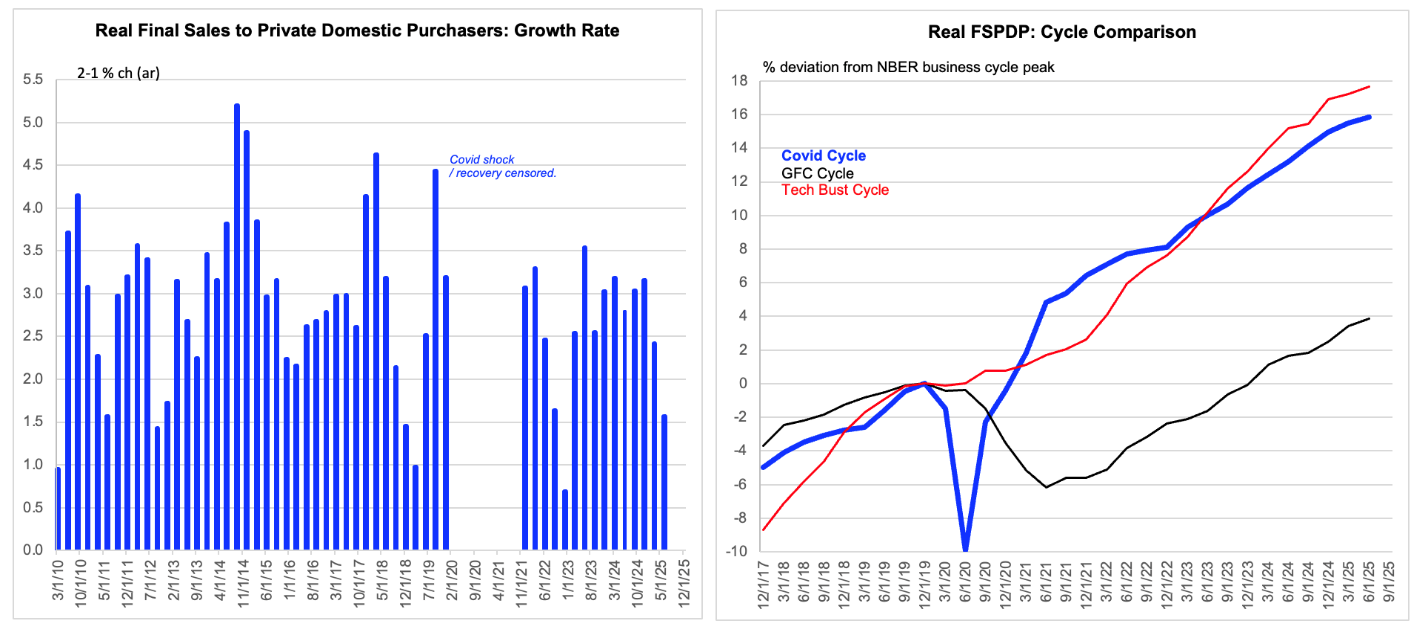
Data are actual to Q2.
—

