

Main Point: There is a lot of detail here, some of which may strike you as minutia or even pleading. The main practical point is just to argue that underlying PCE inflation has more likely been quickening than decelerating slightly in recent months. This reinforces the point that the Fed will be inclined to delay rate cuts as we head into the tariff shock.
Informed consensus for June PCE prices did not move yesterday
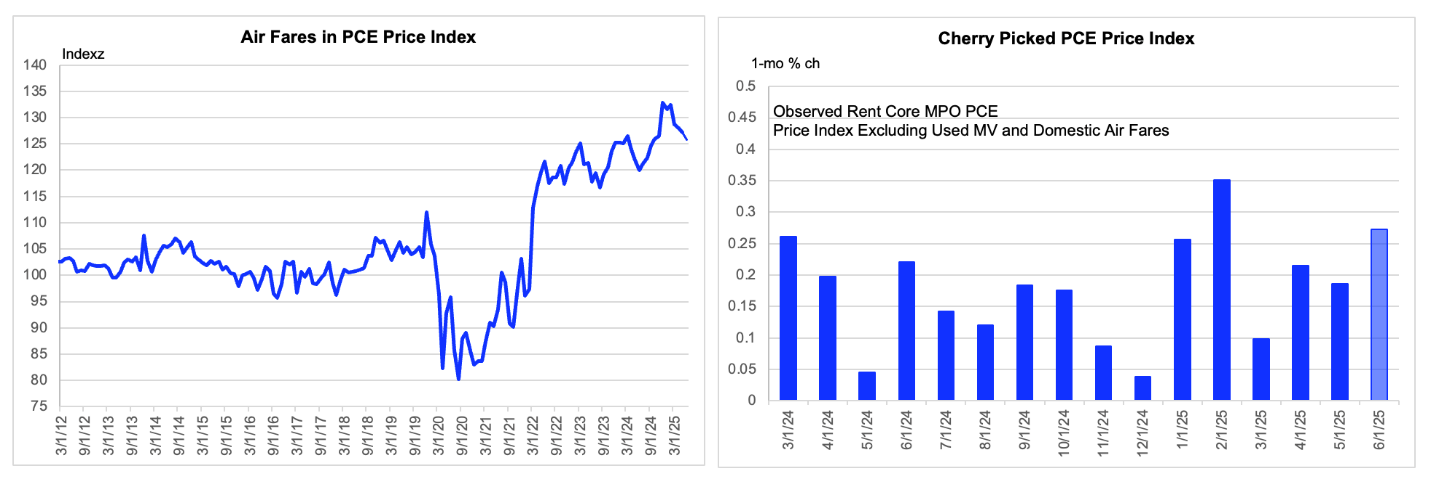
The informed consensus did not move its estimate for the June Core PCE Price Index much after the import price report gave us another look at air transportation fares. This does not mean that analysts are now in agreement about how these fares will print in June. Rather, it seems that there remains division around this point even with the additional estimate. I know of one analyst, for example, who is looking for a 3% decline in even the domestic component of air fares, which is the focus of this note. A big issue here seems to be controversy around how the BEA will seasonally adjust these data. My sense is that other analysts are probably clustered more closely around a 1% decline in air fares, which is hardly dramatic for the month but extends a recent pattern of weakness. For example, if that estimate were confirmed, then air fares in the PCE would be down by just over 5% (SA but not annualized) since the end of last year.[1]
Let’s work with that less dramatic number, not necessarily because it is correct, but because it is embedded in the informed consensus for the overall Core PCE Price Index and related detail. I think the risks around this figure are skewed to the left, i.e., to a deeper decline, but I am inclined to strip the effect of that out anyway, so it does not matter much. What is embedded in the informed consensus is what matters practically.
More likely an adverse supply side shock
What are we to make of the extended weakness in air fares since the turn of the year? The most popular interpretation (away from the idea that it is just pure noise) is that the weakness in air fares reflects a downturn of discretionary demand. If that is the correct interpretation then there would be no case for stripping these prices out, because they are directly linked to a key and likely durable (for a while) aspect of the business cycle.
But I favor a different interpretation, which starts by recognizing that air travel has become even more unattractive and that the utility (to the consumer) of any given flight into or around the United States has declined. If that is the correct interpretation, then the decline in ticket prices may just reflect a decline in the “quantity exchanged” (properly conceived as utility). Indeed, it is possible that ticket prices have fallen by less than the (invisible) quantity exchanged, in which case inflation in this sector is being misinterpreted as deflation. I hasten to add that this distinction has no implication for nominal demand, which might seem to interest the Fed more than price or quantity taken in isolation. However, we can identify the effect as one off and not related to the business cycle. And that alone would warrant stripping it out for the purpose of assessing what we might call underlying PCE inflation.
Air fares and a key measure that excludes them
Data are actual to May and assumed inferred estimate for June
Cherry picked measure
Accordingly, I have invented yet another measure of underlying inflation, which is just what I have been calling for many months now The Single Best Measure, but with air fares stripped out. Before going further, let me quickly run through the adjustment to the conventional Core PCE Price index involved here, what the rationalization is and what it is worth during June:
I replace the lagging government measure of average rents with my subjective sense of the trend in marginal rents, because marginal rents are more current. That reduces the measure by 1 bp after rounding.
I strip out used car prices because they are a recurring source of volatility and because there is no reason to extrapolate the decline during June, as tariff pressures go the other way and the Mannheim is not weak. This adjustment raises my measure by 1 bp.
I strip out non-market prices to start to eliminate what is effectively a mismeasurement at short horizons. Overwhelmingly, the main source of this mismeasurement is the arbitrary effect of the stock market on portfolio management and advisory fees. But the argument applies more broadly, so I just eliminate all non-market prices, although doing so happens not to have much additional effect for recent periods. This lowers the measure by 3 basis points.
And this month I strip out that presumed 1% decline of air fares, for reasons discussed above. And that raises the measure by 1 bp.
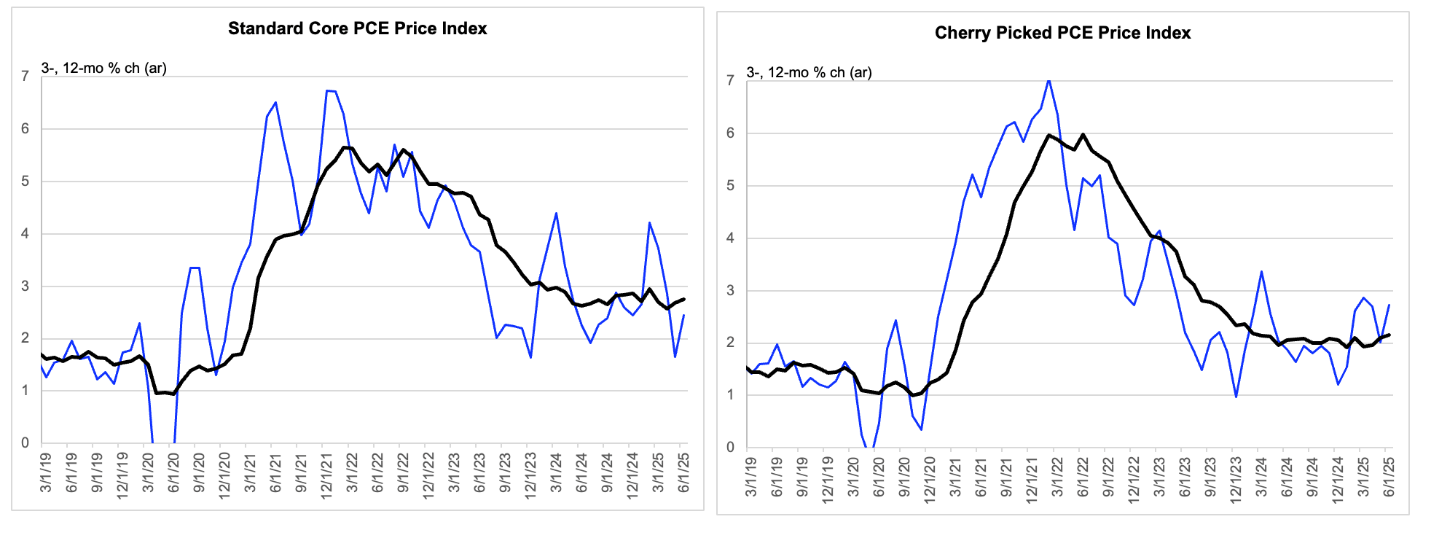
So, what starts as a 29 bp estimate for the gain in the Core PCE Price Index gets converted to a 27 basis point rise in what I will call the cherry picked measure. Accordingly, it might seem like all this quibbling tilts me slightly dovish. But with these adjustments, the monthly pattern in what I am calling here underlying inflation seems to be an accelerating one over the past four months. That is clearly at odds with what had until recently been the consensus view that inflation might actually be ticking lower. And I get this result despite suspicion that the monthly gain in the price data for June has generally been depressed by residual seasonality.
Residual seasonality aside, note from the chart below that the Cherry Picked price measure shows a clearer acceleration pattern in recent month than does the standard Core. We see this especially in the 3-month rate and to a lesser extent even in the 12-month rate. You may notice that the cherry picked measure has a lower 12-month rate in absolute terms. The part attributable to rents is definitely legitimate in my view. But that part that can be linked to excluding non-market prices should probably be corrected by adding a constant 20 basis points to the entire history of the series, because we want to strip out the short-term noise from those prices but not the fact that they do tend to rise more quickly than other prices over time.
An aside on import prices
As I mentioned at the top of this note, the point of all this detail is not to be alarming. The main practical takeaway is that inflation has not really been cooling heading into the teeth of the tariff shock, and this point does point away from the Fed easing soon. And on the topic of the tariffs, I want to reiterate a good point I have seen others making about how import prices have recently been the dogs whose failure to bark has been quite loud. Import prices are not strong, as you will have noticed this morning. But those data are measured pre-tariff, so the fact that they are not falling is evidence against the hopeful but forlorn view that producers would just eat the tariff, a la Trump’s wishful thinking. What we do know is that that is not happening.
But Trump being wrong is seldom incremental. There remains the more interesting question of whether US multinationals will absorb into narrower margins the cost of the tariffs, in order to avoid huge sticker shock on their own consumers. To the extent that happens and involves more than just a delay, it would favor narrower profit margins in select sectors but a lower-than-otherwise impact on inflation. Even an equity bull would probably prefer that because it would lower the risk of the Fed having to tolerate a high recession risk.
And another possibility has arisen recently, in which multinationals accept narrower profits inside the USA but then make it back by raising prices in third markets. Economics 100 tells us that should not happen. But economics 100 – excessive faith in which is sometimes derived as economism – does not take account of market power and the satisficing associated with that. So, that scenario is plausible and recently some supply chain consultants have been suggesting it is actually going on. At this point, we cannot know, which again will give the Fed pause, figuratively and literally.
Underlying slightly perkier than standard Core
Data are actual to May and assumed inferred estimate for June
[1] This month international air fares are expected to be down much more than domestic. But this note focuses exclusively on domestic, in the interest of simplicity and of avoiding a computing error. Dealing with net trade in anything takes more time than I had yesterday.

