

The informed “consensus” for the June gain in the Core PCE Price Index is understandably firmer than what is implied by a cursory look at the Core CPI. It is not unusual for these two measures to diverge meaningfully, and it is important to resist the temptation to split the difference. Rather think of Core PCE as truth and just ignore the core CPI once you have what the report implies for PCE. This month, the misses in the CPI were largely concentrated in used motor vehicles and rents, which have a lower weight in the PCE than in the CPI.
But there is also something else going on. The range around street estimates of the Core PCE seems wider than normal, which is why I put scare quotes in “consensus” above. And I suspect this may have something to do with people penciling in different estimates of the role of portfolio management and advisory fees. Those with high estimates for the overall core are probably assuming a big gain in those financial services prices, and vice versa. The point is not that these prices are themselves important. They are a complicated moving average of the stock market and tell us nothing about inflation pressures, especially at short horizons. So, the first thing you should do is strip them out. The reason they are relevant is that we need to know what the analysts are assuming they did in June, so that we can infer what they are estimating for the Core PCE excluding them.
At this point, my best guess is that the median guess for portfolio management and advisory fees is that they are up 2 ½% +/- a lot, which would mean that the consensus estimate of a 30 bp rise in the Core PCE would reflect a 26 bps rise in the Core excluding portfolio management and advisory fees and a 25 bps rise in the Market Price Only (MPO) version of the Core PCE, whose main advantage is its exclusion of these same prices. Please forgive the false precision there.
We must also recognize that best guesses of the services component of the core is also being held down by these fake prices, as by airline fares, which are a separate discussion. As a result, the MPO version of services inflation (which includes the disinflation effect of airline services) now looks quite low, especially at very high frequency. (The 12-month rate looks sticky at a high level.)
Conversely, away from used auto prices especially, goods price inflation is clearly accelerating, although certainly not by more than specialists in tariff passthrough would have assumed. The story here is that those experts have a point, not that they will have been surprised by the upside here.
With the release of PPI tomorrow, we will have a very good read on portfolio management and advisory fees. To repeat, the point is not that they matter. But when we see the informed bean counters producing updates of their Core PCE estimates, we will know exactly what they are implicitly assuming for the Core excluding these dubious financial services prices.
Let me conclude with an out of consensus take on airline fares that will have no effect on how markets will process these data. If people are hesitant to fly into or around the US for whatever reason, then the real value of a seat on an airplane will fall. If the measured ticket price falls by more than the real value, then we will have actual inflation masked as deflation. But there is no chance that anybody but me will look at it this way. 😉
This month, portfolio management and advisory is again the main reason to focus on the MPO figures
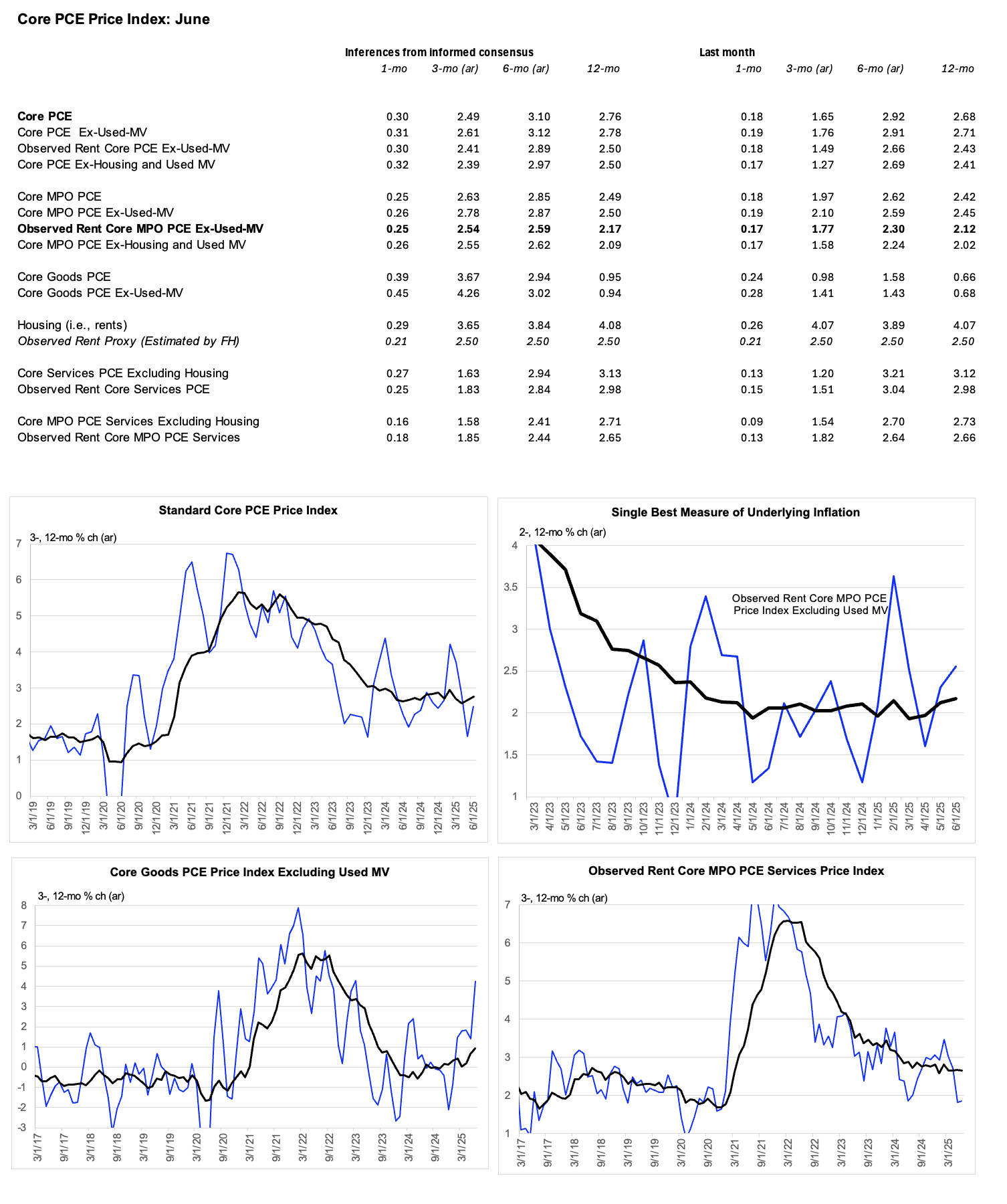
Data are actual to May and inferences from consensus for June.

