June CPI: Dovish Topline but Less Comforting Internals
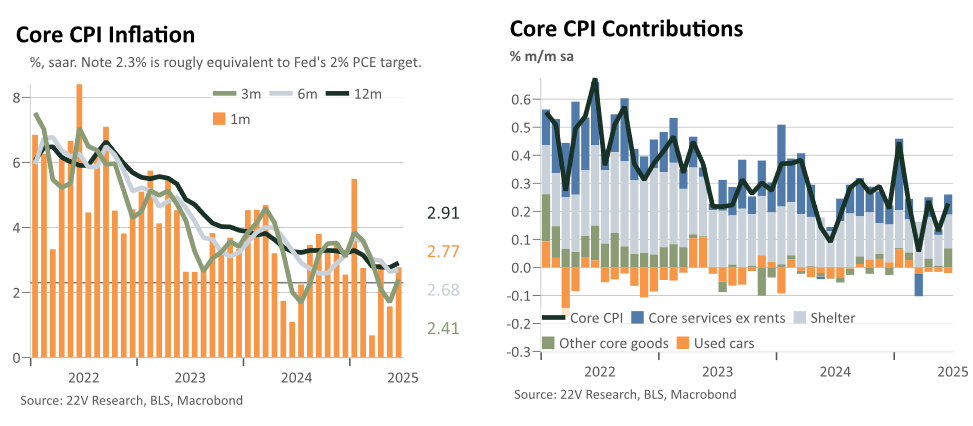
- Calling this the 5th straight downside surprise in core CPI seems a bit of a misnomer.
- While core printed below consensus, although near our read of the whisper at 0.23%, the downside surprise was driven by soft airfares, hotels, and used car prices. Not exactly things which a ton of medium-term signal.
- As firms burn through pre-tariff inventories and get additional ‘clarity’ on the permanence of a notably higher avg tariff level, we are seeing more signs of tariffs’ impacts with core goods ex used autos having their hottest print since Feb ’23 and core ex shelter and used autos printing its 2nd hottest print of 2025. In the near-term, this is only likely to accelerate.
- Despite the topline, rates are higher on the day, which seems the correct read-through to the medium-term. The topline will further administration comments but the internals of this report justify near-term Fed caution (tracking estimates of core PCE seem to have generally moved higher on the day and point to 35bp or a bit below CPCE print for June; tomorrow’s PPI fills in some important details).
- Keeping it as simple as possible: labor market slack seems stable in recent months, topline growth rates are decelerating but so is supply growth, tariff inflation is starting to hit, intermediate goods and food-away-from home prices have been bouncing since mid-24, there’s little sign of consumer credit stress, and risk asset pricing is highly supportive of risk taking and the economy. Housing is the one area of the economy under a bit of pressure but its inability to reaccelerate is likely necessary to keep overall heat in check. This is hardly an economy begging for rate cuts in the near-term even if a few more towards ‘more neutral’ remain an eventual presumption.
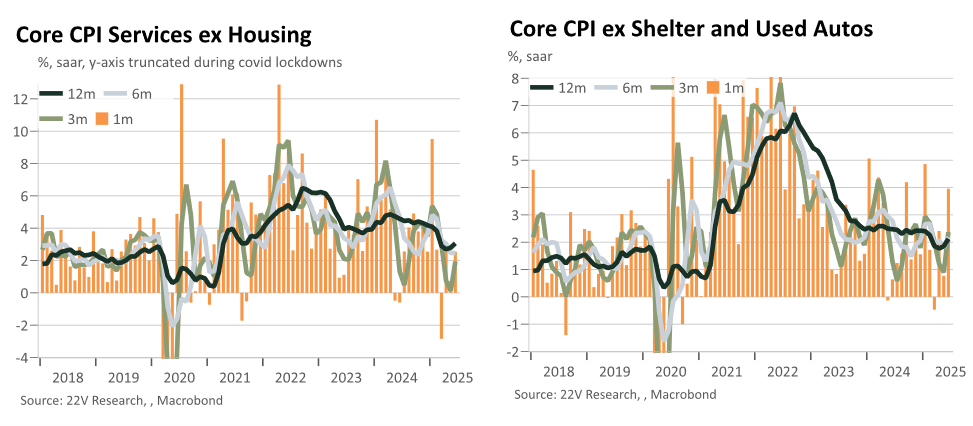
Broader measures of core price pressures were told a less helpful story than topline core did in June. Core services ex housing wasn’t bad at 0.21% m/m sa; a smidge above target-consistent levels perhaps but not too far off. However, this was helped by notably soft airfares and hotels prints. Core ex shelter and used autos had its second highest print of the year and does not share the same comforting level as CSEH.
The continued gradual deceleration in rents, now to roughly target-consistent levels given usual historical relationships, is a comforting building block for the medium-term but is only one piece of the puzzle as direct impacts from tariffs seem to be building, their indirect have yet to be felt, electricity prices are moving higher which will radiate into other prices, and inflation’s underling medium-term trend remains unclear.
Optimism based off of some inflationary subcomponents returning to more target consistent paces should be less than full, given that, as the Fed has told us many times, it is the topline over the medium-term that matters. With the tariff shock on top legacy inflation concerns, a changing supply-shock backdrop, and a solid, if no longer overheated economy, confidence in any medium-term forecast, especially one assuming a quick and partial pass-through inflationary impact from tariffs, should be modest.
Investors seem notably sanguine on the subject of tariffs, largely looking through recent headline escalations / negotiation positioning from the White House and with the model respondent to our survey expecting only a +28bps increase in cumulative inflation overall due to tariffs (the tail is quite long though; see more here). This seems sharply below what anything close to current policy would suggest and implies either very quick walk backs from the administration on even current policies or a notable hit to margins, which doesn’t seem consistent with risk asset price action. Most likely, the modal investor in our survey seems to have internalized a view which sees the IEEPA tariffs, the source of almost all the current consternation, are overturned and the administration then has to resort to slower moving and more guardrailed alternative approaches. There would still be some tariff shock over time in this scenario, likely cumulatively smaller than current policy, but more spread out and with reduced escalation risks; this would be less of a clear one-off shock but also less threatening in size at any given moment in time.
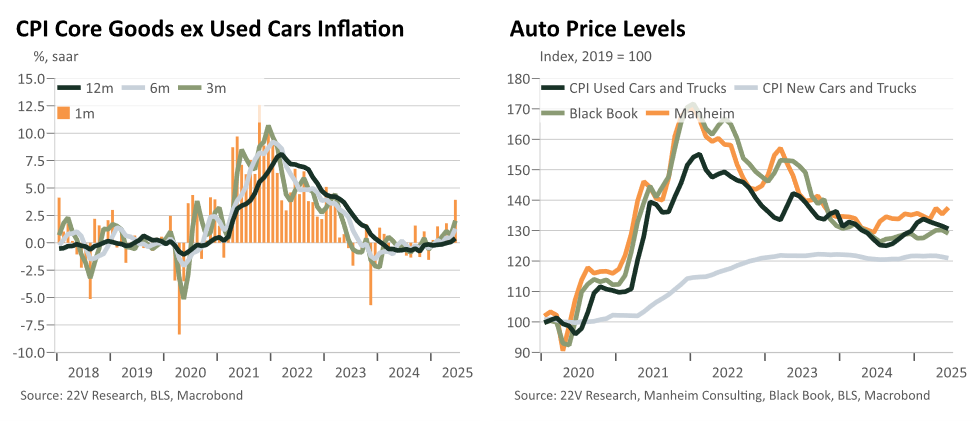
Core goods prices jumped sharply in June. Core goods ex used autos were up 0.32% m/m, their fastest pace of increase since February 2023. This trend is likely to continue for some and almost surely accelerate some further in the months ahead. Firms have been surprising cautious so far in raising prices in response to tariffs, largely responsible for the series of good surprises in inflation over the past few months. With pre-tariff inventories being gradually depleted and increasing confidence that at least some of the tariff shock will be persistent, we seem to be seeing a larger more obvious tariff impact on inflation now. Upward inflections, relative to recent trends, in electronics, appliances, tools, some construction inputs, and other sectors are quite apparent.
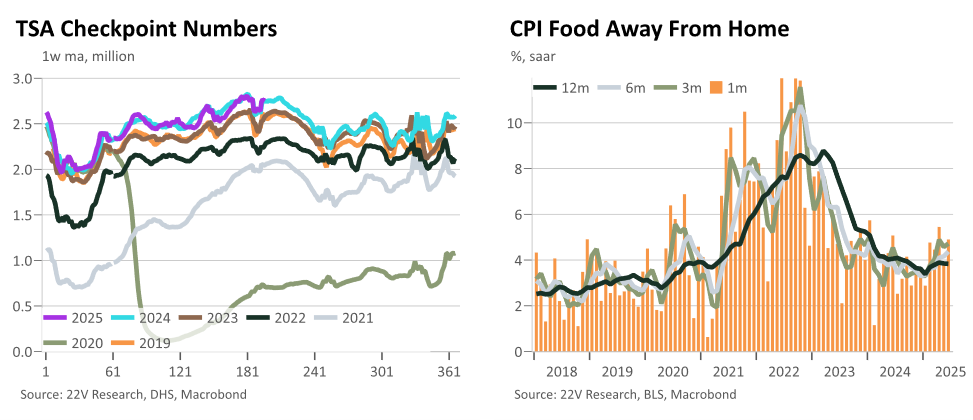
Discretionary spending signals inside CPI seem to be going in sharply different directions in recent months. Hotel pricing saw a sharp decrease, which drove the m/m dip in shelter inflation, and airfares have been notably soft as well. On the other hand, food away from home, which is one of my favorite measures of underlying inflation dynamics given its link to high salience food prices, rents, and wage pressures, has been in a fairly consistent uptrend since early ’24. Food away from home could, very tentatively, be the first area seeing impacts from increased immigration enforcement but the average hourly earnings data for the sector shows only tentative and very noisy evidence of that, it at all. Given that TSA checkpoint numbers are roughly matching 2024 levels, this suggests to me that declining international tourism flows and, perhaps, government travel spending shifts are building on top of a mild shift in domestic spending patterns which does show up in some card data.
While hotels drop pulled down June’s overall shelter numbers, rents and OER largely moved sideways at a level fairly consistent with close-enough to target core.