

BEA’s data on America’s net international investment position (or external debt less formally) are slow moving and therefore never newsworthy. However, this morning’s update through the first quarter of 2025 present an occasion to update a story I have been following.
The gist of the story is that the large current account deficit confirms what the currency chart would itself suggest, that the US dollar has been – and remains – somewhat elevated. And relatedly, the accumulation of large current account deficits over the past few years has pushed America’s net debt up to a level that suggests that portfolio balance effects should increasingly weigh on the relative price of dollar-denominated assets. Most of the rebalancing here is likely to come through the dollar, rather than domestic financial asset prices, primarily because the US is a large and (relatively) closed economy, compared with, say, Canada, where domestic asset prices would have to move more to accommodate / offset the (larger) macro effects of a weaker currency.
It would be great to quantify this issue, but that is not typically my strength. My attempt at a value add here is to point out that the backdrop has evolved over the past couple to few years with implications that would be obvious, qualitatively.
An image of US risk off during the first quarter
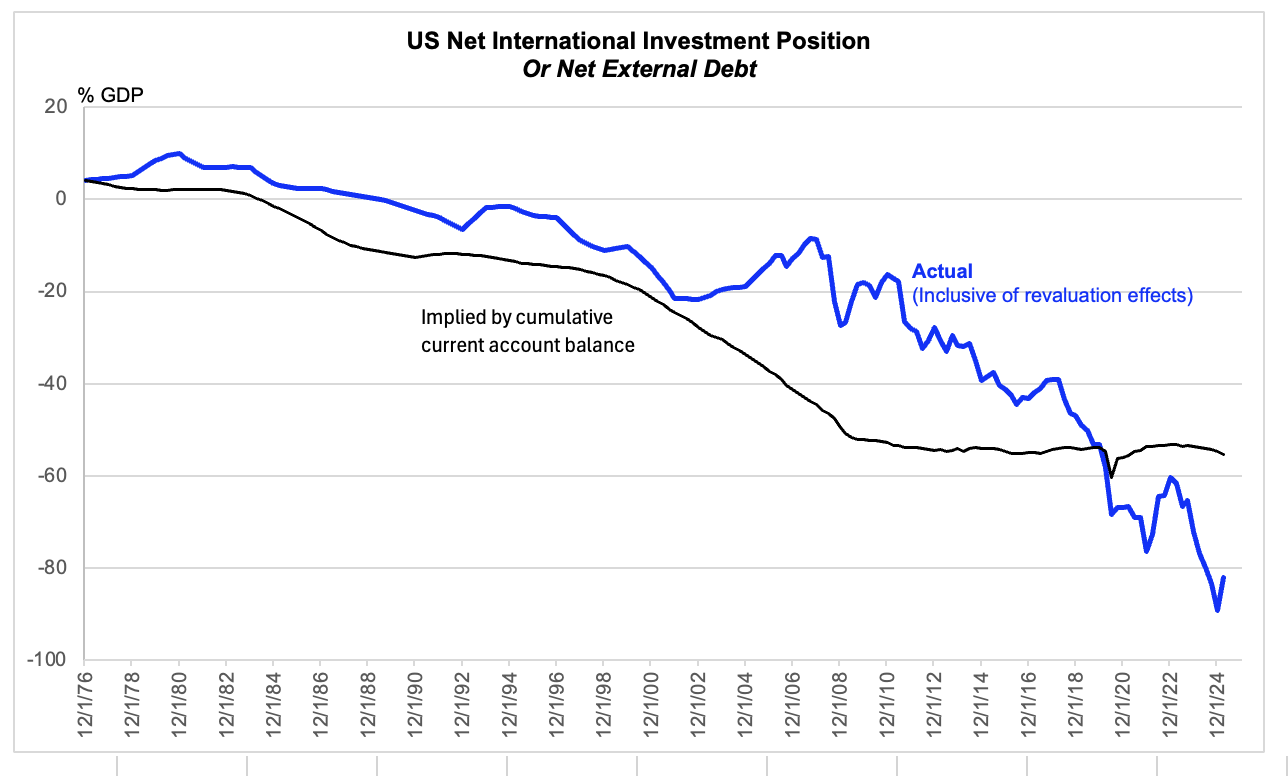
Data are actual to Q1.
Starting with the headline, the net external debt fell – unsurprisingly – from 89% of GDP during Q4 2024 to 82% in Q1 2025, primarily due to revaluation effects that I will discuss immediately below. But when thinking about how the external accounts relate to pressure on asset prices, it is probably best to start with a thought experiment in which revaluation effects are assumed to be neutral and we trace out the path of the net debt under various scenarios for the current account balance. Assuming that the current account balance stabilizes at about 5% of GDP and that nominal GDP growth runs at a trend of 4%, the net external debt would approach 125% of GDP along a tangent. Because 125% is probably too large (again a qualitative assertion), we should expect asset prices to move in a way that would ward off that result, via both revaluation effects in asset markets and competitive realignments in goods and services markets that would incline the net export deficit (and therefore the current account balance) to improve. Within this template, the key point is that the net external deficit is large and inclined to rise further. If it fails to rise because of revaluation effects, then my call here would have been correct.
The market value of external liabilities fell
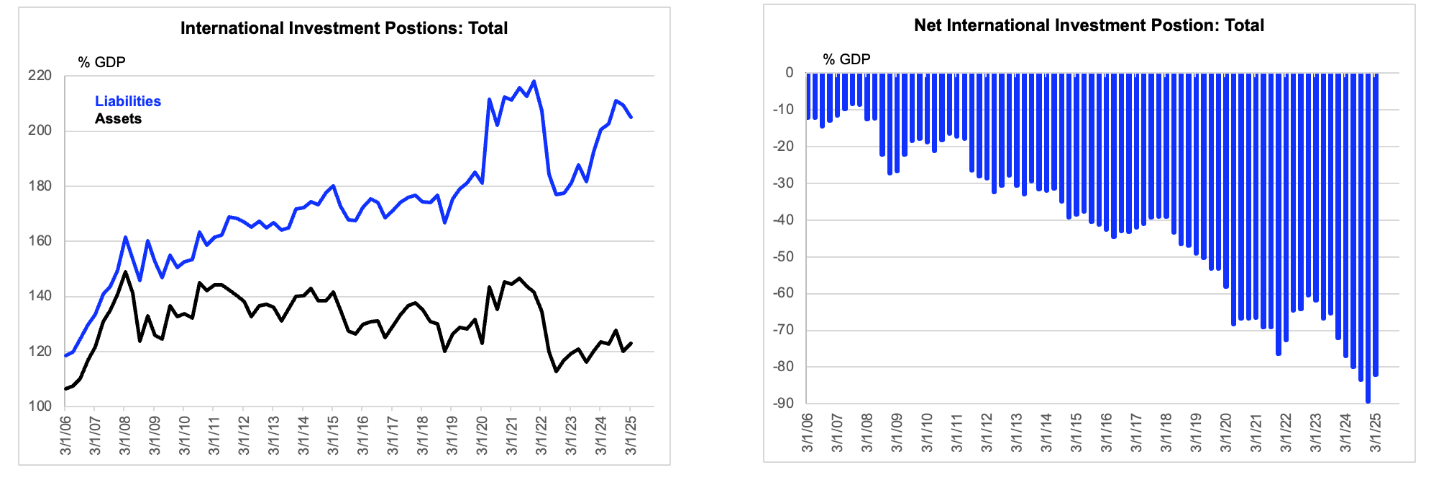
Data are actual to Q1.
During the first quarter, the main cause of the decline in the net external debt was the drop in the market value of US liabilities, associated with the recent – and recently reversed – risk off in US markets. The market value of US assets somehow managed to eke out a small gain, but that seems to have been due more to developments in overseas asset markets than to the translation effects of the dollar itself, as its recent weakness has been mostly concentrated in the second quarter. And as an aside I should mention that it might not dominate, because US equities have gone up more than the dollar has gone down.
We can separate the external debt into equity related (including FDI) and non-equity related, which is heavily denominated by debt. In fact, what the BEA calls non-debt items seems to me to be best considered as debt anyway. As you can see from the chart above, the market value of equity-related external liabilities fell during the first quarter, even though there have been net external flows into this asset class over the past few quarters, as I documented in my note last week. So, here we see the straightforward effect of risk off, which the dollar asset bull does not get to extrapolate for obvious reasons. He would be right by being wrong on the more practical issue!
Mostly in equity related
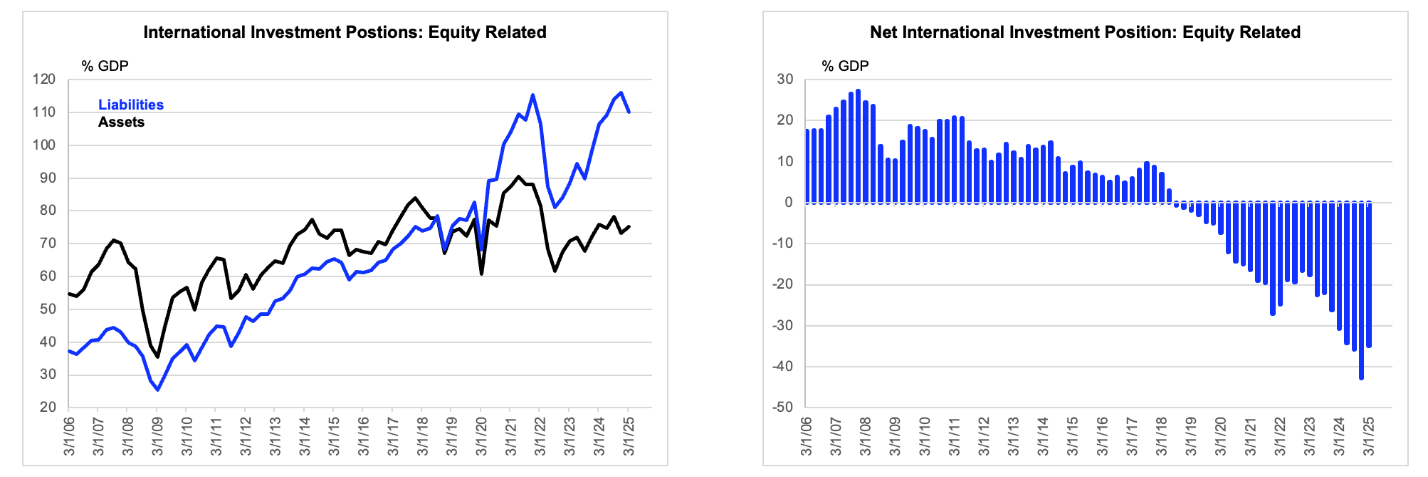
Data are actual to Q1.
And the non-equity related external debt figures moved by much less, because fixed income valuations are less volatile and because – as mentioned – the dollar was not particularly weak during the first quarter. There will be some slippage between the trade weighted dollar that I monitor and the external asset weighted dollar that you might imagine. But you get my point.
Not much going on elsewhere
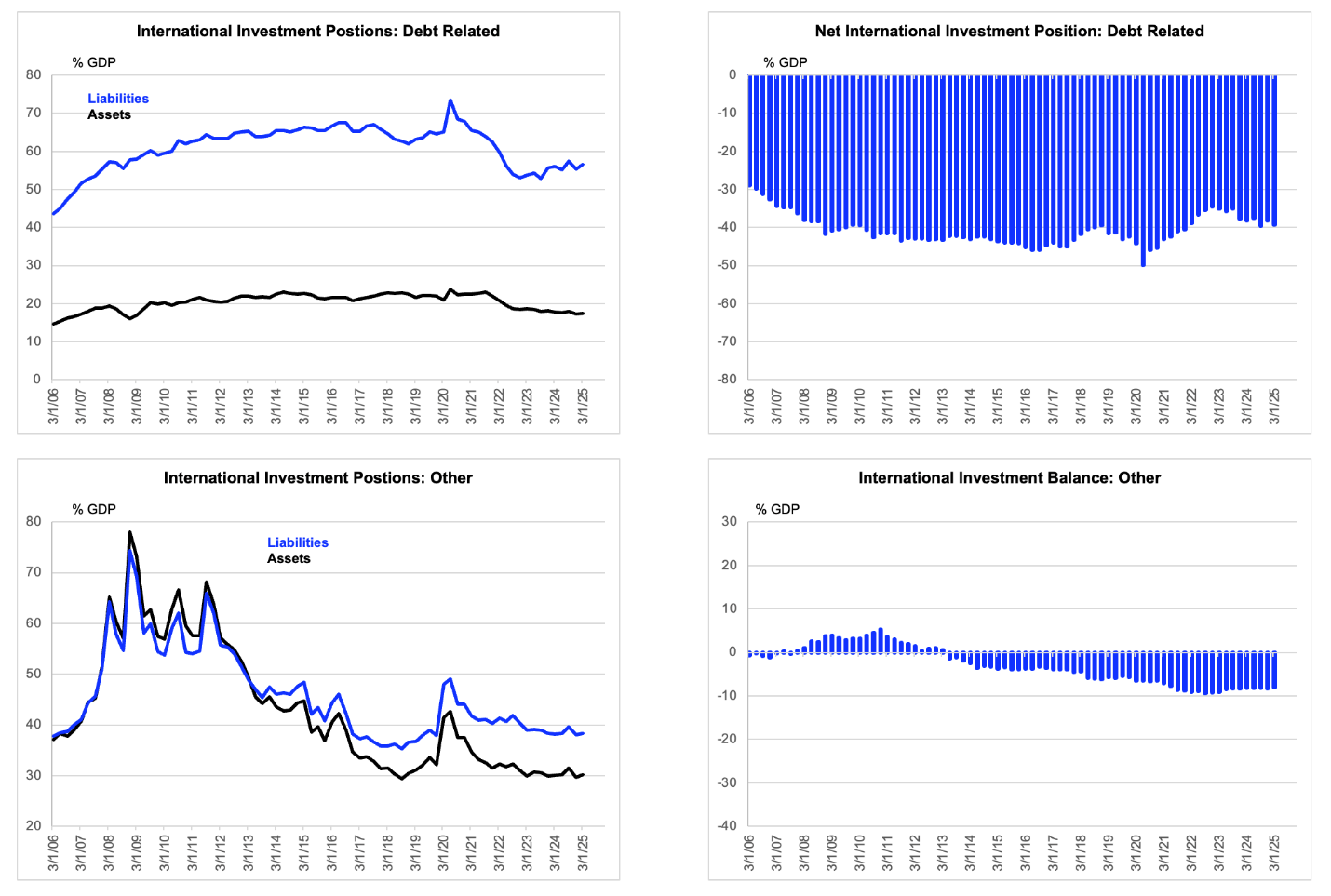
Data are actual to Q1. Note that vertical scales are set to allow easy comparison of relative importance of revaluation effects.

