

This issue came up during the webinar with 22V earlier this morning. But time constraints precluded us from getting into it in any detail, so I will elaborate a bit on it here. This is a bit theoretical. NGL.
One possibly fun irony here is that concerns about fiscal sustainability might ultimately put downward pressure on r*. And the reason for this has nothing to do with the well-worn idea that the Fed will pin rates to zero to assist the Treasury in avoiding a fiscal crisis. Monetary accommodation of a rising debt would show up first as the Fed guiding actual r below r*. In the first instance that would not be about r* itself.
No, the real reason here, if I have this right, is that r* rising well above g* would generate fiscal strains at some point. And the fiscal, not monetary, policy reaction to that would be a consolidation, which would tend to push r* down, irrespective of what the Fed is up to, and consistent with the Fed itself staying orthodox, i.e., focused on achieving the dual mandate.
The idea that g* might limit the extent to which r* might rise is hardly new. Economists have long argued that a higher growth rate would incline consumers to try to draw future income into current consumption, by borrowing, to smooth lifecycle consumption. And such behavior would incline r* to rise along with g* via the intertemporal substitution effect. And vice versa.
Working in the same direction, a technology advance that sped growth by raising the return on capital, would put upward pressure on r* as businesses sought to convert financial capital into real, to put it briefly. There are complicating factors here for sure. For example, a tech advance that increased market power among dominant players might actually reduce the demand for physical capital. I concede the complexity. My point is that the idea that these things are connected is not novel.
But there is a third mechanism that may be newly relevant. In a world of high public debt, a rise of r* well above g*, is more likely to generate fiscal worries that would have two effects, both of which would favor a lower r*. First, risk premia would rise. This might make, say, 2-year notes less well correlated with changes of r*, but r* itself would fall in response to this. Second, the fiscal policy response to these strains would probably involve fiscal consolidation, which would reinforce the tendency of r* to fall.[1]
The tendency of r* itself to fall in response to fiscal consolidation is one reason I argue that when the fiscal “crisis” comes, the cure for it might be a fairly minor fiscal tightening. The fiscal tightening would lower the primary deficit by definition, but it would also operate directly on r* vs g*, pushing it in a benign direction, making any given primary deficit more tolerable, both because the debt / GDP ratio would rise less quickly and because any given path of the debt / GDP ratio over the medium term would be a lesser worry to markets. And that’s why sitting out an investment strategy until after America has had its Liz Truss moment might not be a good way to go through life. The bump you avoid could be quite brief.
I think that point is interesting in its own right. But the part that is “fun” and novel to a high debt environment, is that fiscal sustainability joins intertemporal substitution and the return on capital as one of three ways that g* limits r*!
When that limit begins to bind, you probably don’t want to be long the medium maturities of the US curve. I get that. But if the response is fiscal consolidation rather than fiscal dominance, this limits the extent to which bonds can sell off over time.
And for the dollar the effect would be more immediate. Fiscal strains would be negative the dollar and the response to those fiscal strains would also be negative the dollar, by reducing r*. If you want to bet on a fiscal crisis without worrying too much about the timing getting back in, the call might be just short the dollar.
Estimates of r* might be more limited by g* in an environment of very elevated public debt
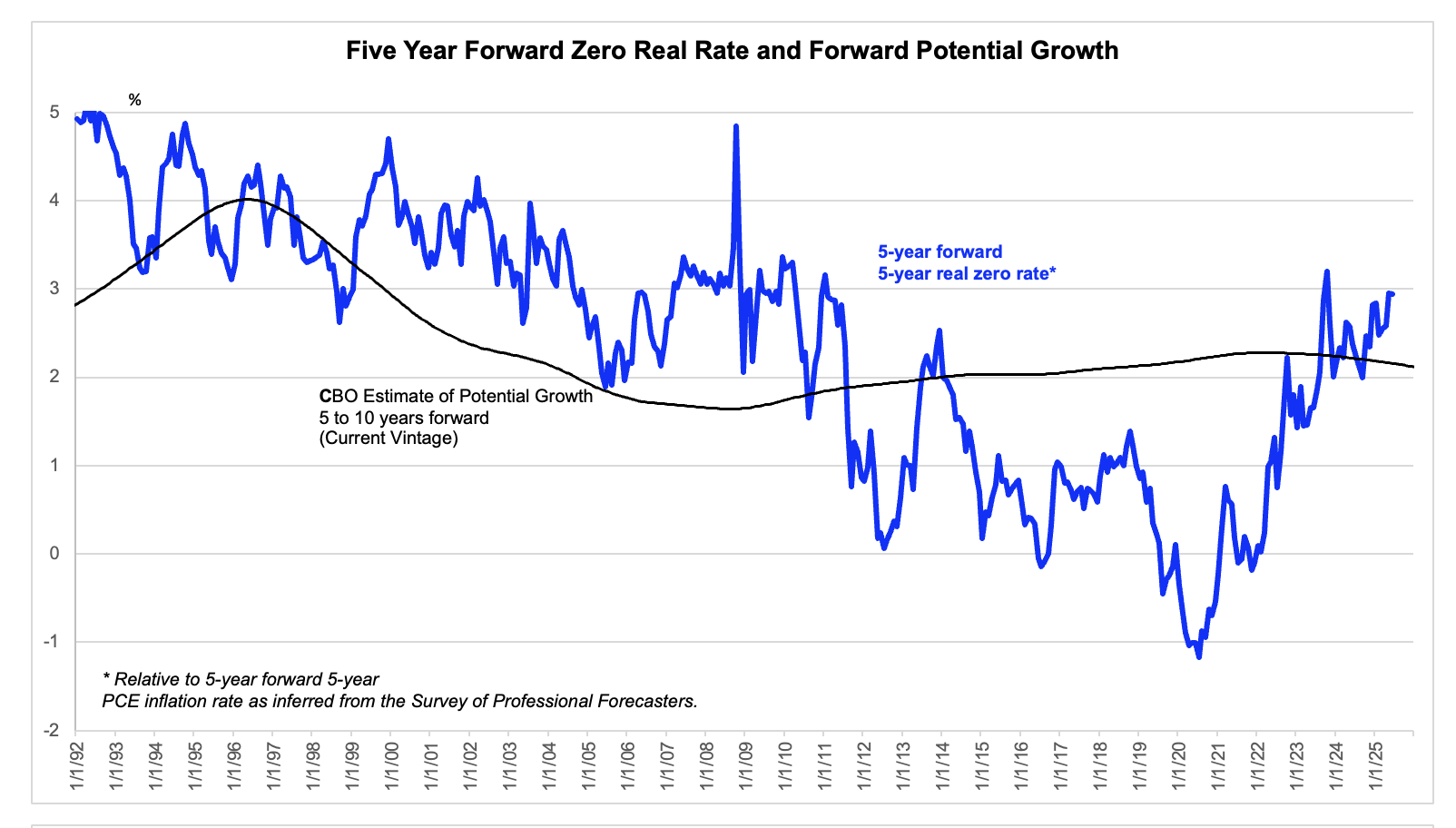
Source: CBO, Federal Reserve Banks of New York and Philadelphia, FH calculations
Pricing data is to the Monday close.
[1] Incidentally, in the chart I use the 5-year forward 5-year real rate as a proxy of the market’s estimate of r*. I take very seriously the idea that the market has repriced r* relative to g*, that this implies an increase of fiscal worries, and that g* will limit r* via that channel. However, there is a technical complicating factor here. It seems that the term premium at the 10-year maturity is higher than at the 5-year maturity. ACM and KW show a difference of about 50 bps, although both are reliable. If we take those 50 bps as truth, then the 5-year discount factor is too high by 100 basis points. Incorporating that effect fully would drive forward r* back to g*. I am not saying this is obvious. I am saying it is non-obvious. Also, this has nothing to do with the idea that the Treasury does not need to pay the term premium. When borrowing at 5-years it must pay the 5-year premium. I am talking about a gap between forward rates and expectations, because differences in term premia at different maturities mechanically affect the forward discount.

