

Main points:
· Credit raters don’t provide particular insight into US sovereign credit quality.
· The Moody’s downgrade may trigger a greater fool effect?
· The real issue remains the tariffs.
The Moody’s downgrade of their US sovereign credit rating after the close on Friday raises two thoughts that seem always to apply in situations like this. First, a credit rater has no more insight into US sovereign credit quality than you or I do. And they are prevented by commercial considerations from stating plainly what they even do know. So, effectively it is as if they know less, at least by design. (Who knows when or where a clever analyst will show up?)
Secondly, the mainstream media almost invariably overstate the importance of these events, whether they be a downgrade or shift to watch negative, as though something has happened to the US. But nothing has happened. We have not been stripped or downgraded. The verb is intransitive. All that has happened here is that analysts have published an opinion. One might retort that this criticism is unfairly dismissive because some investors require a AAA rating. But the supply of credit to the US Treasury is elastic, as experience with QE and QT and earlier ratings events has shown. It is the substance of the news that matters.
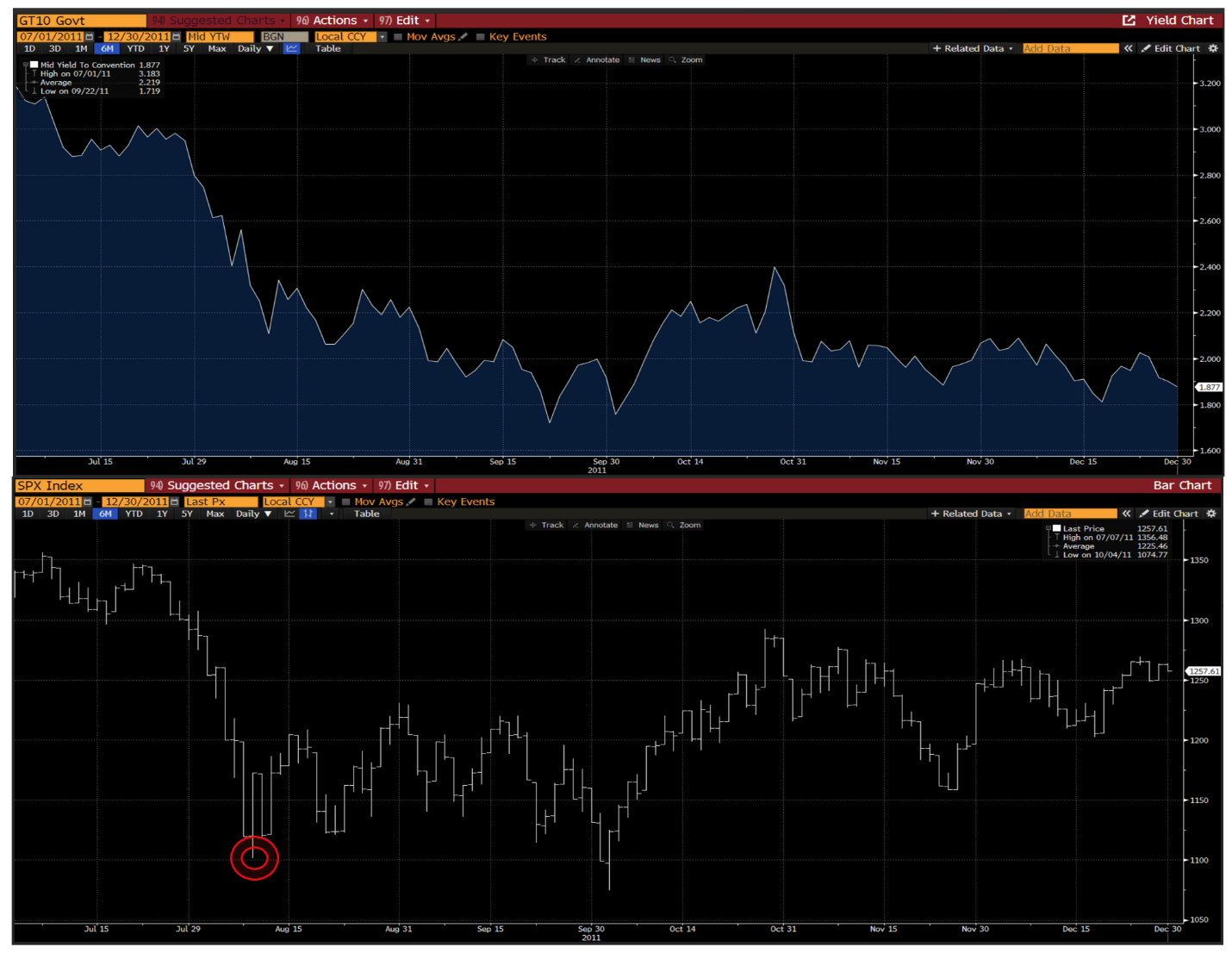
Ten-year yield and SPX around the 2011 downgrade
Source: Bloomberg
Red circle is around the low on August 9
I don’t want to guess whether we should try to apply the logic of the greater fool here, to sell US Treasuries – or more to the point, equities – because others will be briefly confused into believing there is substance in the Moody’s announcement. Instead, I will just quickly review what happened when S&P delivered a downgrade in August 2011, go over some of the economics relevant here, and conclude by arguing that the main issue now remains the tariffs, not fiscal policy.
Substandard and poorly timed
Standard and Poors’ decision to cut the US rating from AAA to AA+ on August 8, 2011, was well telegraphed – by having put the US on watch negative. Still, the S&P500 fell 126 points, more than 10%, from the open on the 8th to its low on the 9th*, and then it drifted net sideways until making a marginal new low in early October. Fixed income sold off for a tick, but the move in equities was so quick – and so obviously not about impending fiscal strains – that bonds ended up rallying. By late June, the 10-year Treasury yield was down 70 basis points from its pre-downgrade level of 3.6%.
The simple market test I run on the case for fiscal expansion actually switched signs in August 2011 from recommending “orthodoxy” to recommending “laxity.” In other words, as I measure the issue, Standard and Poors got the sign wrong. Of course, the fact that my crude metric changed signs in August 2011 is just an artifact of arbitrary details in how I design it. Still, the summer of 2011 was a watershed event in the sense that the bond market had for decades been signaling a case for fiscal orthodoxy and then shifted decisively and durably (taper tantrum excepted) to greenlighting aggressive fiscal expansion. I have argued that the signal meant not only that fiscal expansion was tolerable but that it was also desirable.
I suspect that the analysts at Standard and Poors were not aware of the Ponzi Public Finance literature — or at least its implications looking forward. This argues that when r* is far below g*, then fiscal capacity rises. There are two reasons for this, one obvious and one more interesting. The obvious point is that the debt / GDP ratio will rise more slowly (or perhaps even decline) for any level of the primary deficit when effective r is below g. The less obvious point, often overlooked, is that any medium-term path for the debt / GDP ratio is simply less relevant when r* is far below g*, because the present value of a potential fiscal tightening in the distant future looms much larger in fiscal sustainability arithmetic under that condition. Or put almost equivalently, there is no scenario in such an environment where default – or inflation – is the dominant strategy for public debt issuers.
So, that was a spectacularly bad call by Standard and Poors. In fairness to them, though, they could not have known that r* was going to collapse relative to g*, in part because of the mistaken turn to fiscal austerity that the premature debt panic (among policy makers, not markets) of the early 2010s ushered in. Eventually, the signal from markets got into fiscal policy, which allowed the deficit of the late 2010s to rise to the appropriate level. K And then with Covid and its aftermath all the restraints came off, which in hindsight was a mistake.
The problem with the Trump and especially Biden fiscal expansions was not that they forced the debt / GDP ratio higher. That was a blessing, in my view, for reasons I will get to (again) below. The problem is that the Biden fiscal stimulus contributed to a big inflation overshoot that was by all account regrettable. The resulting rise of the debt / GDP ratio, though, was probably mostly salutary, in the sense that it has helped raise r* and take the economy toward full employment and away from liquidity trap. So, I would say that the win here is that the US now has enough public debt. This is an unpopular take, but I think it is correct, so I will continue to press it.
We seem to have a bit too much debt at the medium-term horizon

Source: Federal Reserve Banks of NY and Philadelphia, CBO, FH calculations
Data are to the close on Thursday.
The fact, as I would describe it, that the US now has more than enough public debt is reflected roughly in my crude market test of the case for fiscal expansion. For the past year or so, it has been signaling that a more cautious fiscal policy may be appropriate. It is important to recognize that the market -based measure of forward r* is premised on – or incorporates – the consensus outlook for the debt / GDP ratio, which is that it will rise steeply. So, this test is not necessarily telling us that the debt / GDP ratio should be stabilized. It may be telling us only that its ascent should slow.
And any effort to reduce the fiscal deficit would probably quickly lead to a decline of forward r*, via conventional Keynesian effects, which I think is widely overlooked – as part of a remedy — by folks who overstate the required size of adjustment here. The policy lift required to return the US to an apparent path of fiscal sustainability is probably not that large. Having said that, I do concede that the environment now is much different from 2011. The debate is now how soon and hard we need to tap the brakes. In fairness, to Moody’s, then, their timing is probably better than the Standard and Poor’s timing. Let’s not paint “economists” or raters with too broad a brush here!
Tariffs remain the pressing issue
The day may come when errant fiscal policy is one of the one or two major themes on which markets can focus. But my guess is that we are not yet there. The bigger issue remains the tariffs – along with uncertainty around them. Many tariff critics missed the importance of the Trump Regime climb down, especially around China, beginning ten days ago, because they view the issue as binary or because they figured the damage had already been done. That was a mistake.
But even tariff less heavy will deliver a significant impetus to inflation, which the Fed will have to resist by ensuring that growth runs at a below trend pace and that the unemployment rate edges higher over the next few quarters, even if inflation expectations remain anchored, which is not guaranteed. So, while the recession risk seems to have fallen, to below even at the one-year horizon, IMV, that risk does remain elevated.
Moreover, we are not headed into the teeth of the tariff hit because the ports are partly empty and because there are tariffs imposed on what the remaining ships are offloading right now. Paul Krugman has a very interesting interview with Joseph Politano, who has recently carved out a niche for himself being expert on exactly what is happening with tariffs, while partly deferring on the economic theory part of it. Politano emphasizes that even under the new modal scenario the tariffs are up a lot. And he speculates that Trump is not done spinning the tariff wheel and that the risk of another negative (in the normative sense) tariff shock is quite likely. It makes for a sober read – or listen — and is probably more important than what Moody’s is really up to.
* If we include the decline heading into the S&P downgrade announcement, the drop looks more like 20%.

