

SUMMARY
- The recent escalation of the US-China tariff war has sent domestic economic sentiment in China to the lowest levels since last September’s policy pivot; Beijing also faces a challenge in stabilizing sentiment towards the equity and property markets, which the leadership views as important for broader confidence.
- Analysts remain more optimistic about the outlook for consumption growth than we are, given our concern that the trade war will exacerbate weak labor market conditions; a decline in exchange rate sentiment reflects the difficult balancing act that the PBOC faces in managing depreciation pressures in coming months.
- While Q1 GDP data to be released tonight (10pm ET) will likely show decent headline growth, monthly data for March suggest that activity has started to weaken even before the latest tariffs hit; we expect the end-April Politburo meeting to signal incremental fiscal stimulus is on the way, but yet more stimulus will be necessary in Q3 unless there is a breakthrough in the tariff war.
In this China Brief we first provide an update on signals for China’s outlook based on our China Economic Sentiment Series (CHESS) tool. CHESS uses ChatGPT to assess the sentiment of economists commenting in China’s domestic financial media. Not surprisingly, overall sentiment has declined sharply since President Trump’s April 2 “reciprocal tariffs” and escalation of the US-China trade war (see chart below).
We then take stock of the latest high-frequency data for March, ahead of China’s Q1 GDP release at 10PM ET tonight. While the headline GDP numbers will look decent (at around 5%), monthly data show growth momentum slipping even before the impact of US tariffs fully hits the economy.
These factors highlight the importance that Beijing mount a prompt and effective stimulus response to support activity and confidence. We expect the end-April Politburo meeting to signal that incremental support is coming, with announcements of additional central government debt issuance to follow around July. But additional stimulus will be necessary in Q3 unless the Washington and Beijing enter into deal-making mode, which we see as unlikely anytime soon. See HERE for our note from Sunday evening on US-China dynamics.

CHESS SENTIMENT SIGNALS
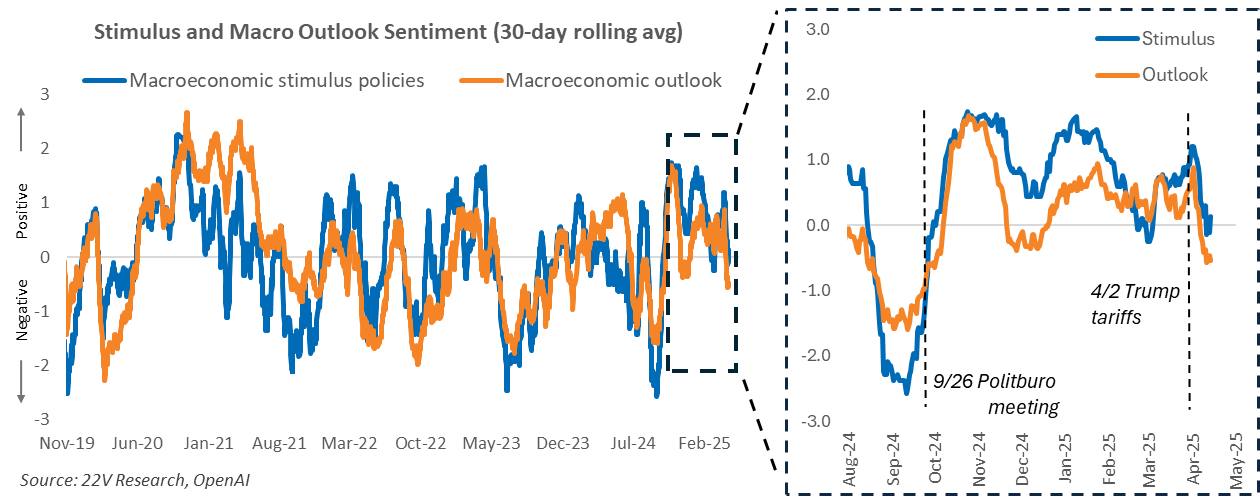
Macro sentiment has dipped to post-pivot lows. Sentiment towards the broad macro outlook (orange line below) has fallen sharply since Trump’s April 2 announcement of reciprocal tariffs. While just below neutral, this is the lowest level since China’s “policy pivot” in late September. Analysts expect macro stimulus (blue line) to not be fully effective in offsetting the impact of the tariff war, but the view is differentiated between fiscal and monetary support (see next section).
Our take: The decline in analyst sentiment is of reasonable and likely not over. We assess that the trade war will subtract roughly 2 percentage points from China’s growth this year. We expect stimulus to offset half of that hit, with real growth falling to 4% this year (and risks to the downside), compared to our January forecast of 4.5% growth.
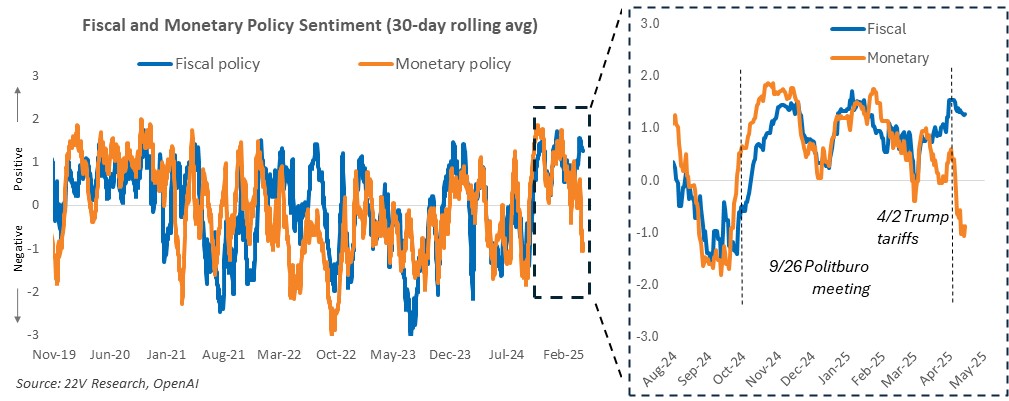
Analyst hopes for fiscal support are high, with monetary easing limited by exchange rate concerns. While overall stimulus expectations have declined, much that reflects diminished hopes for monetary easing (orange line below). The tariff-induced pressures on the exchange rate limit how much PBOC can lower rates without risking rapid currency depreciation. By contrast, expectations for fiscal support (blue line) remain high.
Our take: We agree that fiscal rather than monetary stimulus will be the main source of stimulus this year though we expect to be modest in scale and focused on investment rather than consumption. While Beijing does not face hard constraints on fiscal stimulus, the leadership’s caution about adding to government debt reduces the willingness to go big. We expect Beijing to announce an additional 1 trillion yuan in fiscal borrowing around July. If the US-China standoff continues beyond Q3 – a very real possibility – Beijing will announce additional stimulus around late Q3.
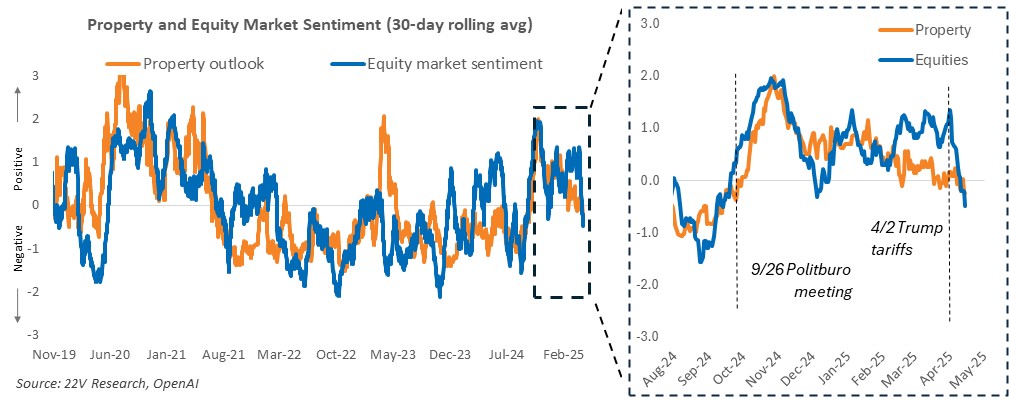
The decline in property and equity market sentiment is a worry for Beijing. One of the more notable aspects of Beijing’s September policy pivot was the signal that the leadership is keen to boost sentiment in the equity and property markets as part of broader efforts to support confidence. Recent dynamics show that will be challenging. If equity sentiment (blue line) and equity prices decline to pre-pivot lows, the leadership will face greater urgency to announce new support measures. For property (orange line), we have long felt that a recent improvement in sentiment was not sustainable and are not surprised to see a steady decline. The trade war will hurt household economic confidence (largely through the labor market channel) making a rebound in sales and prices even more difficult.
Our take: We expect Beijing to try to put a floor under equity prices through stepped up support of state-owned financial institutions. For property, we expect a double dip with policy providing some cushion on the downside. We expect further cuts to mortgage rates and incremental increases in government purchases of housing inventory. But the property sales decline in 2025 will likely be in double digits.
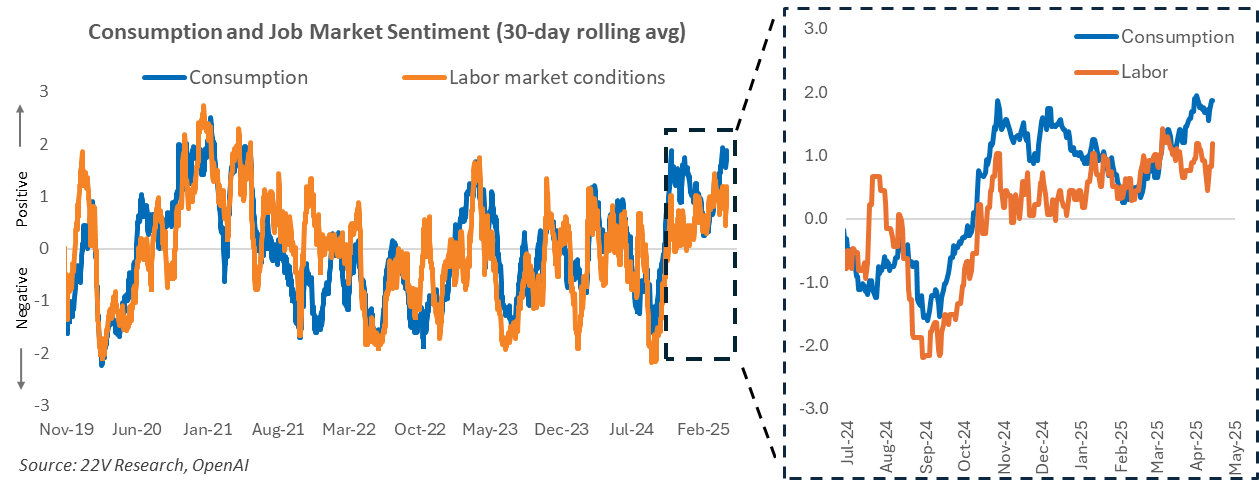
Analysts remain more bullish on the consumption outlook than we are. Domestic analysts are notably optimistic about the outlook for consumption, reflecting the high priority (at least rhetorically) that it has received from the Chinese leadership. Our own view is more guarded, as we see Beijing only gradually opening the door to broad-based consumption support.
Our take: We expect overall household spending to remain subdued this year, as an export downturn exacerbates existing weakness in the labor market. Beijing’s policy support for consumption will not be powerful enough to offset these macro headwinds and is likely to focus on relatively narrow trade-in programs for consumer goods.
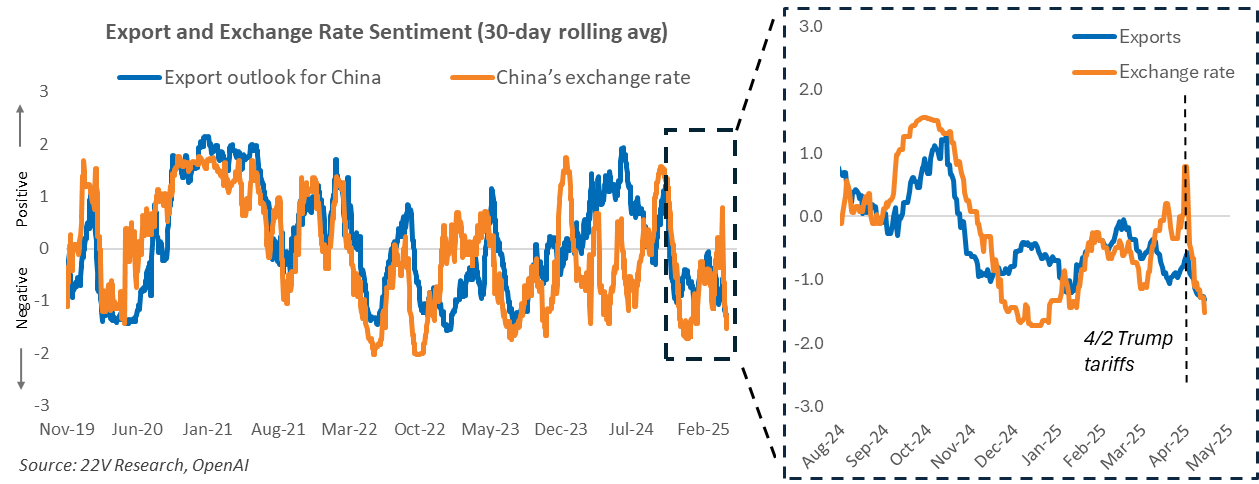
Weak sentiment towards the exchange rate shows PBOC’s difficult balancing act. Not surprisingly, Trump’s April 2 tariff announcement and subsequent tit-for-tat moves hit sentiment towards China’s exports (blue line) and especially towards the exchange rate (orange line).
Our take: We expect PBOC to carefully manage the exchange rate over the next few months, allowing gradual depreciation but taking care not to invite expectations of a more rapid adjustment given the potential risks of capital outflows and financial stability risks. In order for that balancing act to be sustainable over the course of the year, China will need the support to confidence that comes from either US-China de-escalation or a relatively prompt and convincing stimulus program.
Q1 GDP PREVIEW AND STIMULUS EXPECTATIONS
The Bloomberg consensus is for China’s Q1 GDP report tonight (10PM ET) to show real growth of 5.2% y/y, but this improvement is transitory. We have expected Q1 GDP growth to look decent, fueled by front-loaded fiscal spending and a front-loading of export orders to avoid US tariffs. But we have cautioned that momentum will slow in Q2, as these factors fade and tariffs start to hit.
Indeed, monthly data for March already show weakness for domestic demand as the economy braces for tariff impact. In particular, we would highlight the weakness in employment and property:
- March construction PMI new orders (43.5) and construction employment (41.4) both remained below 50 and edged lower compared to the previous month. More generally, March employment in both the services and manufacturing sectors was weak. The average of the employment sub-indexes for manufacturing and non-manufacturing PMIs stood at 47—below 50 and weaker than February’s reading.
- March property sales, which are due out tonight, benefitted from seasonal factors and will likely show some improvement. But based on the alternative data we have been tracking, property prices likely continued to decline in most cities. This suggests property is still far from reaching bottom. As the trade war will adversely affect employment and income, we expect property to show further weakness in the coming months.
Given that China’s domestic economy is not in great shape as the trade war escalates, a prompt and effective stimulus response will be important for avoiding a hard landing this year (growth of 3% or below). The end-April Politburo meeting on the economy will be a key watchpoint as to whether Beijing is prepared to be proactive in supporting domestic demand. We expect Beijing to signal that incremental stimulus is on the way, but not to disclose numbers. Beijing is likely to announce an additional 1 trillion yuan in fiscal borrowing around July. But unless Washington and Beijing return to the negotiating table quickly – which we regard as highly unlikely at this stage – Beijing will need to announce additional stimulus in late Q3.

