December Employment Report Brings the Heat
- The December employment report was hotter than expected nearly across the broad. NFP came in notably above expectations (+256k vs 165k survey, with minimal negative revisions) and the unemployment rate unexpectedly dropped 14bps, when consensus had been flat and the whisper (self-included) towards 4.3%.
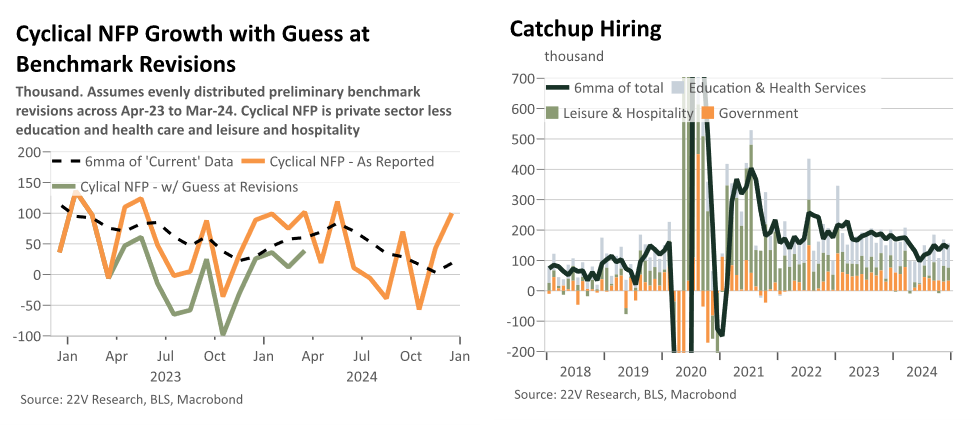
- NFP saw another continued month of strength in catchup hiring sectors (gov’t, education and health care, and leisure and hospitality) while other, more cyclical, hiring had its strongest month of gains since May ’24.
- The household survey was broadly strong across the board, with most measures of slack looking slightly firmer on the month.
- There is a chance that the some of the strength in Dec’s data is due to seasonal adjustment noise (the bounce in retail trade seems most suspicious), as we have seen in the jobless claims data, but the broader context is still solid if not spectacular. It is also worth remembering that next month will see substantial downward revisions to the level of NFP in March ’24 and likely some carryforward into the rest of 2024, as well as population estimate updates to the household survey.
- Wage growth was not soft enough to offset the overheating concerns, and general evidence that higher for longer rates may be necessary, which this data highlights. The burden of disproving overheating concerns will have to come from the inflation data as growth remains strong and, at least for this month, the labor market seems to be retightening a bit.
- In recent months, the dovish labor-market driven pull towards cuts has been fading and today certainly attenuates that further. Having taken care of the first 100bps of insurance cuts additional easing, if it happens, will be a result of underlying inflation still gradually moving down and a continued, if less urgent, pull towards neutral. That of course assumes the labor market remains healthy enough.
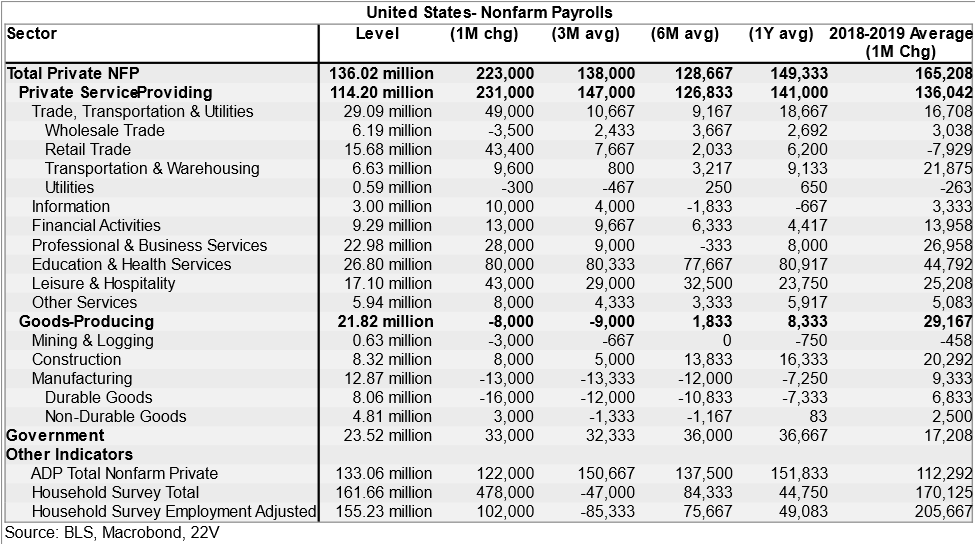
Non-farm payrolls growth came in well above expectations. This was a result of continued strong catchup hiring in government, education and health care, and leisure and hospitality. The strength of this catchup hiring over the past few years is one of the key forces which prevented the US from entering a recession when so many indicators suggest, and forecasters expected that outcome. Other hiring (‘cyclical hiring’) had its strongest month since May. This included an slightly suspiciously strong retail trade number (+43k) as well as the best white collar hiring print since May.
Perhaps the only really weaker bit of a data in the employment side was the soft manufacturing employment number. The sector has been in the doldrums for 2y so the gradual job shedding over recent months, taking into account the symmetric noise from Boeing and the port strikes, is not particularly surprising. This could become a larger risk if rates stay high and global manufacturing activity weak, but it seems questionable if manufacturing weakness alone could derail the overall outlook more than just change its composition, although the manufacturing cycle does matter for markets.
Wage growth and take home income both look solid and seem consistent with inflation running moderately above target but not so hot that the Fed is forced to really lurch hawkish again.
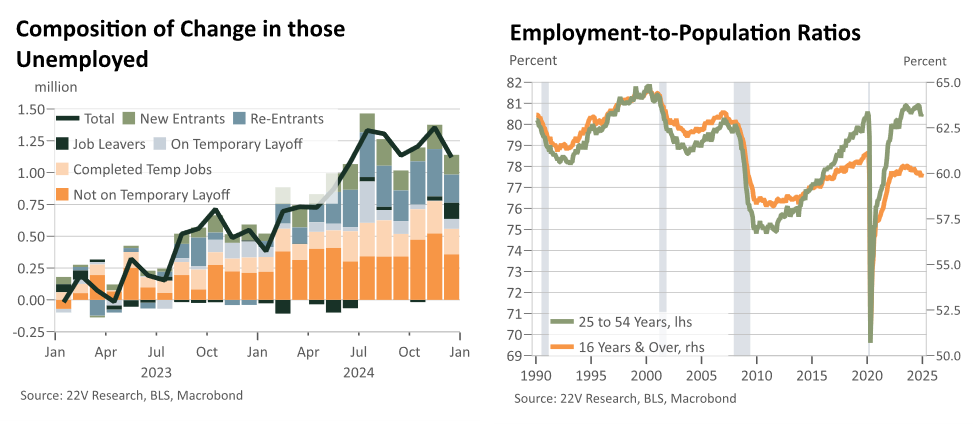
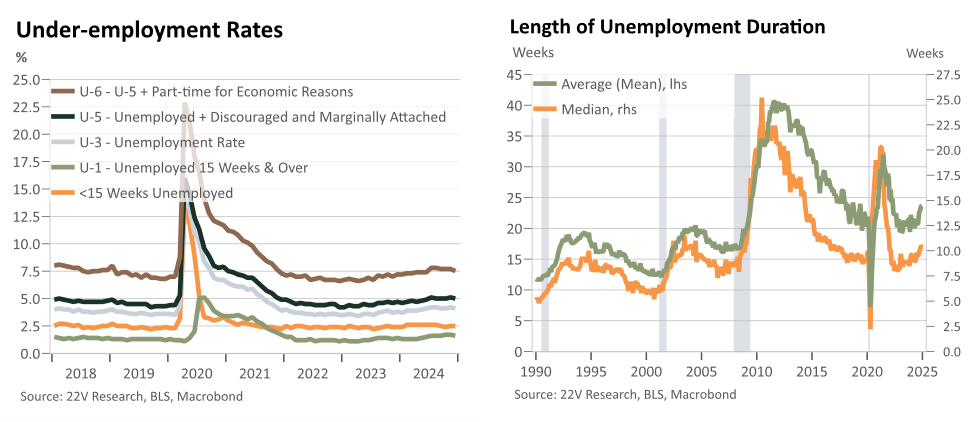
In the household survey, most measures of slack were a bit tighter, or at least not weaker, in December. This includes the drop in the unemployment rate and the U6 under-employment rate, the increase in the prime-age employment to population ratio, and a slight decline in the median duration of unemployment. The composition of those unemployed was also somewhat helpful with the number of worked on layoff, most importantly those on permanent layoff, dropping a bit and suggesting that relatively flat range that series has been in since the start of the year continues to hold (broadly consistent with continuing claims low single digit y/y growth in recent months).
The broad trends across data series have been towards gradual but linear and well-behaved easing of labor market slack. It will be interesting to see if the JOLTS data validate the message from the employment report or if they have a more ADP- and claims-like continuation of recent solid-but-not-spectacular trends.
In my base case, hiring levels will remain broadly steady in 2025 but the composition of demand will get somewhat better as catchup hiring fades and white collar hiring gradually starts to rebound. At the same time, immigration inflows slowing notably will reduce labor supply growth and eventually see slack start to stabilize and retighten some over the course of 2025. The key endogenous risks stem from the housing and manufacturing sectors, as well as the possibility than white collar employment growth, after an anemic few years, doesn’t start to reaccelerate as it very tentatively and sluggishly appears to be doing.