

December FOMC Preview: 25bps With a Few More to Come as Fed Upgrades Forecasts
- The FOMC will likely cut rates by another 25bps at their December meeting.
- The SEP forecasts will move in a hawkish-optimistic direction with a better unemployment rate and growth outcomes, and a slightly higher inflation path in 2025 (2024’s core PCE forecast will move up from 2.6% to 2.8%).
- The median dot plot will show 3x 25bs cuts in 2025, down from 4x, and with a notable chance of just 2x cuts as the median. This is a result of: a 2024 that saw more cuts than many envisioned in September, calls for easing only to a ‘more neutral’ stance, and the fact that policy levels will be getting close to some estimates of the long-run dots by mid-to-late 2025.
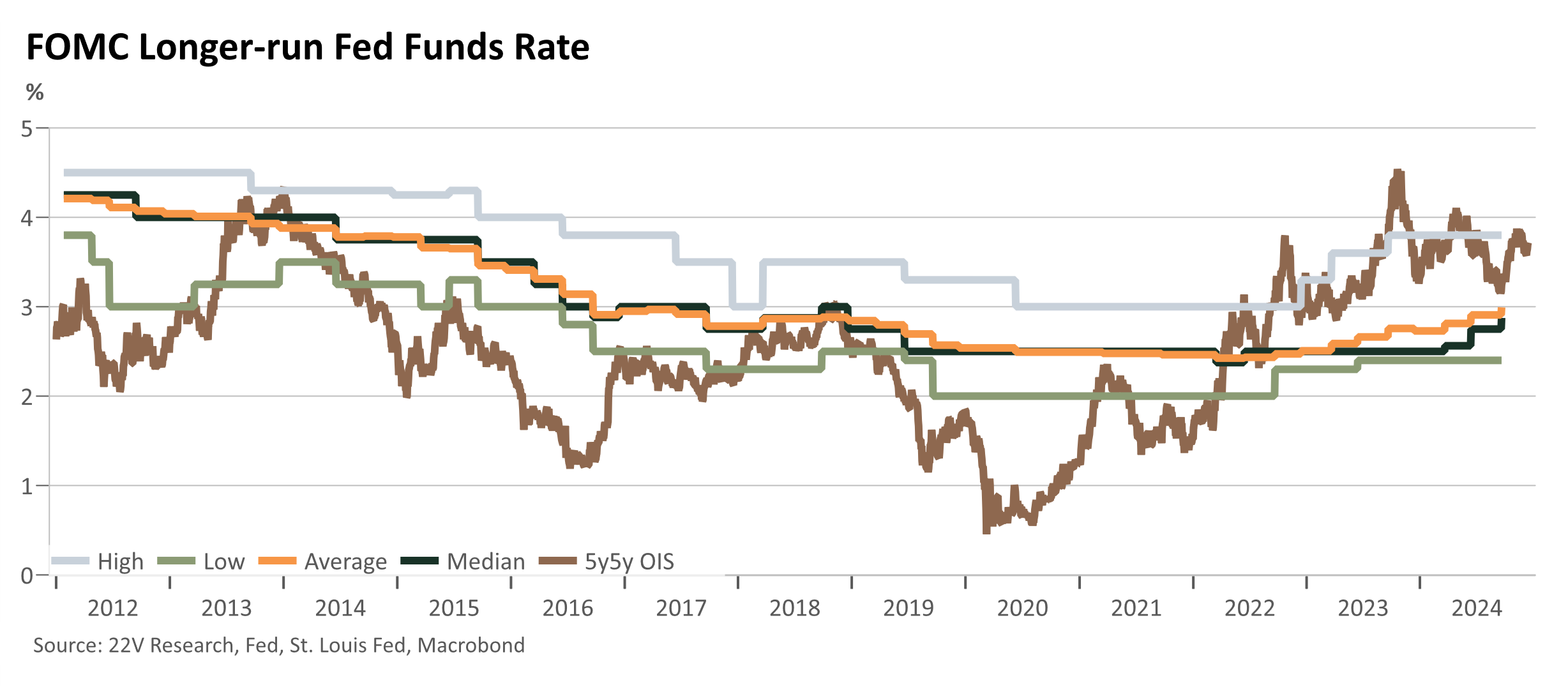
- The long-run dot may drift higher again as well as its gradual consolidation into an eventual 3-4% range, from a 2-3% range pre-covid, likely continues.
- Powell will note that while they are analyzing possibly tariff, immigration, and fiscal scenarios, currently Fed policy is being driven by the incoming data and the evolving risk balance, which has seen a notable reduction in left-tail labor market and growth risks since September.
- My own forecast remains that they will cut at the March and June meetings, although these are closer to 50% calls than 100%. The two 1990s mid-cycle adjustments, although likely with a modestly lower nominal neutral rate now than then and quite different geopolitical and trade backdrop, loom large as analogs.
Updating the SEP Away from the Labor Market Tail
Since the September meeting, the data have shown two important trends. First, the left tail in the labor market has failed to emerge in a sharp non-linear way, even most FOMC members are see a gradual easing in the labor market taking place. Second, the inflation data has moderately surprised to the upside. The levels seen have not been dramatically high, but they represent a challenge to the view that Q1’s inflation was transitory to the upside and the summer’s softness much closer to trend. The SEP’s economic forecasts will see a number of optimistic-hawkish (perhaps anti-dovish?) revisions:
- The core PCE forecast for 2024 will be revised up by 0.2p.p. to 2.8%. 2.9% is possible and was my tentative baseline until this morning’s PPI release, which took tracking estimates for November down enough to shift the cuspy rounding. The upward revision is a telling illustration of the Fed’s modestly too-optimistic forecast assumptions showing convergence in inflation to just above 2% from the next-month on even as the data itself keeps showing a bit more of an upside bias (2% as soft floor rather than the pre-covid ceiling).
- The 2025 CPCE forecast, and perhaps 2026, will likely tick up a 1/10th as well reflecting a bit slower pace of medium-term convergence and somewhat better than expected activity and labor market outcomes. There’s a limit to how much these forecasts can shift when the Fed says that the labor market is roughly balanced (strange but roughly balanced seems fair enough) and longer-run inflation expectations remain anchored.
- The unemployment rate forecast will likely tick down 0.2p.p. to 4.2% (it’s a Q4 average) in 2024. This represents a modest undershoot of the September forecast which had showed a gradual easing to 4.4% for both 2024 and ’25. This old path implied a likely short-term overshoot in 25H1 to 4.5-4.6% that would then see the labor market gradually start to retighten. Those same general dynamics are likely to continue to hold at a slightly lower level and seem consistent with recent Fedspeak on the labor market. 2025 will probably be revised down 0.1p.p., leaving a multi-year span with just a mild amount of slack.
- Growth for 2024 will be upgraded from 2.0% to ~2.5%. The September forecast always felt a bit too pessimistic and this upgrade better outturns since then and a handicapping of Q4 tracking estimates to the high-2s (GDPNow is at 3.3%). The Fed had been seeming to forecast GDP off of a medium-term trend of GDO (averaging GDP and gross domestic income) but with the substantial national account revisions after the September meeting, this convention imparts less drag to the near-term (the revisions also removed two of the main plausible causal pre-recession risks that had been in place in September). The 2025 and perhaps 2026 forecasts will each see a mild upgrade as well.
- Eventually the long-run growth forecast should move up as so much sustained forecast outperformance is hard to fully ignore even if there are some reasons to be skeptical of its full durability (this median has not appreciably shifted since hitting its post-GFC level of 1.8% in 2016). But there is also little to force the issue at this meeting given the limited near-term policy relevance and that the Fed may be looking ahead at another possible round of supply shocks which would dint short-run potential growth. The long-run unemployment rate, which is implicitly that consistent with inflation sustainable at target in the Fed’s framework (and not some vaguer notion of maximum employment without anchoring to the rest of the mandate) seems apt to drift a bit higher in the coming years.
2025 Dots Moving to ‘More Neutral’ Stance
The Dot Plot is likely to show notable revisions in 2025 as we (presumably) realize the final 4th 25bp cut of 2024. The median for 2025 is likely to shift up by 25bps, showing 3x rather than 4x 25bp cuts. The median is likely to be tightly clustered around 2-3x cuts in 2025 and 2 vs 3 as the median is a fairly close call. In September most of the 2025 dots were in the 3-3.5% range, now they will cluster in 3.5-4%, with some more dovish tail remaining.
These revisions reflect the realization of rapid cuts in 2024 (back in September 4 cuts was the median by a quite narrow margin and many were clearly a bit skeptical of the front-loaded 50), which pulled forward a number of participants cuts from 2025 into 2024, and because the labor market left tail has declined notably, reducing the need for further preemptive easing to stabilize it.
Since the November meeting, Fed officials have consistently noted a desire to get policy back to a “more neutral” stance. This has been used by speakers across the hawk-dove spectrum suggesting that barring a more appreciable deterioration in the labor market, most speakers view a modestly restrictive stance of policy (defined relative to a long-run neutral which is drifting higher and making a modest adjustment for slightly above target inflation) as the appropriate intermediate-term goal. From there, the data will hopefully present a more clear picture of where policy should head next.
The 2026-27 forecasts will be only minimally changed, mostly just reflecting any shifts in participants long-run dot submissions. 2026 could drift up 25bps higher as a bridge between 2025 and the long-run. These are far enough out that there’s little immediate market relevance for them and enough economic uncertainty, in both the true underlying cyclical sense and the post-election policy unknowns, that they should have little bearing on market participants interpretations of likely Fed actions.
The longer-run dots have been drifting up since mid-2022. Views on the neutral rate and its post-covid evolution, to extremize both perspectives a bit, seem to be on a spectrum between those most focused on broader financial market conditions and the recent positive surprises in overall activity data, and those basing their forecasts on perhaps less-distorted pre-covid estimates, rate-sensitive, as opposed to overall, activity, and truly secular drivers of rates in the long-run such as an aging population and slowing labor force growth. That second group seems to be losing numbers gradually as data keeps surprising to the upside and long and variable lags seem longer and less plausible as a new drag on growth. The supply-side gains in productivity and the labor force over the past few years could have been masking these lagged impacts, with the potential for them to bind more as short-run potential growth fades but that seems more risk scenario than base case at the moment.
Initially this drift higher in the long-run dot reflected the bottom-end of the distribution moving higher but since early-23 the top-end and average have been moving higher as well. The median has ticked higher at each meeting so far in 2024 and given the robust growth seen so far this year there’s little reason to think that there may be a shift again among the center of the Committee (the most dovish seem a bit stickier in their anchoring to truly secular long-running trends).
There is also a chance that the Committee tweaks the ON RRP rate, dropping it 5bps to the lower end of the fed funds target range. This was noted as a topic of an informational briefing by the staff and presumably subsequent discussion in the November Minutes. This would likely lower the effective fed funds rate at least a few bps (I defer to greater experts in money market funding mechanisms on whether it would see a full 1-to-1 passthrough but given that the IORB would not move that seems unlikely). This possibility could be inflating cut probabilities by 5-10% given that a ½ passthrough would represent a 2.5bp move lower in fed funds for a given policy rate.

