

We often hear from Team Biden about how much he has done to restore American manufacturing, primarily through incentives to capital spending. Such praise always strikes me as odd, because it seems to take as a given that Americans want to work in factories. My guess is that people have a misplaced sentimentality about the 1950s and associate that with manufacturing. When they say they want manufacturing back, what they mean is that they want not to have to worry about stuff generally, like in the 1950s that they imagine, probably wrongly. People may also miss American hegemony. I confidently expect to miss Pax Americana.
Looking back 50 years to when they looked back 20 nostalgically

Anyhow, the Federal Reserve updated its industrial production data on Friday, and it showed manufacturing output falling 0.5% in October, which represented a slight intensification of weakness from the 0.3% decline in September. “Under” Biden, manufacturing output growth has indeed recovered a bit from Covid on balance, but it remains about 3% below the peak achieved during the expansion prior to the Covid shock and about 10% below its peak prior to the Global Financial Crisis. Biden has not stoked a manufacturing Renaissance.
Alas, still benighted

Source: Federal Reserve Bank of St. Louis (FRED), NBER, FH calculations
Data are actual to October.
What Biden and the earlier Democratic Congress have done is provide incentives for American companies to invest in microchip manufacturing structures, via the CHIPS Act, whose acronym sounds like it was produced by a child. The H is for helpful. And it explains the boom in the BEA’s measure of overall manufacturing structures equipment capex shown in the left panel of the chart above. I do not have data on real spending in manufacturing structures specifically dedicated to chips, but nominal data to Q2 suggest about 75% of the gain in overall manufacturing structures capex has been in chips.
I assume that the reason that this is a win has something to do with defense priorities. We need a domestic source of chips for weapons and to protect the economy from a possible boycott from an enemy or an ally / neutral that has been somehow taken out of the game. That is beyond my paygrade, but it would seem to make more sense than the idea that creating space for more people to manufacture stuff is somehow a win for the youth.
Manufacturing structures capex has boomed
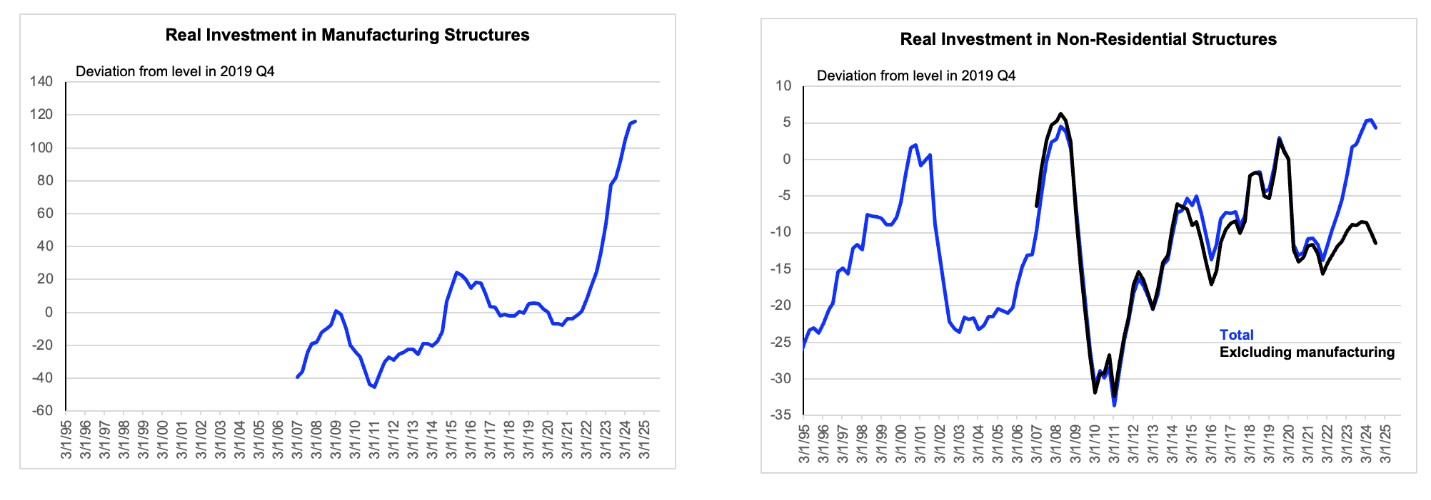
Source: BEA, FH calculations including chaining
Data are actual to Q3
A related question here, though, is why has manufacturing output growth been so weak for so long? On the official data, it has been two lost decades. I am not an expert in how the Fed puts together their manufacturing output data and nor will I become one. But I am a bit more familiar with how the BEA measures output in goods and structures, which is logically connected to manufacturing in the sense of making tangible stuff. The unit of account in such measures is effectively (indirect) utility measured through the real value that markets place on various forms of output. During the past ten years, real goods production has risen at an annualized rate of 3% on average. It took a header at the Covid shock and then bounced back very strongly and has done nothing of much interest since Biden became president, which is the win from the perspective of the economy itself.
Real output of tangibles grows more quickly over time than that of services, because productivity growth is higher in tangibles, entirely because of goods production. This creates downward pressure in the relative price of tangibles, which helps keep realized (relative) demand in line with the (relative) rise of supply there.
What is most striking is how little is going on here, now that the flow and ebb of the Covid shock has largely played out. The only interesting bit here might be that the manufacturing structures capex boom has probably played out, which may contribute to tangibles overall looking a bit sluggish relative to services for a bit. But it is not a major macro story. Despite the measurement issues here, a deep header in the manufacturing indicators themselves from here would be a macro story. It is just that there is no reason to expect one.
You won’t get these five minutes back. But I hope to have allowed you to waste them just this once.
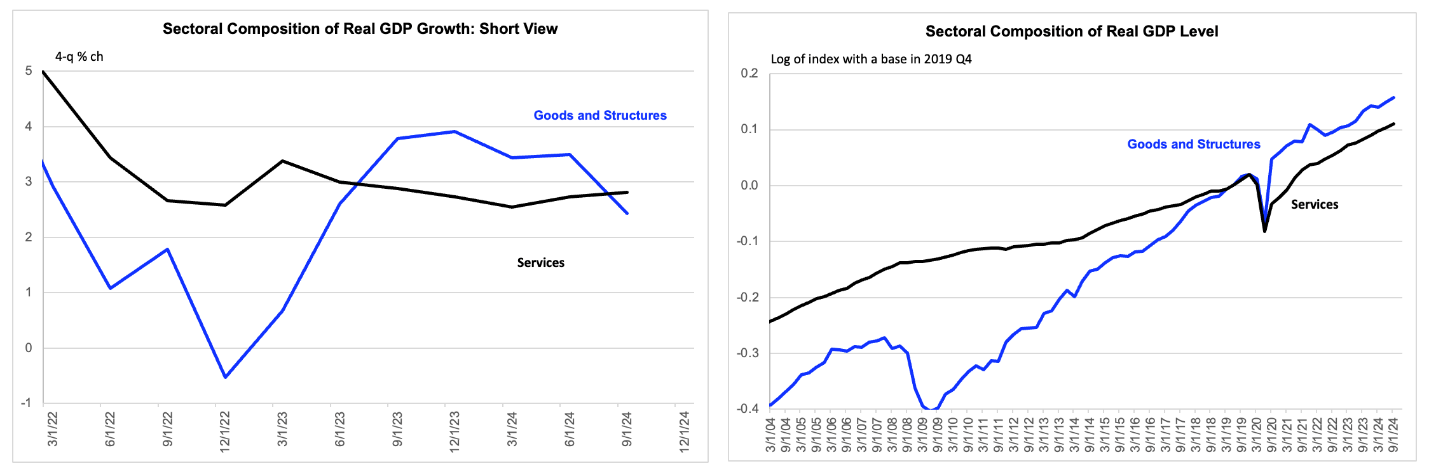
Source: BEA, FH calculations including chaining
Data are actual to Q3

