

While Pessimistic Headlines Abound, It Looks Like Delinquency Growth is Normalizing, Not Accelerating
- Consumer delinquencies have been rising since late 2021 and in some riskier and more discretionary categories they have surpassed pre-covid levels.
- A number of Fed speakers have mentioned this as a sign of policy tightening and a slowing economy, as well as a key possible recessionary risk.
- Research work by the Fed staff suggest that much of the current level of credit card and auto loan delinquencies is due to credit score migration during 2020-21 that allowed for greater than usual credit access by fundamentally weaker borrowers (especially once student loan payments resumed and fiscal stimulus ended).
- When looking at rates of change, rather than outright levels, the increases in delinquencies seems to have peaked over a year ago, roughly what the timing of the increase in jobless claims and fading fiscal stimulus might reasonably suggest, and are now growing only slowly.
- Recent bank earnings calls and other appearances suggest that management teams see a less pessimistic outlook than many, with most expecting delinquencies to taper off and perhaps even improve later this year and into next.
- Much like the gradual return to neutral of bank credit standards tightening, the normalization of consumer delinquency rates should help curtail a number recessionary concerns as they gradually stabilize from here.
Consumer loan delinquency ratees have risen notably since early-2022 and several measures are now at or above their pre-covid levels. This has been a cause for concern for many in markets and has been highlighted by a number of, generally more dovish, Fed officials in suggesting that there are clear reasons to be weighing risks to the employment side of the mandate as or almost as highly as the inflation side. While consumer distress is real struggle for those impacted, a clear downside macro readthrough seems less clear given the likely drivers of this consumer credit cycle and, according to many large banks and consumer finance companies, its expected stabilization and normalization over the course of 2024.
This cycle of stress is particularly true for auto and credit card loans. Among credit card types, the stress is much more apparent private label cards relative to the major issuer trusts (some banks mentioned may reflect selective distress on the part of consumers who will see less of an impact from falling into delinquency on a private label card versus a general purpose one).
The mortgage market, where post-GFC lending standards and high prices have combined to restrict access to credit, shows notably less stress. The delinquency rate on non-credit enhanced Freddie Mac mortgages continues to decline and that on Freddie mortgages with mortgage insurance (for those who put less than 20% down) has been flat or down in recent months.
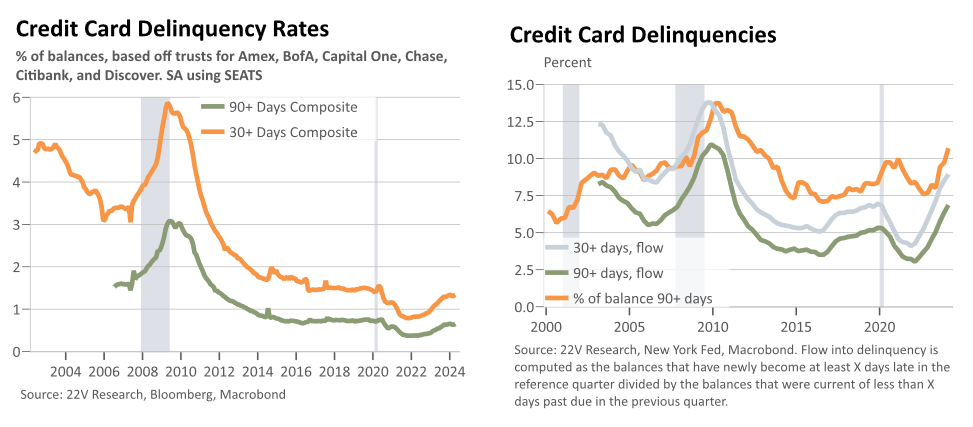
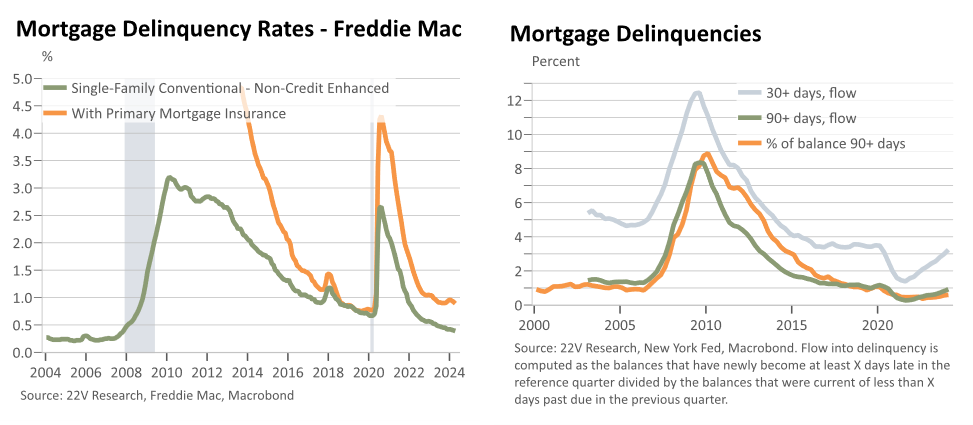
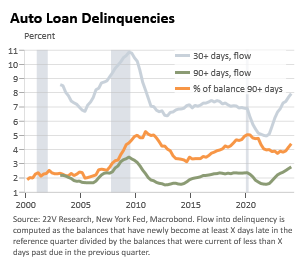
A number of Fed blogs have dived into this issue in recent months and provide a helpful analytic lens in analyzing the data.
- Staff at the Fed Board (see more here), highlight that much of the current stress most be seen as a natural impact as a result of the stimulus measures which took place in response to covid, “income support and forbearance programs led consumer loan delinquency rates to fall to near-record lows for borrowers across the credit score distribution.” These programs somewhat artificially (my word not theirs) boosted the credit profile of many borrowers and, as a result, “many consumers saw an in increase their credit scores sufficient to move out of the subprime category, and the share of borrowers with subprime scores decreased to the lowest level seen since the late 1990s.” This is especially pronounced for subprime borrowers who as a group saw an adverse survivorship bias. In the absence of this credit score drift, the subprime delinquency rate on credit cards would be below its pre-covid levels while the near-prime rate would very close to inline with pre-covid (similar results hold for auto loans). They do not dive into how credit extension based off inflated credit scores has impacted overall delinquency rates but it likely plays an important general equilibrium role given that higher score and income borrowers would have likely seen their limits enlarged at, ex post, suboptimal times.
- FRBNY staff (here) note that, “for all debt outside of student loans, delinquency has been steadily rising since the fourth quarter of 2021 after historic lows during the COVID-19 pandemic.” The weakness in delinquencies has been especially concentrated among borrowers who have high credit card utilization rates. The share of borrowers who have maxed out on their credit cards is now back to pre-covid levels but the share of those borrowers transitioning into delinquency is well above pre-covid levels; in other words, among weaker credits there is more distress, a story which fits well with the Board staff’s findings above.
Taken together these findings from the Fed seem consistent with evidence in the hard data and corporate commentary that lower income consumers have been a source of relative weakness in recent months and are currently under some pressure. It is important to remember though that household balance sheets remain the healthiest they have ever been (excluding the immediate aftermath of covid) and that the bottom 60% of wage earners account for only 39% of consumer spending so we should be hesitant in extrapolating that weakness too far.
These facts seem to jointly point to a credit extension and delinquency cycle which was driven by stimulus, loan and rent forbearance and repayment pauses, and extremely rapid lower income wage growth. With all those largely in the past, consumer credit conditions are normalizing with some payback for a bit of the ‘excess credit extension which took place because of income, balance sheet, and credit score drift in 2020-21. The timing of the peak in deal disposable personal income and the 6-12m lag to increasing delinquencies requires relatively little explanation.
As a base case, I continue to think the US economy is working through a period of high rates digestion and post-pandemic bullwhips rather than heading into a recession. Over the past few years the US economy checked off many of the usual pre-recessionary signals due to sectoral bullwhips and reopening without ever entering into a recession and is messily returning to a new normal, which means there are more spots of relative strength and weakness across the economy, rather shifting into outright weakness.
The May personal income data seem consistent with this point given that is hard to see too much weakness in overall economic performance when aggregate wages and salaries growth is printed at an 8.5% m/m saar pace in May and 3, 6, and 12m saar paces of roughly 5-6%. Tracking estimates for Q2 GDP around 2-2.25% at the moment suggest that
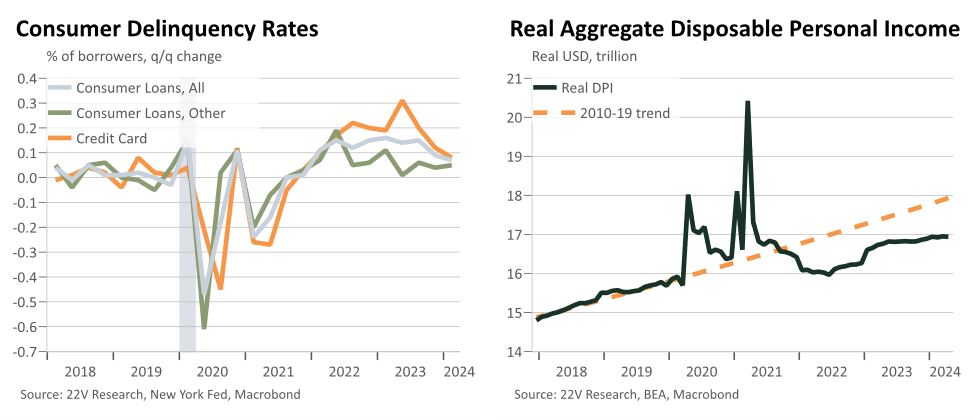
Banks Suggest Slowing Normalization, Not Outright Deterioration
When reading through recent bank and consumer finance company earnings reports and calls I was struck by the broadly positive tone heard from them. The 2022-23 peaks in the rate of change in charge offs (happening somewhat later for credit cards than other consumer loans) aligns well with the senior loan officer opinion survey results. While not yet back to neutral levels, the SLOOS has shown a gradual trend towards normalization since peak tightening in early 2023.
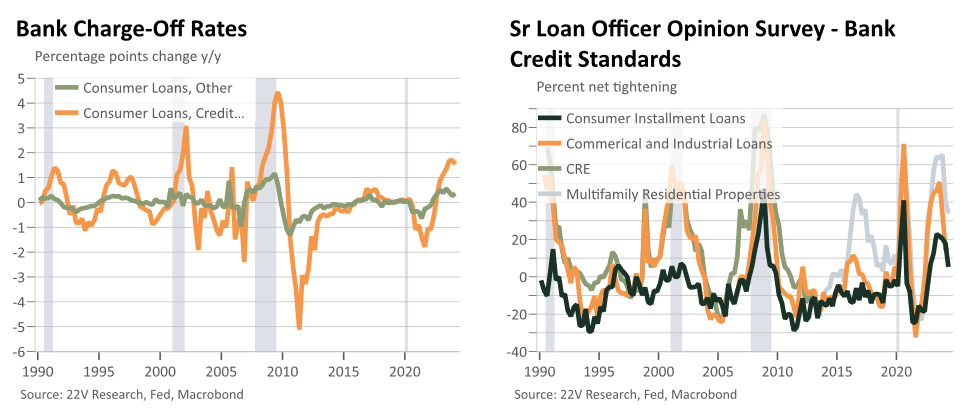
In recent earnings calls and other corporate events US banks and consumer finance companies broadly suggested that while delinquencies are still increasing the pace is slowing and is, broadly, expected to plateau or fall in the latter part of 2024 or into 2025 (italics below are my own).
- “I feel really good about the credit situation, delinquency rate… So you’re right that I’ve been making comments about you should expect this write-off rate and delinquency rate to tick up a little bit over time. But we’re starting from such a low number of 2.1% debt, we’re still going to be like best-in-class.” – American Express, 6/12/2024
- “I think, we said we thought our credit metrics would peak in the second quarter and we believe that’s true, and then we actually may see some modest improvement. So, we said non-accruals, levels of charge-off, criticized and classified loans would peak in this quarter.” – Regions Financial Corp, 6/12/2024
- “I think the bulk of the consumer portfolios at this point have normalized…So, I think for the most part, we feel like a lot of that has normalized… I would expect our charge-offs quarter-to-quarter to be relatively stable.” – Truist Financial Corporation, 6/11/2024
- “Importantly, as we see – look at delinquencies, both early and late stage, they’re flattening, and that’s a positive. So we – they were sloping up to normal. We weren’t sure what would happen when they got to normal. And they’re flattening, which is a positive sign.” – US Bancorp 6/11/2024
- “Delinquencies are declining, which is in line with the narrative that we shared with folks where losses in the back half of the year will be lowered than the front half of the year, and you’ve kind of seen that peak really in April. And if you look at the delinquency trend for the last three months, I think people should get more comfort in the trajectory of net charge-offs as we move forward.” – Synchrony Financial 6/10/2024
- “But underlying consumer delinquencies stuff, they’re basically stable, they are stabilizing and tipped back down. And that was a key to say, this is normalizing, not a trend.” – Bank of America, 5/30/2024
- “The increases that we’re seeing in terms of delinquencies continue to look like they are very much on top of the performance that we had seen pre-COVID. So a more return to normal. There is a clear differentiation in terms of the health of the consumer between those that are more affluent and those that are less affluent.” – Wells Fargo & Co, 5/29/2024
- “In card, as we anticipated, delinquency formation is improving as more recent vintages season. The 30-plus-day delinquency rate was down 4 basis points versus the prior quarter.” – Discover, 4/18/2024

