

The January employment report and benchmark revisions were clearly very strong. More broadly, the recent data flow has been too: Q4 GDP came in at 3.3%; the Atlanta Fed’s GDP Now for Q1 is at 3.4%; the recent ISM and S&P PMIs seem to have troughed and may be bouncing (more here); personal income and wage data look fairly strong, if off their cyclical highs; housing appears to be slowly coming off its bottom; and, despite frequent headlines, layoffs appear to be contained.
Despite all this, recessionary concerns have been extremely difficult to shake. Some of this naturally comes from the non-linearity of recessions and the US’ mid-to-late cycle position. This is accentuated by the asynchronized nature of the different sectors of the economy, which elevates dispersion among economic data and makes finding pockets of potentially leading weakness easier.
Economic surprise indices, which only capture surprises relative to day-of consensus rather than 1-3m out which which would show medium-term cyclical outperformance more clearly, have persistently positive for most of 2023 and have turned up a bit again to start 2024.
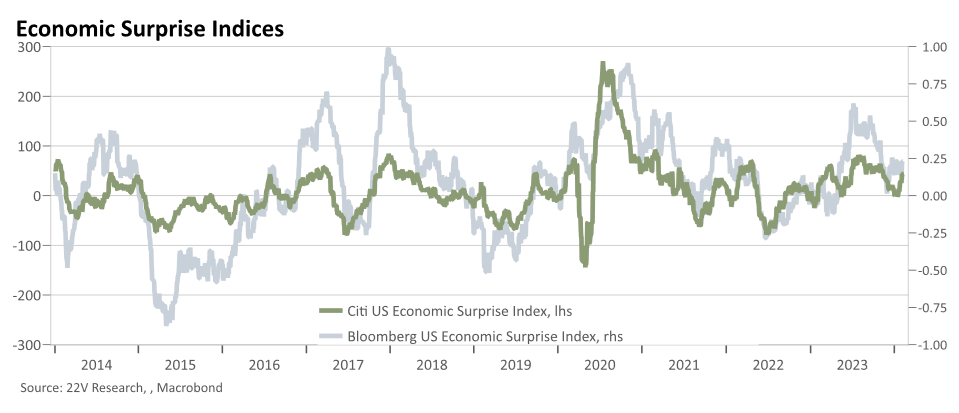
My own view has been that we effectively had the recession, or all the things which would have usually caused one (real estate downturn, manufacturing hit, banking crisis, and hits to white collar and financially speculative sectors), but skated past thanks to the services spending and hiring boom, fiscal policy, and the extra breathing room high nominal income growth gave firms and households. I was most concerned about this impacts spiraling into an actual recession in late-22 through early-23. This isn’t to say that weakness or recession is impossible going forward but that this cycle is profoundly different from any recent ones and rigidly using frameworks from the past 20-30y has not been particularly helpful at a macro level. The Fed likely needs to ratify some of the easing priced into markets to maintain the cycle from here but just how much easing is ultimately necessary will be driven growth and labor market outcomes and how broader financial conditions react to the Fed, rather than anchoring to a 2019-like world.[1]
Around the turn of the year, I thought that there was a notable risk that with slowing underlying growth, or at least slower than it had been, and increasing data dispersion we would get a clunker print or two from one of the main data releases, catalyzing a kneejerk move lower in rates. This possibility also raised my odds of a March cut on the margin as the Fed would shift towards dovish risk management if labor market concerns became a bit more acute. Ultimately though, I thought any near-term weakness would fade as the cycle’s solid underlying momentum reasserted itself.
Clearly this risk hasn’t come to pass.[2]
While the amount of penciled in forecast weakness has lessened over time, it continues to be the main feature of the BBG consensus outlook.[3] Currently it is not a recession so much as a ‘sustained period of below trend growth,’ which is historically quite rare (especially as we already had this in 2022H1).
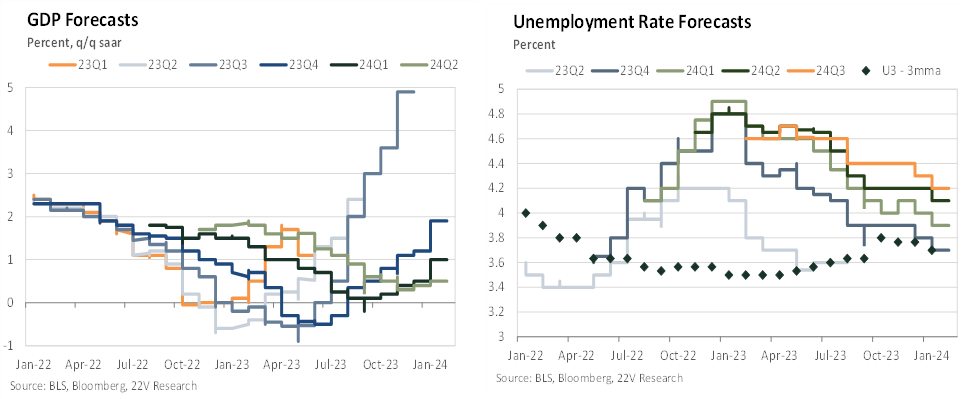
This begs the question of why has consensus been so persistent in its expectations of weakness when the data has held up remarkably well?
I see four main forecasting anchors/heuristics (which are not independent of one another) which have contributed to this negative forecasting bias over the past 18-24 months and are important to flag as potential sources of upside risk for consensus and, to a lesser extent, the Fed in 24H1.
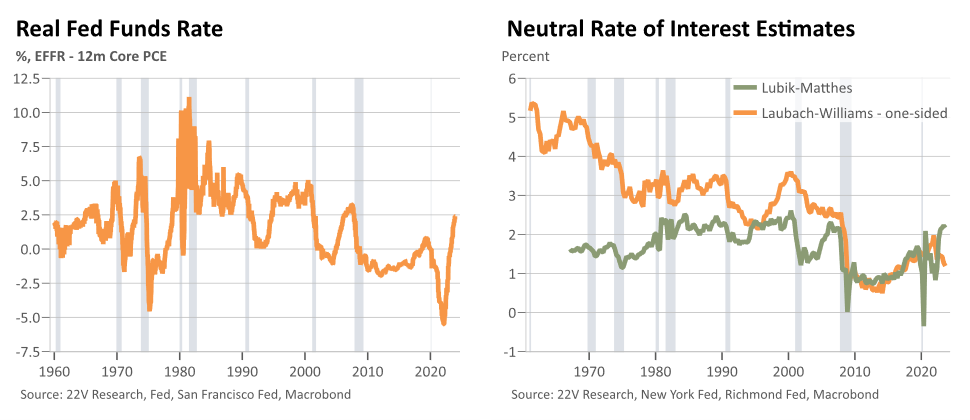
- High spot real rates mean the Fed is increasingly restrictive and this will weigh on activity. This is the way economic theory tends to describe the impact of monetary policy on the real economy (perhaps with a lag or two on real rates) but it is a theory which is somewhat challenging to get the data to support in modern times (financial conditions were less anticipatory and Fed officials less communicative historically, so modeled FCI impact generally look roughly unchanged even as they have fallen for official policy rates). Much of this debate (same with the lags one below) boils down to how much you think rate levels or rates of change (whether relative to a moving average or period-by-period shocks) are the most important driver of growth.
Implicit in this view as well is usually an anchoring to pre-covid level of the neutral rate (r*), which I think is simply impossible reconcile with the overall growth and employment outcomes we have seen since then at anything like a policy-relevant horizon (how much an infinite horizon r* hasn’t moved doesn’t matter much if forces which are persistent across the cycle but perhaps not permanent are moving it around).
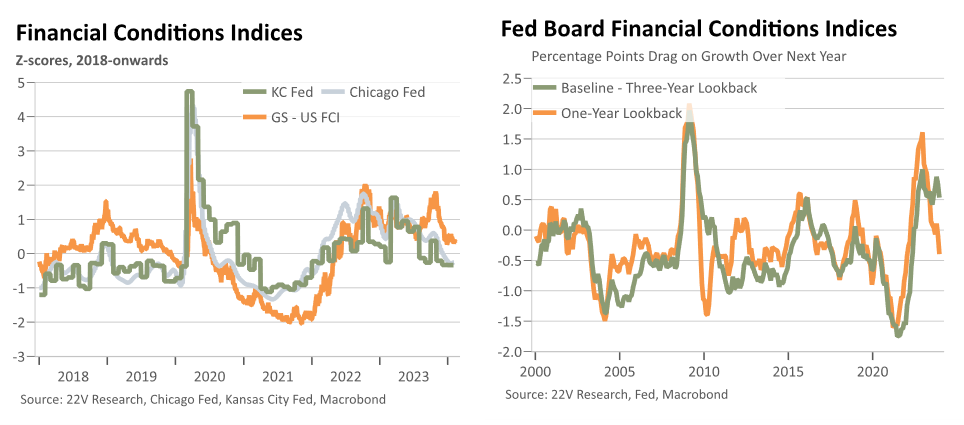
My prior research experiences made it clear just how challenging it is to get economically significant coefficients on real rate levels or real rate gaps to neutral. FCI measures, or things as simple as the VIX or SLOOS, tend to do a much better job explaining shocks to growth or unemployment and so I focus more on them and the feedback from fed policy into those measures rather than outright policy rate levels (the idea is that we want to explain the shocks to activity beyond general mean/trend reversion and these shocks to be very heavily left tailed, which lines up well with spikier FCI measures). This isn’t to say rate levels don’t matter but they matter less than many tend to assume and exhibit more of an low drag than an acute cliff-like impact on growth. - Long lags mean that the risks from high real rates may just be beginning to bite. Most studies which find year+ long lags for the peak impacts of policy shocks on growth are discussing the impacts on the level of activity rather than the rate of growth. This seems much less controversial given the way a reasonable small drag could cumulate over time but has become a dogma in its own right. Both more standard FCIs and the Fed Board’s growth scaled ones suggest that the peak impact on growth is likely behind us and starting to normalize. The Fed’s 1-year lookback FCI implies that financial conditions are now supporting growth (a bit extreme of a view I think but notable nonetheless) while the baseline version suggests a 50bps drag, which is the bottom of its range over the past 18-months.
- A recession is just inevitable given where we are in the cycle, so prudence requires at least partially writing it down. This view assumes a certain inevitability to recessions rather seeing them as a result of shocks propagating into broader weakness. Now, reasonable forecasting does require elevating one’s recessionary odds relative to normal because of the mid-to-late cycle position we’re in but that’s substantially different from calling for a recession outright just because the unemployment rate is low or the yield curve is inverted.
- Inflation was largely demand driven so the Fed will have to break things. This view has fallen out of favor some given the rapid progress in inflation’s decline over the past 6 months and the return of supply recovery discussions to the Fed’s base case. Going forward this means that the Fed will have some ability to respond to downside weakness, if it appears. The legacies of high inflation, the structural shifts in the economy post-covid, and the risk of further supply shocks all attenuate this relative to 2019-20 but that doesn’t mean there would be no response forthcoming, it will just require balancing between the two sides of the mandate.
This assumes that inflation is largely near-enough-to-target going forward. Of course, if inflation reanchors higher than target-like levels, >2.3-2.5 in my view, the Fed will have to continue further tightening policy or at least lean substantially more hawkish than current data suggests. ↑
There may be some residual or abnormal seasonality issues post-covid but these are not strong enough to negate the broader points on the strength of the data relative to 3-6m out expectations and the seeming broadening out of growth to some of the sectors more obviously hit by the bullwhip and rates cycles. ↑
Consensus (ECFC on Bloomberg) has Q1 and Q2 GDP growth forecasts at 1.
1and 0.5% q/q saar with a q4/q4 forecast of 1.0% for 2024; the Fed’s December SEP (a bit outdated by now as Powell effectively admitted) had a 2024 growth forecast of 1.5% (and a 2023 one which was 50bps below the outturn as well). ↑

