

The US economic data have generally come in stronger than expected during the past several months, including over the past several weeks.
My favorite index for measuring economic surprise is the Goldman Sachs MAP, because it focuses exclusively on real side[1] indicators and includes (admittedly subjective) real time adjustments for this or that technical factor. Moreover, the Goldman index is available as the simple underlying daily observations, rather than (just) as an accumulation of surprises within a fixed rolling window that the street tends to prefer, and which obscures. what the data have actually been doing recently.[2] With the underlying daily data, we can create a level index defined as an ever extending (no window) accumulation of daily surprise over time. When that index is rising, the data are beating, and vice versa. And the reader is free to impose whatever observation period they prefer, avoiding the inherently arbitrary “signals” from the imposition of an arbitrary fixed window. With that in mind, you can see from the chart below that the data have recently been beating.

Data are actual to February 5. Goldman apparently imposes a brief reporting lag.
The failure of the GS accumulation to plunge around Covid is interesting, but it is not something I have investigated. Maybe the real time data moves the screen consensus before each release?
This has been reflected in a meaningful repricing of the Fed outlook to scale back expected rate cuts during 2024. But financial conditions have not tightened in response to this, because risk asset prices have generally been strong. And I would say that, in turn, reflects that markets recognize that the case for the slightly more hawkish rates outlook is that demand growth must be contained, not the inflation situation has itself deteriorated. Indeed, last week’s Atlanta Fed Wage Tracker confirmed that the measured acceleration of wage growth in the January employment report was noise.[3] If anything, then, the speed limit imposed by the Fed on economic growth is becoming slightly more generous. So, for any given path of the funds rate, it might make sense for risk asset prices to be higher. This would not be the case if the problem were a re-emergence of hot inflation data.
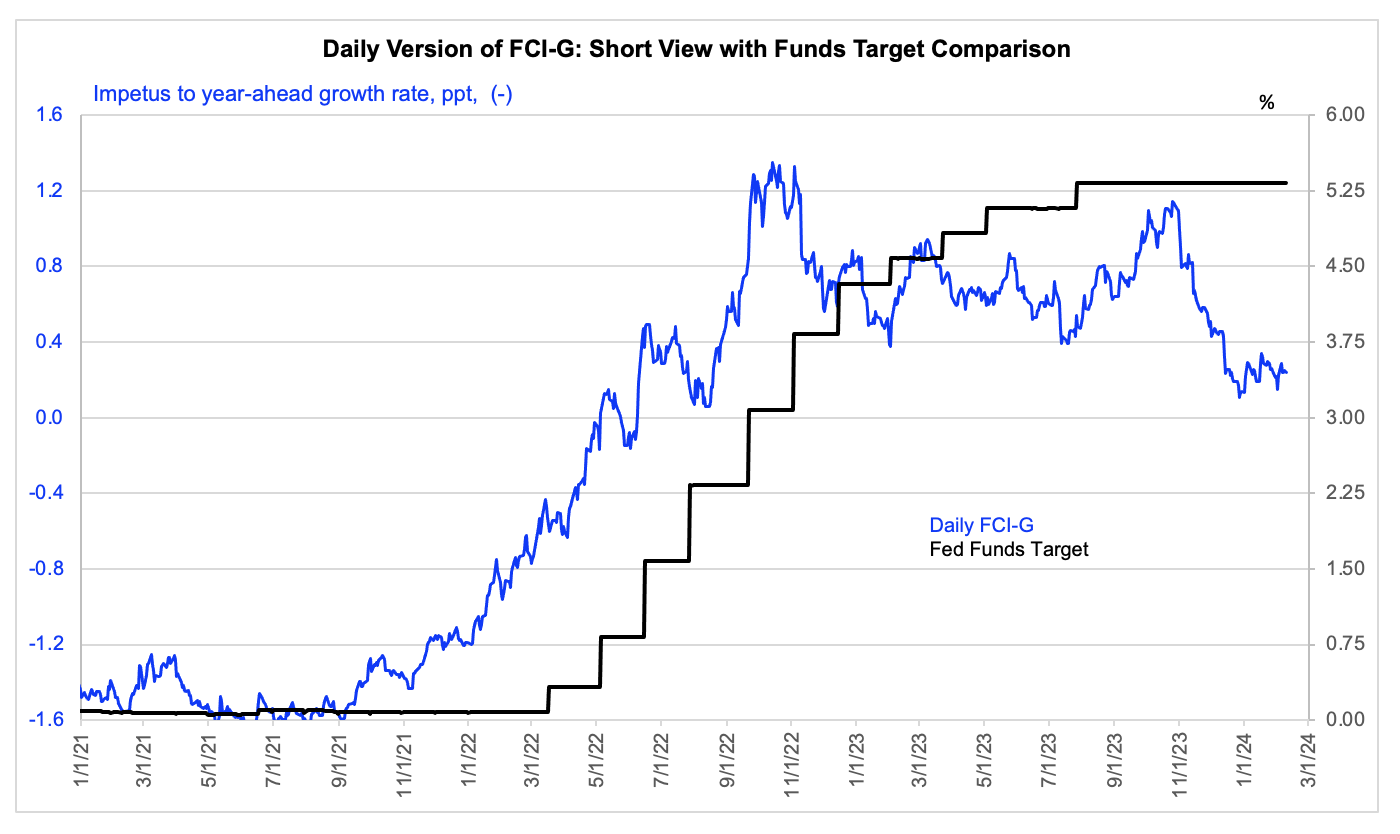
Data are actual to the Friday close.
But the implication of this is not that financial conditions can stay easy. At the end of the day, they have to go to a level that the Fed judges is consistent with the Fed’s own objective for demand growth. And while it is a near call, that probably involves some tightening from here. And that may explain why the drumbeat from the Fed has recently been so loud on the theme that rate cuts are likely to be limited and possibly delayed relative to what markets even now think. My suspicion is that the Fed is trying to nudge conditions a bit tighter, without actually delivering a final rate cut, for reasons I have been over in recent notes.
If I am right, then this is a coherent story. The only fly in the ointment is that the Fed is not actually guiding on rates. Indeed, away from the effective lower bound on rates, guidance is logically incoherent, because it reduces Fed flexibility without relaxing any constraint on the Fed’s ability to deliver the desired stimulus (or restrain) in real time, for the simple reason that there is no such constraint. (Such constraints apply asymmetrically, and uniquely at the effective lower bound on rates.) So, we can trust the Fed rhetoric about as far as we can trust the run of strong data. I don’t see much point in saying more than this until I see the price data for February and the retail trade report.
[1] Other surprise indexes include price data on the grounds that they can affect the central bank outlook and thus rates and currencies. There is a case for that, but I prefer to know exactly what I am looking at.
[2] When a rolling window is imposed, base effects inevitably obscure why the index is moving. Was it strong data dropping out or weak data coming in. It is impossible to see without referring to the underlying data, which defeats the purpose of an index. Geometric weighting can mitigate this issue, but it cannot eliminate it.
[3] Leaving aside its recent oscillation, I think wage growth is too high and is a good reason to expect the Fed to delay easing. But that is a separate discussion from how the market itself processes economic news, as I have been emphasizing.

