

2024 is rightly considered a super election year with both Europe, the United States and India going to the polls. It is erroneous, however, to believe that this implies a high risk of major political upheaval in Europe. In contrast, if anything a relatively high degree of political continuity is – for better or worse – the most likely outcome for Europe in 2024.
First, European elections are for the European Parliament which has only partial co-decision power over some policy areas in the EU. At the same time, there are no elections in any of the major EU members scheduled in 2024, immediately lowering the potential implications of elections in the EU this year. Indeed, the only national election in a major European economy in 2024 will be in the UK, where the opposition Labour Party is projected by virtually all polls to win a landslide victory. Yet a Labour victory in the UK would if anything represent a rejection by the British public of the increasingly populist platform of the governing Conservative Party.
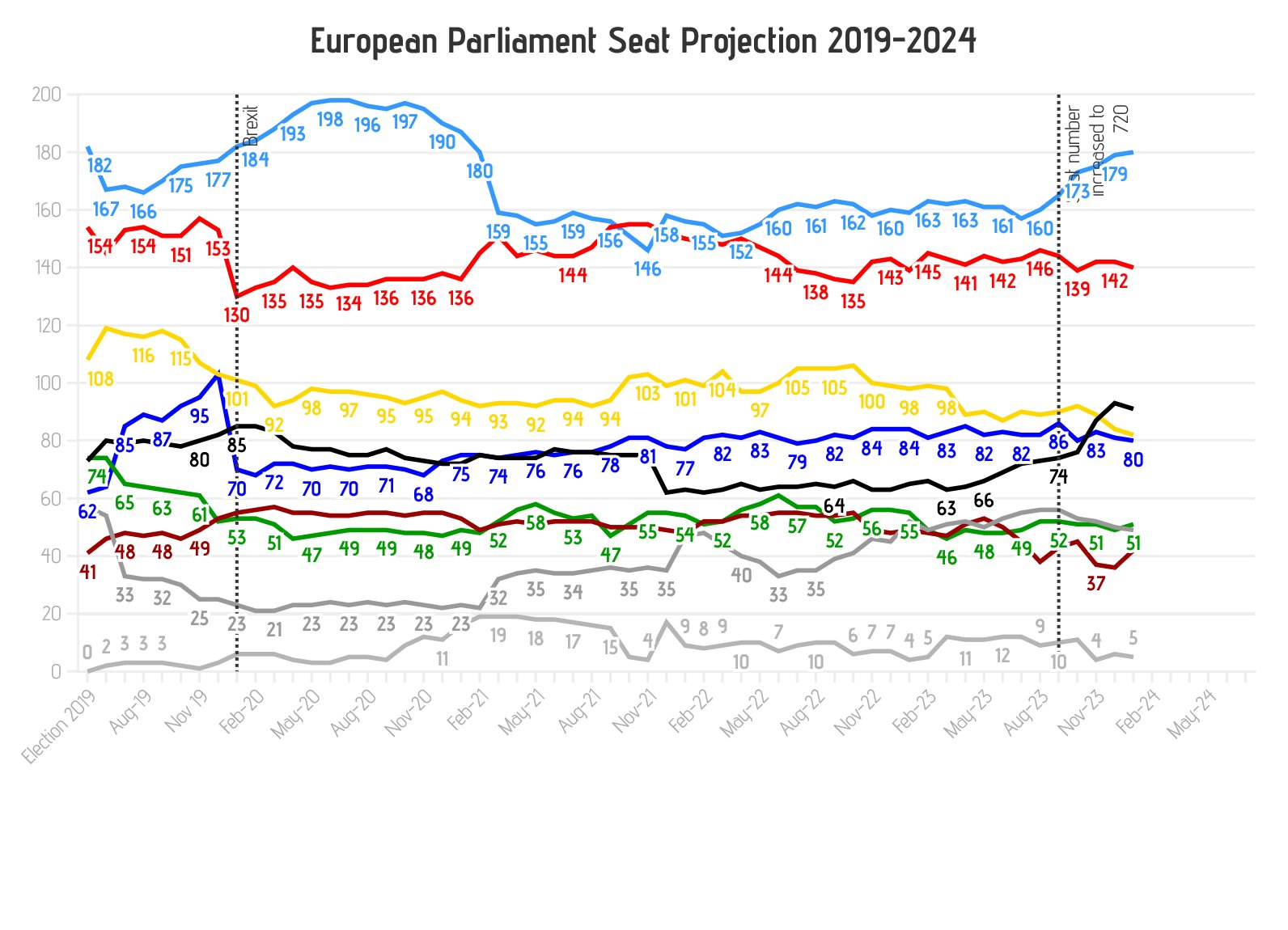
Polls further indicate that the new to be elected European Parliament will not see a huge increase in rightwing nationalist anti-EU members. Figure 1 shows how the rightwing political groupings in the European Parliament (ID Black Line and ECR Blue Line) will gain only a relatively limited of seats compared to the post-Brexit situation in 2020 (when UK members of the European Parliament left).
Figure 1: European Parliament Elections, Projected Seats by Political Group.
Source: Politico, 22V Research
Figure 1 further shows how polling indicates that the traditionally dominant center-right (light blue) and center-left (red line) groupings will remain the two largest in the new European Parliament. Combined with the liberals (yellow line) and greens (green line), the “center in European politics” is therefore overwhelmingly likely to hold also at the 2024 European Parliament elections.
The principal political change is likely to be the emergence of a far-right grouping as the new parliament’s third largest group, depending on precisely how national rightwing parties group themselves at the EU level. This though is unlikely to immediately impact the complicated process of distributing the top positions at EU institutions after the elections, as the centrist groups with the majority are likely to keep the “spoils to themselves”. It has further to date proven difficult for different rightwing groupings each with their own nationalist orientation to effectively collaborate at the EU level. Given deep disagreements among them on issues like Ukraine – strongly supported by the rightwing in Italy and Poland, but not in France and Germany – or fiscal policy, where Northern members typically want less EU-level spending and Southern ones more, this inability to form a single coherent rightwing block is likely to continue in the next Parliament. While aspects of European policymaking will become marginally more time consuming after the election, the basic point for investors is that the EU continues to function more or less as it has to date. Barbarians are not at the gate of Brussels and Strasbourg in 2024.
Most consequential politics in the EU however remain, if not local, then at least at the national level. As noted, there are no elections scheduled in any of the major EU members in 2024, though national parliamentary elections will be held in Portugal (March), Belgium (June), Croatia (July), Austria (September), Lithuania (October) and Romania late in the year. From these, several changes in coalition governments are likely, but only in Austria does polls suggest that the far right in the form of the Freedom Party FPO is likely to emerge as the largest party. Austria in other words represents the biggest risk of another right-wing leader taking the reins of power in an EU member in 2024. In Belgium, the election is likely to see a renewed focus by especially Flemish rightwing parties on the possible breakup of the country in to its French and Flemish speaking regions. This though, is an ultimately immaterial risk, given the complexity of actually implementing a French-Flemist divorce in Belgium.
2024 further has one major outstanding national government formation from elections back in 2023 in the Netherlands, where far right leader Geert Wilders has not yet managed to secure a parliamentary majority coalition government. Indeed, this outcome seems increasingly unlikely, as the two main center-right parties – the VVD (of outgoing Prime Minister Mark Rutte) and the new NSC – have now indicated that they only wish to support a Wilders premiership on a case-by-case basis outside a governing coalition. This in turn suggests that the VVD/NSC reserves the right to withdraw support for a Wilders minority government at any moment (but preferably from their point of view only after Wilders’ populist appeal has been possibly dented by his time in office), setting up future early elections in the Netherlands.
Lastly, the issue of possible unscheduled early elections in the larger EU members in 2024 presents itself. The German Ampel coalition is doing very poorly in the polls. It is though, it’s very political weakness and not least the possibility that the liberal FDP would fall below the 5 percent threshold for representation in the Bundestag, that is likely to make it the least bad political strategy for the three coalition members to stick it out together. Given how rare early elections are in Germany, it is moreover likely voters would further punish the party responsible for such an outcome. The German coalition is hence likely to be held together by its own weakness through 2024.
In France, President Macron has already lost his parliamentary majority and has the political capacity in the French constitution to force key laws through parliament, so while France may see more appointed Prime Ministers, early elections are extremely unlikely in 2024.
Fortunately for Europe, the country in which domestic political stability is most important for also financial stability, namely Italy, is also the country with arguably the most stable politics in 2024. Giorgia Meloni continues to dominate the Italian political stage, with no material domestic challenger in sight. Meloni has, however, initiated a risky process to change the Italian constitution to among other things also include a directly elected prime minister. This process may in time severely blunt her political dominance, but this is not likely to happen this year.
Poland has just had elections and a new government in late 2023, and prime minister Donald Tusk will, apart from approaching presidential elections, not face any domestic political electoral threat in 2024. Lastly in Spain, the rejection by the Catalan separatists of a recent amnesty law regarding crimes against the Spanish Constitution committed by Catalan nationalists during an aborted independence referendum in 2017 casts doubts about the sustainability of the thin parliamentary majority of Socialist premier Pedro Sanchez. At the same time, current polls does not suggest early elections would change the fundamental electoral math in Spain, namely that the center-wing PP and far right and “anti-regionalist” Vox party would not get a majority in parliament, while the center-left PSOE of Pedro Sanchez can only find a majority and govern through reliance on the far left and virtually all Spain’s regional parties. Meanwhile, the Spanish economy is right now performing well, with strong permanent employment growth and fiscal inflows from the EU NGEU recovery fund. As Sanchez has moreover decentralized the administration of many of the NGEU funds, regional governments (and with that their allies in the Spanish parliament supporting the government) have resources at their disposal, making it unlikely that they will have a political interest in seeing the government fall. All told, while Sanchez remains the most exposed large EU member state leader in 2024, he is likely to remain in office.
In sum – election and related political risks are abound in 2024, though not really in Europe.

