- Today’s release showed strong data overall for January and a set of revisions which substantially attenuate some recently developing signs of pre- or early-recessionary weakness that the more pessimistic/dovish had been leaning into.
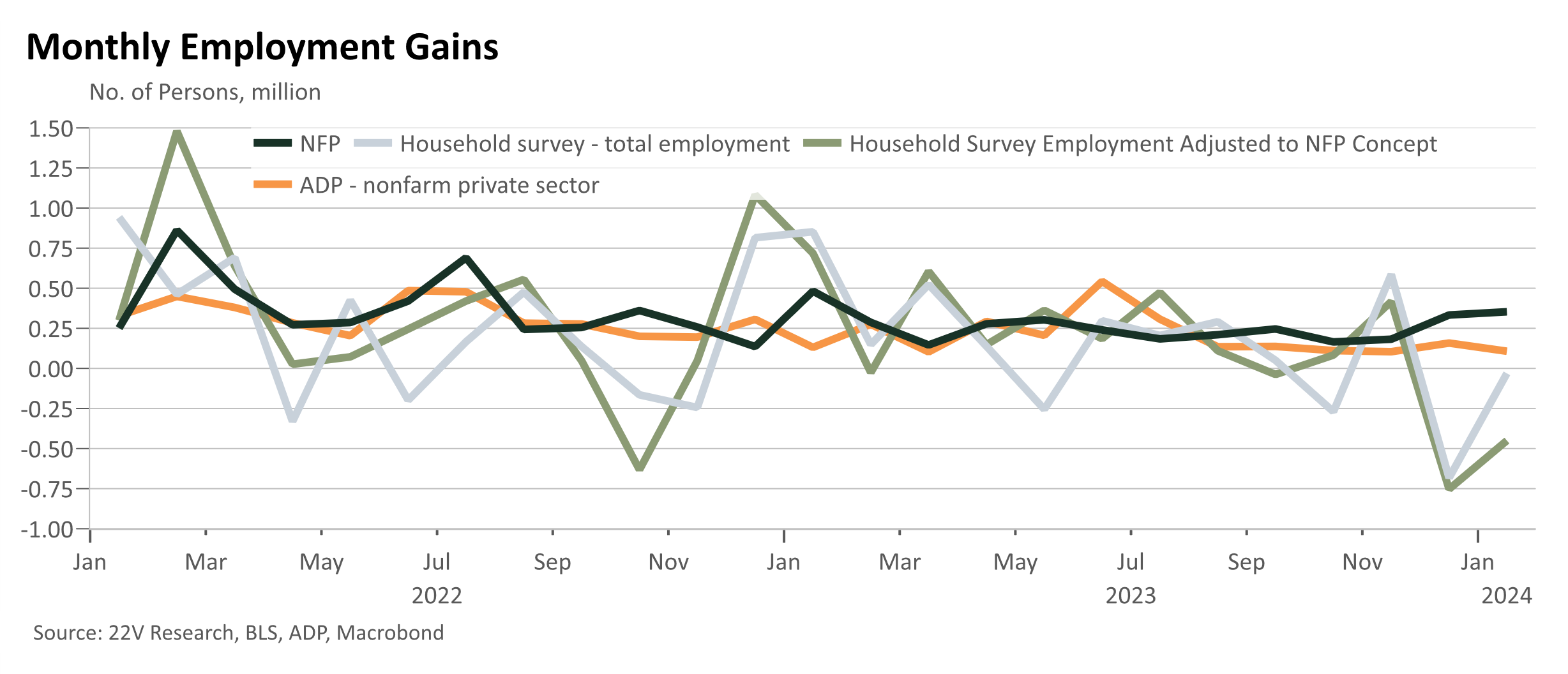
- The household survey remains notably weaker over the past few months than does the employer survey, which remains somewhat challenging to parse, although there have been fairly substantial gaps open up between the series before so I give it some but not too much weight.
- I suspect that the Fed’s access to the underlying ADP data allowed them to have a fairly high conviction that these revisions, and the December and January numbers specifically, were likely to tell a story of increasing strength into the end of 2023 and allay concerns about an emerging recessionary tail. More on this at the bottom of the piece.
- While the market is trading this as a policy shock (with equities heavy as rates move up), the underlying news calls for a fade to near-term growth weakness concerns, even if that may mean less need for cumulative rate cuts over the totality of this easing cycle.
The Employment Report and the Benchmark NFP Revisions (Partially) Retell the Recent Story
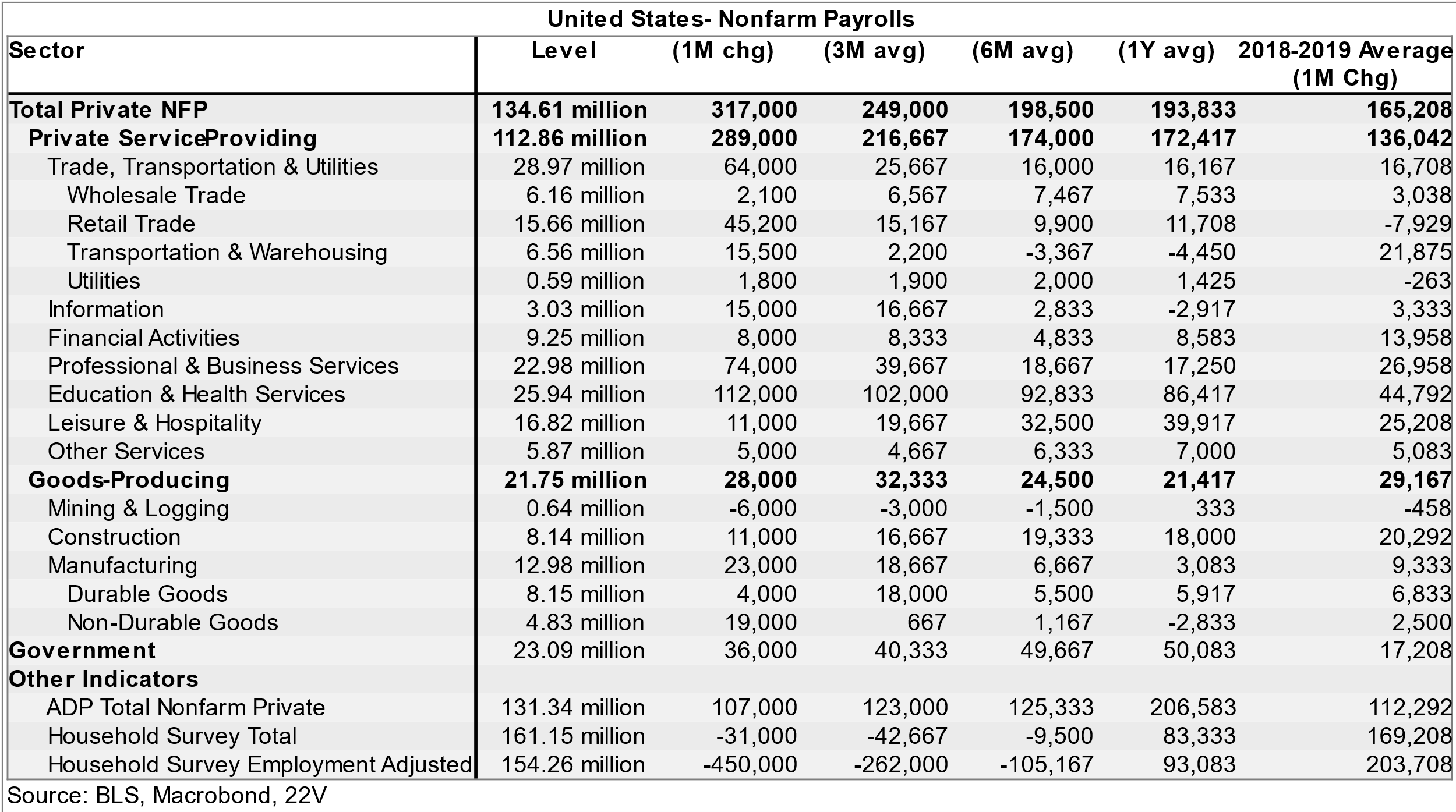
December and January came in as gangbusters for the non-farm payrolls data. Coming after some slower months in the fall this is welcome news and should substantially attenuate some recent growing recessionary concerns. This likely outweighs some of the more dovish signs which had been emerging in certain parts of the JOLTS and household surveys.
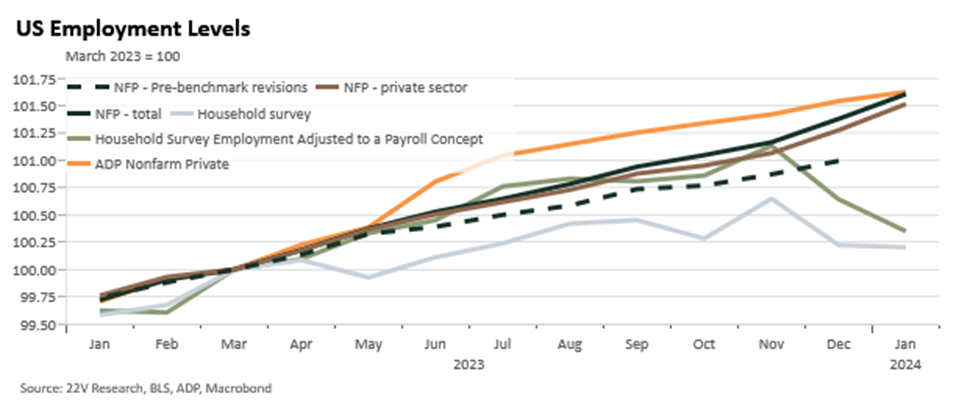
The monthly path of NFP growth over the second half of 2023 and into January notably stronger than expected, despite the benchmark revisions which pulled down the level of employment in March 2023 by -266k.
Some caution around the turn of the year may be warranted when looking at any outlier data points given the potential for funky post-covid seasonality, but I don’t have any explicit reason to doubt the non-farm payrolls numbers and the broader interpretation of the data, which is one of general strength around the turn of the year with a fair amount of noisy internal dispersion.
The wages data were likely a bit softer than the very hot m/m headline number suggests given that the average workweek fell notably, which mechanically boosts average hourly earnings thanks to many workers on salary. Roughly twice as many workers as normal were not on the job or forced to work part-time due to weather over the survey week. There are broader concerns that wage growth, and underlying inflation measures, continue to suggest that the economy is not, or at least not yet, at a inflation target consistent equilibrium. But the January AHE data alone should not be taken as overly strong evidence of that, rather than another point tilting in that direction.
The recent weakness in the household survey, particularly when looking at labor force and employment levels, is harder to explain and stands out in a pessimistic/dovish direction. Still, it is notably more volatile m/m than other data and the new population controls make having a cleaner read on recent momentum (the published data do not get adjusted backwards) more challenging, so I tend not to focus on this too much even if it does raise some tentative yellow flags.
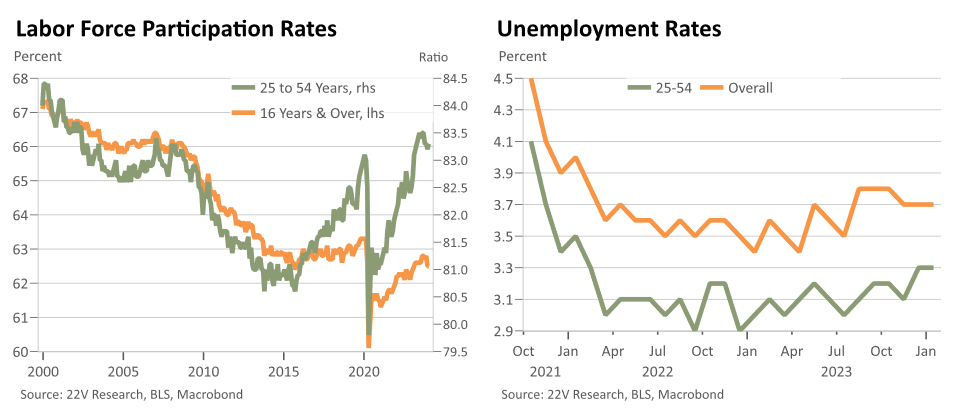
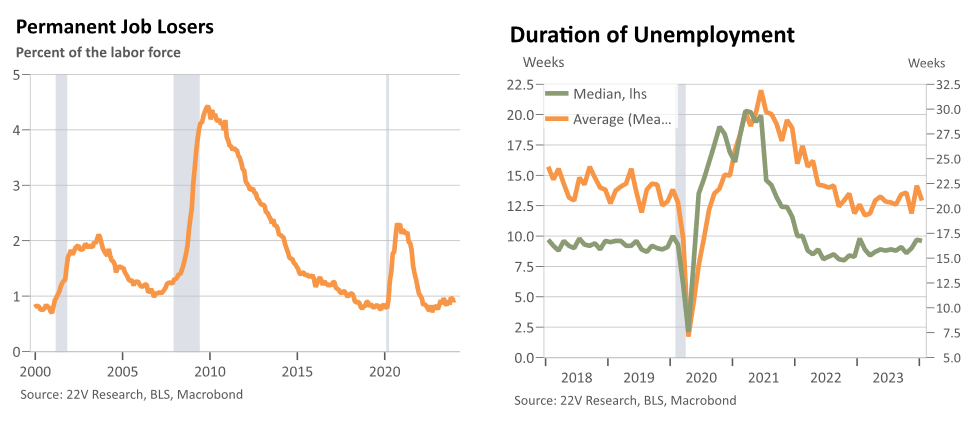
The unemployment rate stayed flat at 3.7% as was the labor force participation rate at 62.5%. The prime-age (25-54) employment to population rate was up a tenth thanks to higher labor force participation. Other measures of slack from the household survey (durations of unemployment and share of job losers on permanent layoff) also suggest that there may be some slightly less tightness than there was but it is hard to find their modest and fairly gradual easings over the past year+ a sign of immediate recessionary concern as opposed to another indicator of warm-to-hot but not boiling labor market.
Separately, ADP Seems to Be Showing Better Gains Under the Hood Than Reported
While many market participants reflexively ignore the current ADP series, the new version of it is much improved on the old. Updated to reflect substantial research work from the Fed itself the ‘new’ ADP data is designed to offer the best possible look at underlying labor market dynamics, rather try to forecast the NFP report (as the old measure did). This is an important shift; as that Fed working paper says, “the timeliness and frequency of the ADP payroll microdata substantially improves forecast accuracy for both current-month employment and revisions to the BLS CES data.” I myself have under-appreicated these data until today, especially in a context where we’re working with only partially revised non-farm payrolls data most of the time.
Recently, the reported ADP data has been running at a solid if not a spectacular pace with a 3mma of 123k. Given the size of the ADP sample (~500k companies with 25mn employees) and its indexation to the quarterly census of employment and wages (which is the key input into the benchmark NFP revisions), this bodes reasonably well on its own merits, given the other concerns present in the labor market
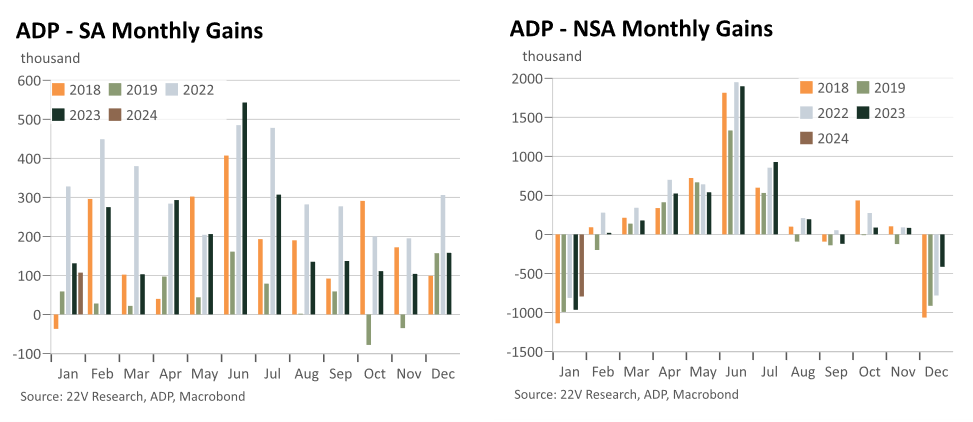
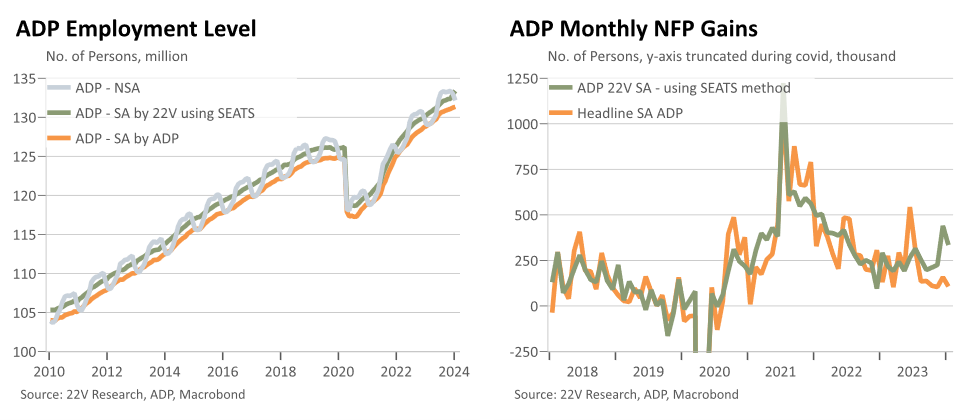
However, there are reasons to think ADP’s seasonal adjustment process may be off in a way which has notably macro optimistic, but perhaps near-term hawkish, implications. The Dec 2023 and Jan 2024 seasonally adjusted ADP releases look to be substantially understating the monthly gains in those months. Just eyeballing the monthly gaps between the NSA vs SA patterns raises one’s eyebrows a bit (then Dec NSA loss was half the size of the prior years but shows a fairly middling SA result).
Using the SEATS seasonal adjustment methodology on the NSA ADP data, suggests that Dec and Jan saw average private sector payroll gains on a seasonally adjusted basis of roughly 387k, with a notably stronger fall as well (the SA payback coming from early summer). This is a different story than what the published results suggest and provides a notable counterpoint to more recent recessionary calls centered on labor market weakness. Of course, this has to be attenuated by the admission that while the inputs to the ADP data are highly valuable (and perhaps the best single quasi-real-time source we have in NSA terms given the nature of the input payroll data) any and all seasonal adjustment processes post-covid are highly challenging to get right. This same general critique applies to the SA NFP data just released as well.
On net, I’m left feeling more directionally optimistic about the near-term interpretation of the labor market data and have to wonder if the Fed staff, which has access to the raw ADP data as well, presented the FOMC with a similarly optimistic counter-point to some of the recent weakness. Given the blockbuster NFP report we just saw and Chair Powell’s failure to mention any signs of labor market weakness in the press conference this makes some sense to me.