

A Q4, and 2023, GDP Reading for the Optimists
- 2023Q4 GDP came in above (somewhat stale feeling) expectations and tracking estimates.
- Underlying domestic demand conditions appear to be solid (personal spending grew 2.8% while overall fixed investment was 1.7%), if less hot than overall GDP, which was boosted by trade and inventory flows.
- Core PCE inflation came in right at 2.0% for the second quarter in a row.
- The real and inflation data jointly tell the story of an economy with fading supply shocks and some tentative signs of getting over the peak drag from Fed tightening.
- Recessions odds remain elevated compared to normal given the broader mid-to-late cycle environment but with largely neutral to positive tailwinds domestically, consensus’ ~50% puts the chance too high, especially in the very near-term.
Internals of Q4 Solid if a Bit Less Punchy than the Headline 3.3% Growth
The advanced 23Q4 GDP reading was an all-around solid one with very little possible negative nitpicking possible inside the report. Like all initial GDP releases, this one will surely have some revisions but the broader story is a positive one.
Instead of the widely projected slowdown, the second half of 2023 saw GDP growth average 4.1% and core PCE come in at 2.0% in both quarters. Admittedly, both of these had help from transitory factors, but the underlying story is of an economy with robust domestic demand that’s seeing the lagged impact of supply shocks (partially) fading away. Remarkably, GDP is now above CBO’s pre-pandemic projections and inflation (admittedly not the price level) has seeming returned fairly close to the Fed’s target (depending a bit on how one weights transitory inflation and deflation in autos, other core goods, and rents you can tell more or less hawkish stories but the general inflation story remains positive regardless of the particulars; underlying inflation is likely nearer 2.5% than 2% in my read but that should not scare the Fed too much).
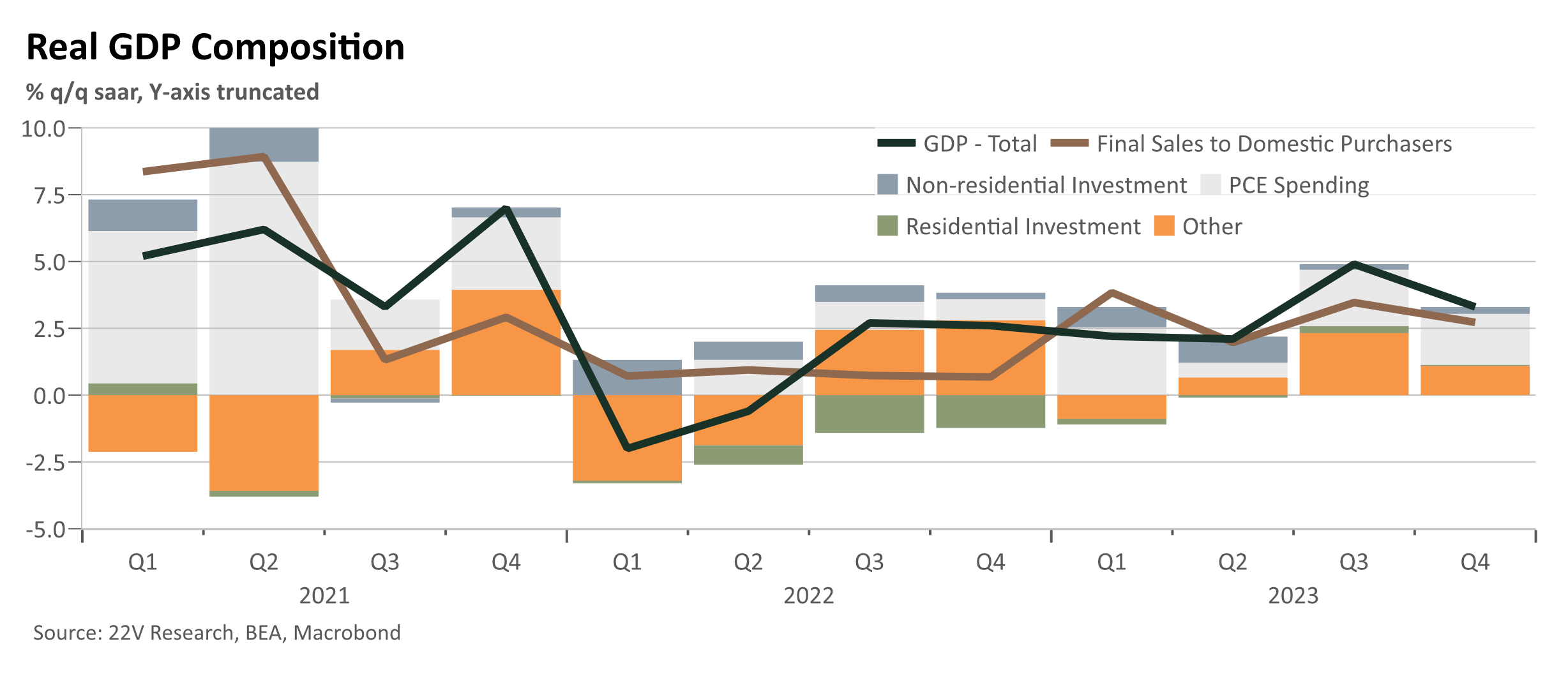
The composition of Q4 was solid, although the headline number was boosted some by transient factors (inventories and trade). Final sales to domestic purchasers came in at 2.7%; this series is analogous to ‘core GDP’ in smoothing through noisier influences. Personal consumption spending came in at 2.8%.
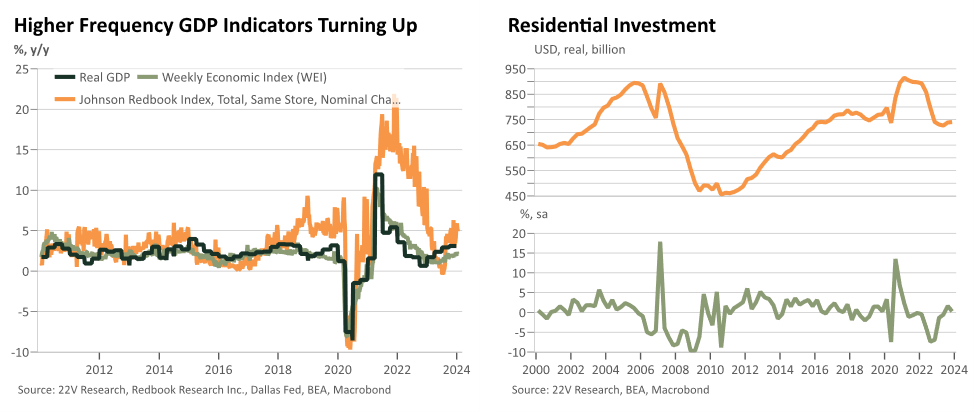
Residential investment came in at 1.1% q/q saar. This was slightly above tracking estimates going into the release but notably slower than the bounce seen in Q3. After having fallen sharply in 2022 and basically treaded water since then, residential investment appears primed to be a modest contributor to growth as housing starts rebound (already seen in the data) and remodeling and existing home sales pick up as well (so far much more tentative but seemingly starting to see some green shoots as mortgage rates decline).
Whither the Recession?
As much or more than the Q4 data itself, it seems worth highlighting the relative outperformance of the year compared to expectations.
At the end of July, BBG consensus had real GDP for 2023 at 1.5% (in late January 2023 it was 0.5%). Given first half growth at the time of roughly 2.2% this implied a roughly 0.8% second half of the year. The Fed’s SEP forecasts were not qualitatively different. This story of a substantial weakness, or a recession, beginning in 3-6 months has been a nearly constant one since 2022 and is, to a large extent, still present in much of consensus. The late-December dated BBG consensus forecast has 24Q1 and Q2 growth at 0.6 and 0.4 respectively before bounced back to the low 1s in the second half of the year.
Instead, we have seen consistent outperformance on the real side of the economy as well as inflation falling faster than forecast. The sectors most exposed to the post-pandemic bullwhip and rate hikes did suffer serious drags over the past few years (see more in my earlier piece The Great Wait); residential investment fell 17.4% in 2022 and has been at a low level since then, while other parts of the more cyclical goods economy have also struggled.
But the overall strength of the consumer, a general reluctance of firms to lay off workers after having such difficulty in re-staffing post-pandemic, robust nominal topline growth giving firms and households greater ability to smooth through shocks (a stark contrast to the post-GFC low nominal growth world), and the asynchronized nature of many of the hits to activity means that the long-expected recession, or sharp slowdown in domestic demand, has not yet materialized (one of my contentions is that if it was going to happen it was likely to be in 2022 when many of these forces first buffeted the economy and were largely overlapping in their hits to growth and we experienced the very rare phenomenon of final sales to domestic purchasers growing below potential GDP for the whole year, growth is almost always either above potential or in recession on more than a quarter or two’s basis). Nothing has quite been as modern (post-1960s) times would tell us to expect this cycle so far.
While a purely endogenous and backwards looking recession is certainly not impossible going forward, the odds have to be somewhat elevated compared to normal just given where rates and the unemployment rate are, but with FCIs easing, the Fed almost surely to start cutting rates in H1, and the most cyclical parts of the economy seemingly having found a trough, there remains reason to fade the current BBG consensus of 50% in the next 12m and, somewhat separately, to have lower recessionary odds than one had earlier in 2023 or 2022.
Having the same causal story running for strongly recession calls, or very elevated odds, seems a stretch; at some point the mechanism (usually high real or long-term rates, or sometimes the inverted yield curve) just isn’t working.
Given the mid-to-late cycle environment, which makes rolling over into a recession easier in the event of shock as firms are more fully staffed and more at risk of being overextended and caught in a weak position by falling demand, one needs to be alert for possible new shocks (RoW growth falling faster than expected and hitting a weaker goods economy, geopolitical shocks, another FCI/banking blowup, etc) in addition to closely monitoring the labor market for signs of cracking, rather than just slowing or the ‘churn bullwhip’ I’ve highlighted previously.

