SUMMARY
- China’s GDP and monthly activity data point to continued weakness in private sector demand; the most acute problems are in property, which shows few signs of stabilization despite months of easing measures
- Household consumption remains anemic amid a soft labor market, subdued income expectations, and falling housing prices; falling population and birth levels add to the challenges that China faces in sustaining consumption and property demand
- A forceful set of measures across multiple lines of policy is necessary to revive confidence and escape deflationary pressures; however, Beijing is unlikely to abandon its incremental approach and its focus on supporting infrastructure investment and advanced manufacturing
The big picture:
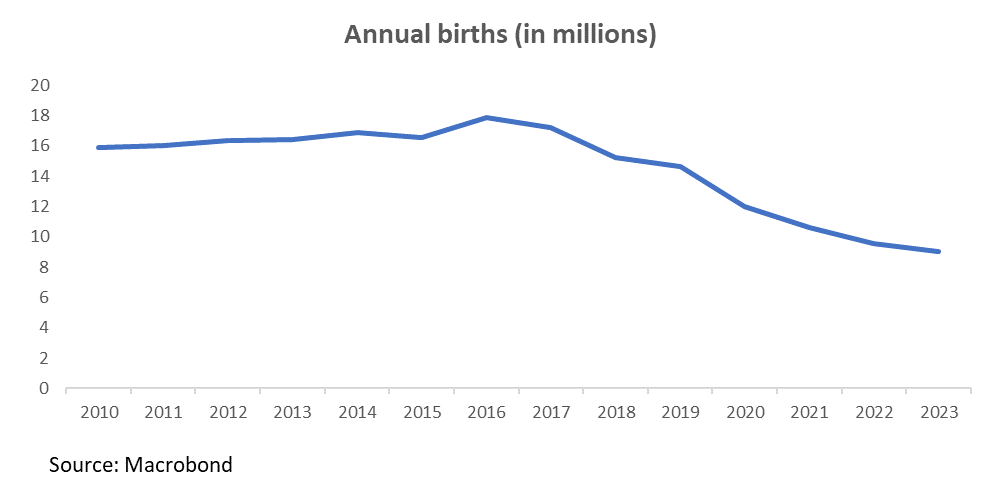
The headline numbers for China’s Q4 GDP and December activity broadly met expectations but the details show an economy struggling to gain momentum and suffering from weak private sector demand. The most acute concern is property, with months of incremental easing measures failing to stabilize prices, sales and developer financing. Household consumption continues to be anemic amid a soft labor market and falling property prices. Demographic headwinds are increasingly prominent, with a further decline in total population and births in 2023 underscoring the challenges for consumption and the property sector.
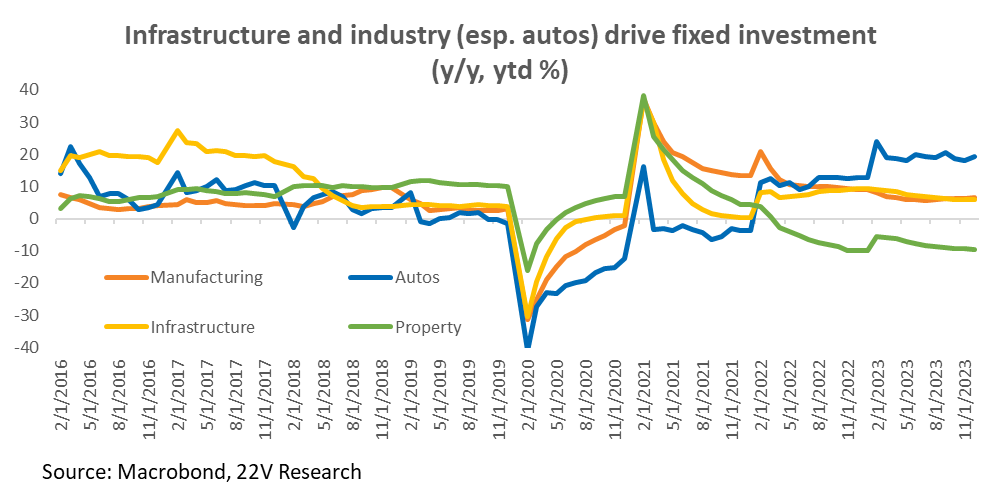
China’s near-term growth momentum is highly dependent on infrastructure stimulus and government-encouraged investment in key manufacturing sectors such as autos. This supply-focused strategy should continue to support China’s appetite for commodities but is less positive for China’s equities, with excess capacity and weak end-demand constraining corporate revenue and profit growth.
Today’s soft data release will stoke expectations of additional stimulus in the run-up to China’s National People’s Congress (NPC) on March 5. Infrastructure spending is already in the pipeline for Q1 with the potential for more support coming, and modest monetary easing is also on the way. However, as we noted yesterday (link HERE), Beijing’s incremental approach is likely to fall short of what is required to quickly revive confidence and private sector demand – a forceful set of measures across fiscal, monetary, property and structural policy.
As noted yesterday, it is possible that Beijing has smoothed down Q4 GDP figures – and withheld some stimulus in December – to boost reported growth in 2024. Even with such a lift, it will be challenging to meet the 4.5-5% official growth target that we expect to be announced at the NPC, let alone the 5% target that some analysts forecast. It also poses a concern that officials are more focused on posting positive numbers than addressing underlying weaknesses.
In the weeks ahead we will be monitoring signals on stimulus coming from Beijing but also local governments, who will be holding their own congress meetings in advance of the NPC. Those local sessions will announce GDP targets and policy priorities that provide clues for the national-level outlook.
FURTHER DETAILS
2023 GDP meets the official target, but 2024 will be tougher:
There was little suspense as Premier Li Qiang had announced the headline number for GDP growth on Tuesday during a speech at Davos. Real GDP grew by 5.2% y/y in 2023, achieving Beijing’s official target of “around 5%.” Q4 growth was also 5.2% y/y, which is flattered by base effects from the zero-Covid economy of 2022. On a sequential basis, Q4 growth was 4% SAAR, down from 6.1% SAAR in Q3. The two-year compound annual growth rate in Q4 (another way of looking past base effects from last year) was 4%, from 4.4% in Q3.
Outlook: The base effects for GDP will make year-over-year comparisons much tougher this year. It will be challenging for China to hit 5% growth this year, which is likely the upper range of the target to be announced at the NPC in March.
Property shows few signs of bottoming:
Property indicators worsened virtually across the board. The contraction in property investment widened to -9.6% y/y YTD from -9.4% in November. Financing available to developers worsened to -13.6% y/y YTD from -13.4 in November. Monthly sales of housing by area fell -23% y/y, from -21.2% in November. With policymakers focused on ensuring that promised housing is delivered, housing completions were up 13.4% y/y in December, from 10.3% in November. But housing starts remained depressed at –21.3% y/y from -22% in November.
A continued decline in housing prices is especially concerning, given the self-reinforcing effect on the confidence of home buyers and the ripple effects to consumption (wealth effect) and to China’s financial system from loans collateralized by property (including the off-balance sheet debt of local government). Prices in the primary market dropped -0.4% (the most since 2015), while prices in the secondary market fell -0.8%, even with November’s decline as the worst since 2014 (see chart).

Outlook: Property remains the key drag on growth and macro risk this year. Policymakers have tools available to try to support property, such as the PSL (pledged supplementary lending facility) instrument recently reactivated by the PBOC. But Beijing appears intent to avoid aggressive measures to reflate housing, focusing instead on an affordable housing push and a new model for the sector. Incremental steps may not be effective in stabilizing commercial housing any time soon given cautious households, struggling private developers, and demographic headwinds.
Infrastructure and manufacturing drive supply growth:
Despite the drop in property investment, overall growth in fixed asset investment improved to 3% y/y YTD from 2.9% in November. Manufacturing investment improved to 6.5% y/y YTD (from 6.3%), with auto investment continuing a torrid pace (19% y/y YTD). Infrastructure investment improved to 5.9% y/y YTD from 5.8% in November.
Industrial production (IP) beat estimates, growing 6.8% y/y from 6.6% in November with auto production (20% y/y) a key driver. IP slowed a bit sequentially but with decent momentum (6.4% SAAR, from 11% in November).
Outlook: Beijing will lean on infrastructure and manufacturing to prop up growth this year. With local governments burdened by debt, the central government will need to shoulder a greater share of infrastructure finance, so funding announcements such as a potential special sovereign bond issuance (see our note from yesterday HERE) are an important watchpoint. The central government and local governments are directing credit to strategic sectors within manufacturing, particularly autos and clean tech, but signs of serious excess capacity raise questions as to whether recent growth rates are sustainable.
Households remain frugal:
China’s quarterly household survey underscores the frugal mood of consumers. While nominal per capita consumption increased 9.1% y/y in Q4, there are large base effects from last year’s lockdown economy. The two-year compound growth rate of per capita consumption (that is, Q4 2023 over Q4 2021) was only 3.2%, down from 8.4% in Q3. The household savings rate (trailing four quarters) remained elevated at 32%, compared to its pre-pandemic level of 29-30%.
Monthly retail sales tell a similar story. Although retail sales showed improved sequential momentum (5.2% growth SAAR in December, from 1.1% in November) they remain well below the pre-pandemic trend. The two-year compound growth rate of retail sales of goods was only 2.3% in December, better than 1% in November but a depressing number all the same.
The surveyed unemployment rate rose slightly to 5.1% in December from 5% in November, pointing to continued softness in the labor market (PMI data show this trend more clearly). The National Bureau of Statistics also resumed publishing data for youth unemployment, after stopping such releases mid-year amid the attention to the very high levels (21.3% as of June). The youth unemployment rate for December (14.9%) reflects a new methodology that according to the authorities excludes students in school. Expect widespread scrutiny of those figures.
After peaking in 2021, China’s population is on the decline, shrinking by 2 million persons after a decline of 850k persons in 2022. Even more striking is in the decline in annual births, which fell to 9 million in 2023, a roughly 50% decline from the peak in 2016. That decline has broad ripple effects (such as for housing demand) and reflects factors including falling fertility rates that are not amenable to policy solutions.
Outlook: Beijing’s infrastructure- and manufacturing-focused stimulus strategy is not well-suited to reversing the macro problems weighing down consumption: lackluster employment growth, subdued expectations as to future outcome, the downturn in housing sales and prices, and a falling and aging population. Household spending on goods will remain below the pre-pandemic trend, with shoppers likely to continue to favor bargains (such as those pedaled by discount retailer Pinduoduo) over higher priced alternatives.