

I share the consensus view that this morning’s residential construction report was a significant beat. The bounce in single-family permits in particular is telling, even though it is much less impressive that the rise in total starts. It too now looks like a bottom.
A picture of the flow…

Source: Federal Reserve Bank of St. Louis (FRED), NBER
Data are actual to May.
There is a bigger picture issue here that is probably worth dwelling briefly on. I had been arguing that the huge headwind impeding aggregate demand growth from the residential spending collapse had clearly peaked and was virtually fated to dissipate. A key implication of that was that it was probably wrong to think of there still being major lagged effects on real output growth from the earlier Fed tightening. Abstract theoretical models might imply as much within the historical record. But a practical person could simply look out the window and recognize that – by far – the most interest-sensitive sector of aggregate demand had already done its face plant and that the majority of the real effects from the Fed were already in the economy.
In the event, it looks like I understated that point, even though it was out of consensus for a while. One can actually make the case now for a bit of impetus to aggregate demand growth from an actual revival of residential investment spending growth. For example, the 3-month moving average of single-family starts has actually hooked decisively higher, which was not on my Bingo card. Multifamily is also proving very resilient. I am not impressed by that because this sector looks like an accident waiting to happen. The issue, though, is that the value added in this sector, including intermediate inputs, is just 0.4% of GDP. If it were to get cut in half over a year, which is easily plausible, the hit to final demand growth would be only 20 bps off the 4-quarter GDP growth rate.
I don’t think housing has much upside from here. The idea that it emerges as a major source of demand growth seems a stretch. The point about the lags being a distraction is probably the more important one. Incidentally, when the Fed leadership says stuff that makes little sense to me, as in this case, I tend to assume they are fibbing. An alternative is that I am wrong, where they are right. Another is that they are sincerely wrong. But my guess is that the stuff about lags was at least partly a deflection from something else. Of course, we should never read motives, because that is rude. The only exception would be if we wanted to know what was actually going on. Only then!
… In context of the pipeline
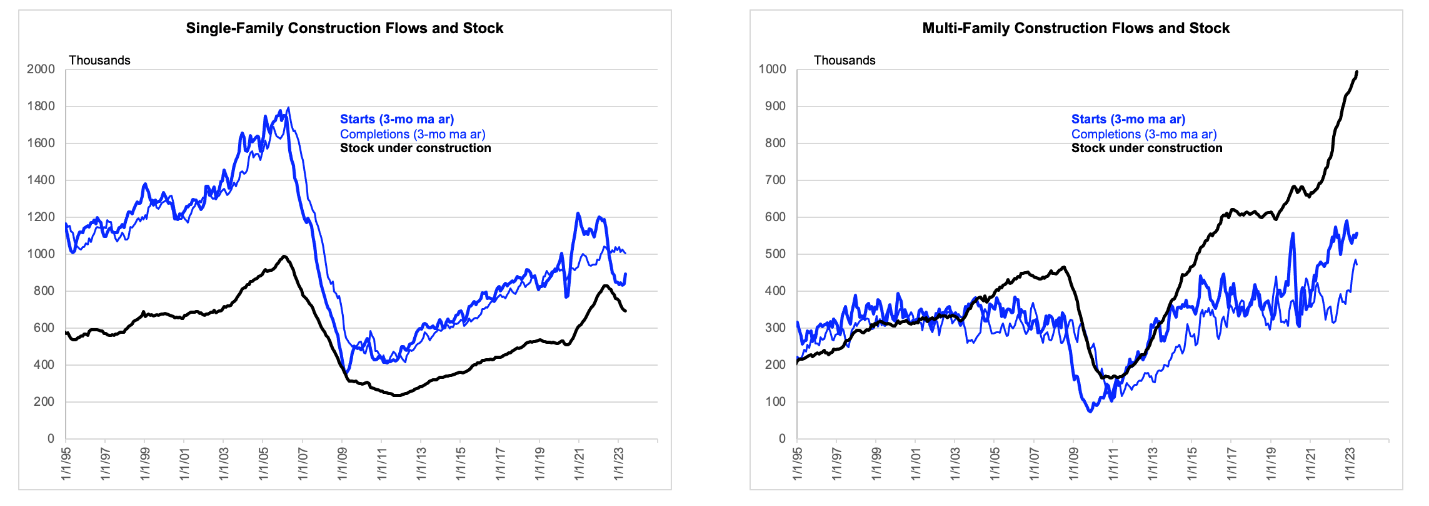
Source: Federal Reserve Bank of St. Louis (FRED), NBER
Data are actual to May.

