Back Portfolio Strategy

Cyclicals Outperform Amid Easing Recession Concerns but Longer-Term Headwinds are Keeping the S&P Range Bound

Published on April 17, 2023

∙ Download the PDF Report

By

Dennis DeBusschere

Brian Herlihy

Kevin Brocks

Sophia Wang

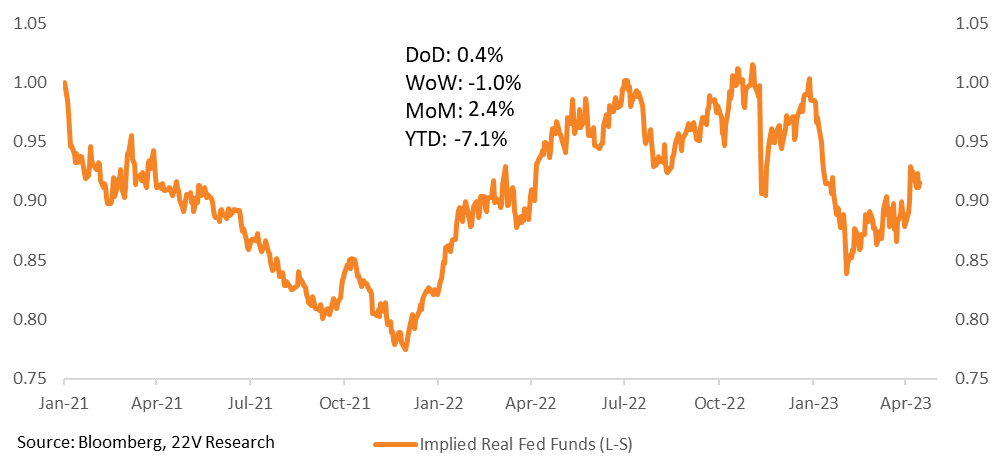
SUMMARY: Lower near term recession risk, systemic bank risk, and/or a shock tightening in lending standards looking much less likely (see the decline in the use of emergency lending facilities and the uptick in C&I loans HERE), along with inflation that remains well above the Fed’s target should favor stocks that benefit from a higher real fed funds rate (we can send the list). The above is also why Cyclicals outperformed last week and yields moved higher.

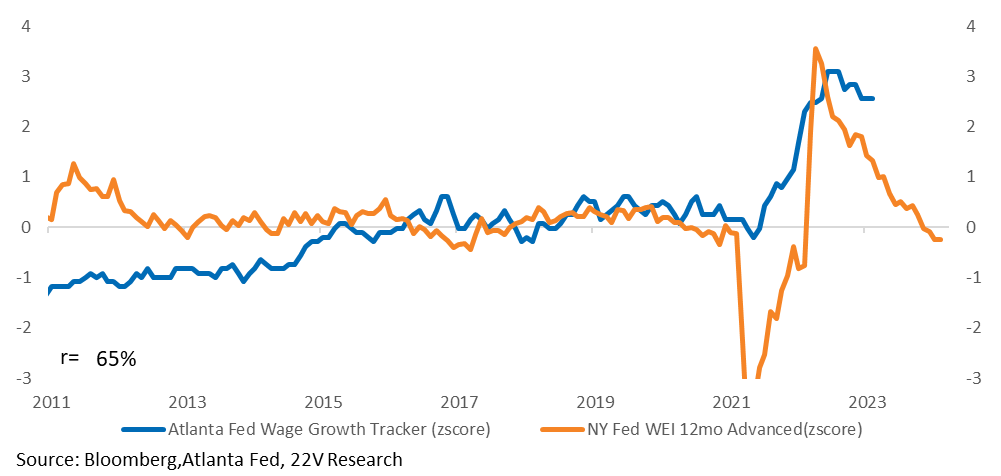
Last week’s macro data was not encouraging from an overall market standpoint though and the risk reward skew is now much less compelling. Current wage trends suggest inflation remains too high and that economic growth needs to slow more. Economic growth is already at a much lower level that last year, so the need for additional slowing increases longer term recession risk. That is a headwind for risk assets. The path to a soft landing is through lower wages AND economic stability. In economic terms, the price price spiral unwinds naturally as one-off shocks subside. That is the dovish theory. Last week’s data did not support that dovish theory. Side note… be open minded as this theory could work out over a longer time frame. The fact is, we have no idea how things will play out, BUT conviction on economic outcomes is still high.

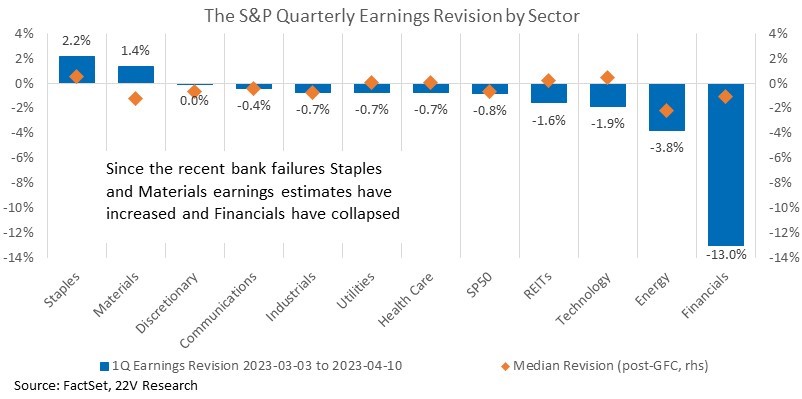
The financial sector’s earnings expectations have fallen the most compared to other sectors, with a -13pp decline relative to expectations before bank failures. Those estimates have deteriorated further since reporting started, falling to -13.8%. On the one hand, it is encouraging that revisions have fallen so fast. We don’t know if Financials have been revised low enough or not, but the major banks did not confirm worst case credit demand/availability last Friday. On the other hand, what regional banks say over the next few days will be important to setting the broader tightening tone.

Lower correlations remain one of the highest conviction themes for the year, and focusing on correlations is more important when the S&P is near the high end of its range. Lower correlations will support stocks with higher idiosyncratic influence.

MARKET VIEWS: Cyclicals outperformed, and interest rates increased as CPI, retail sales, and large Bank earnings commentary were not as negative as feared. Investor concerns over elevated near-term recession risk, which could potentially show up in data now, was unusually high. That helps explain the near record short position in S&P net futures positioning put on before the payroll report 10 days ago. Lower near-term recession risk, systemic bank risk, and/or a shock tightening in lending standards becoming much less likely (see the decline in the use of emergency lending facilities and an uptick in C&I loans HERE), along with inflation that remains well above the Fed’s target should favor stocks that benefit from a higher real fed funds rate (we can send the list).
Last week’s data were not encouraging from an overall market standpoint though. Current wage trends suggest inflation remains too high. Unless that changes, it suggests economic growth needs to slow more to slow wages/inflation. With economic growth already much lower over the past year, the need for activity to slow further increases longer-term recession risk and is a headwind for risk assets. The New York Fed Weekly Economic index suggests 1.5%ish underlying demand growth and wages are still elevated relative to that (see below). That should change going forward (wages lower as economic growth remains at or below trend), but for now, wages aren’t coming down fast enough. Recall, the path to a soft landing is through lower wages AND stable economic growth. Last week’s data did NOT support that outcome.
Financials Earnings Focus: At the sector level, earnings expectations for Financials have fallen most of any sector, down -13pp relative to expectations BEFORE the bank failures. That is a 92nd percentile decline. The number dropped further to -13.8% after banks reported on Friday. We don’t know if Financials have been revised low enough or not, but it is encouraging that revisions have fallen so fast. Those revisions will not help if management teams signal a broad and deep deterioration in credit demand/availability, but as the Quant team covered in detail (HERE) tis morning, the major banks did not confirm worst case credit demand/availability last Friday. What the regional banks say the next few days will be important to setting the broader tightening tone.
Timeline

Description automatically generated

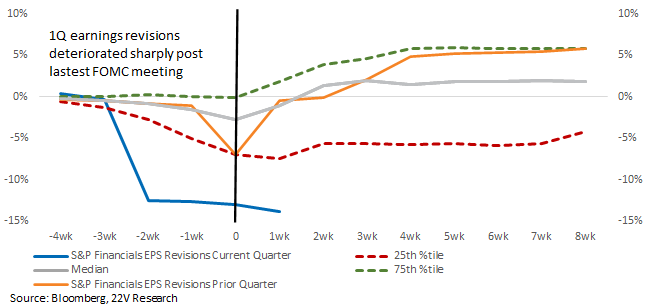
S&P Financials earnings revision declined the most in the week of Mar. 24th (the FOMC meeting) and have stayed around those levels. The decline in Financial EPS revisions is dramatic relative to history.
Lower Correlations: S&P IPC tends to decline during reporting season as investors adjust their expectations based on newly available data. Lower correlations remain one of our highest conviction themes for the year. Focusing on correlations is even more important, in our view, now that the S&P is near the high end of its fair value range.
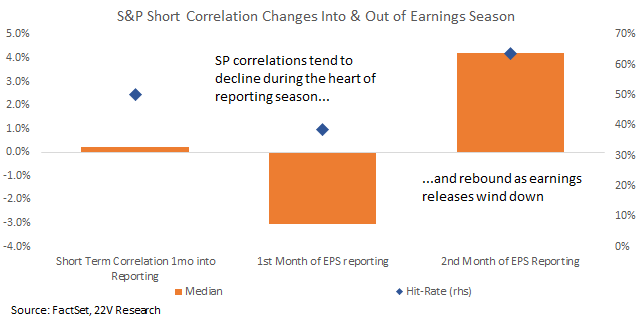
Chart

Description automatically generated

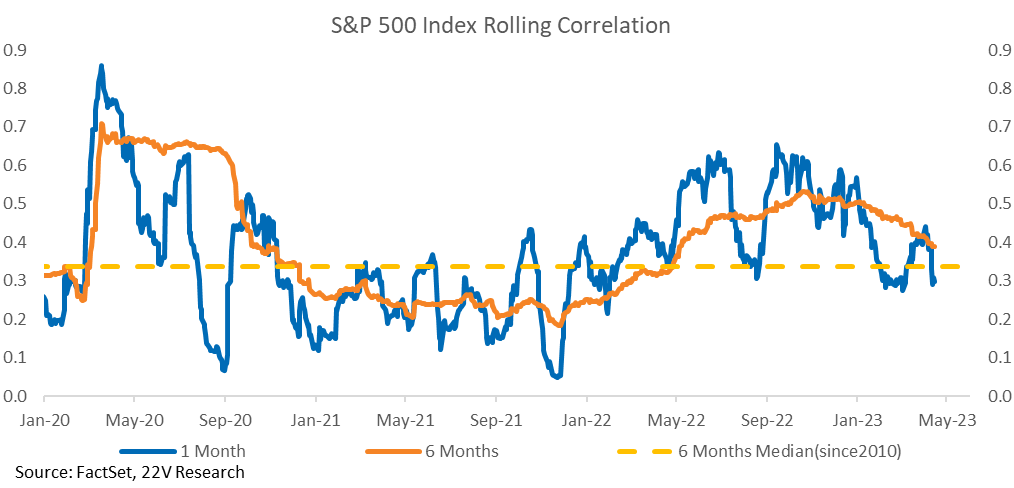
S&P 1-mo corrleations have already moved back down following the bank shocks. 6 months correlations will continue to follow.
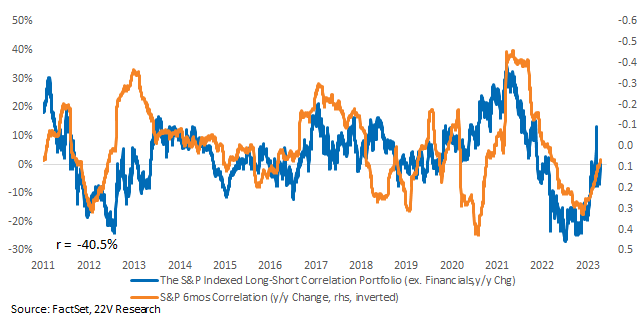
Lower 6 month correlation will supprt stockst that benefit from lower correlations relative to those that don’t. Stocks that benefit from lower correlations had a tough month as bank failures caused a broad increase in the comovement of stocks. But lower near term recession risk (data still ok) and systemic bank issues fading should reverse that trend.
Chart

Description automatically generated with medium confidence

DISCLOSURES AND DISCLAIMERS

Analyst Certification

The analyst, 22V Research Group, primarily responsible for the preparation of this research report attests to the following: (1) that the views and opinions rendered in this research report reflect his or her personal views about the subject companies or issuers; and (2) that no part of the research analyst’s compensation was, is, or will be directly related to the specific recommendations or views in this research report.

Analyst Certifications and Independence of Research.

Each of the 22V Research analysts whose names appear on the front page of this report hereby certify that all the views expressed in this Report accurately reflect our personal views about any and all of the subject securities or issuers and that no part of our compensation was, is, or will be, directly or indirectly, related to the specific recommendations or views of in this Report.

22V Research (the “Company”) is an independent research provider. The Company is not a member of the FINRA or the SIPC and is not a registered broker dealer or investment adviser. 22V Research has no other regulated or unregulated business activities which conflict with its provision of independent research.

22V Research, LLC is a professional services and independent publication organization. 22V Research, LLC is not a securities broker-dealer, not a member of the Financial Industry Regulatory Authority (FINRA), not a registered investment advisor (RIA) and not a member of SIPC.

Securities transactions, when offered, are offered by 22V Securities, LLC through LPS Capital, LLC. Certain employees of 22V Securities, LLC are dually registered as securities representatives of LPS Capital, LLC or Analyst Hub Securities, LLC. 22V Securities, LPS Capital and Analyst Hub Securities are members FINRA, SIPC.

https://brokercheck.finra.org/

Current Ratings Definition.

SECTOR OUTPERFORM: An “outperform” rating anticipates the company will outperform the S&P Regional Banking Index (peer group).

SECTOR PERFORM: A “market perform” rating anticipates the company will perform in line with the S&P Regional Banking Index (peer group).

SECTOR UNDERPERFORM: An “underperform” rating anticipates the company will underperform the S&P Regional Banking Index (peer group).

Limitation Of Research And Information.

This Report has been prepared for distribution to only qualified institutional or professional clients of 22V Research Group. The contents of this Report represent the views, opinions, and analyses of its authors. The information contained herein does not constitute financial, legal, tax or any other advice. All third-party data presented herein were obtained from publicly available sources which are believed to be reliable; however, the Company makes no warranty, express or implied, concerning the accuracy or completeness of such information. In no event shall the Company be responsible or liable for the correctness of, or update to, any such material or for any damage or lost opportunities resulting from use of this data. Nothing contained in this Report or any distribution by the Company should be construed as any offer to sell, or any solicitation of an offer to buy, any security or investment. Any research or other material received should not be construed as individualized investment advice. Investment decisions should be made as part of an overall portfolio strategy and you should consult with a professional financial advisor, legal and tax advisor prior to making any investment decision. 22V Research Group shall not be liable for any direct or indirect, incidental or consequential loss or damage (including loss of profits, revenue or goodwill) arising from any investment decisions based on information or research obtained from 22V Research Group.

Reproduction And Distribution Strictly Prohibited.

No user of this Report may reproduce, modify, copy, distribute, sell, resell, transmit, transfer, license, assign or publish the Report itself or any information contained therein. Notwithstanding the foregoing, clients with access to working models are permitted to alter or modify the information contained therein, provided that it is solely for such client’s own use. This Report is not intended to be available or distributed for any purpose that would be deemed unlawful or otherwise prohibited by any local, state, national or international laws or regulations or would otherwise subject the Company to registration or regulation of any kind within such jurisdiction.

Copyrights, Trademarks, Intellectual Property.

22V Research Group, and any logos or marks included in this Report are proprietary materials. The use of such terms and logos and marks without the express written consent of 22V Research Group is strictly prohibited. The copyright in the pages or in the screens of the Report, and in the information and material therein, is proprietary material owned by 22V Research Group unless otherwise indicated. The unauthorized use of any material on this Report may violate numerous statutes, regulations and laws, including, but not limited to, copyright, trademark, trade secret or patent laws.
