

China’s move to fine-tune its Covid policies on 11 November has been positive for market sentiment, as have stepped up support for the property sector and a constructive meeting between General Secretary Xi Jinping and US President Biden this week (please see our note here).
But near-term dynamics around Covid are uncertain and potentially at a key inflection point, as three factors come together:
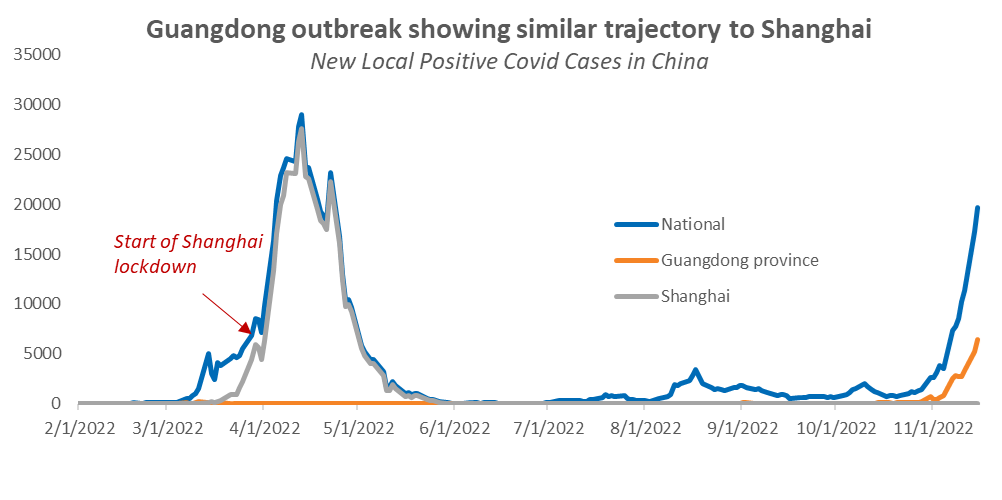
- The most serious rise in Covid cases since Shanghai went into lockdown in April, including a large outbreak in Guangzhou, a key economic hub;
- Confusion at the local level over the new measures and whether China’s leadership is implicitly tolerating a rise in cases; and
- Mounting economic, fiscal and social pressures arising from the zero-Covid framework, which is fueling bottom-up pressure to relax restrictions.
Our basecase remains that China’s leadership will not meaningfully pivot from zero-Covid until spring 2023 and then only gradually (please see: New Covid measures have limited near-term impact but build momentum for a gradual pivot, 11 November). Hence, we expect the authorities to implement strict measures as necessary to bring current outbreaks under control.
However, the swirling dynamics above create significant uncertainty, including the tail risk of a “hasty pivot” scenario in which China moves sooner and more chaotically to a new era of living with the virus.
“Optimizing” or relaxing Covid policies?
China’s 20-point plan, released 11 November, directs local governments to reduce onerous Covid protocols perceived by experts as both unsustainable and unnecessary for containment. At the same time, the central government continues to stress that the measures “optimize” zero-Covid policies rather than “relax” them. Local governments are thus left to make their own judgment calls as to how much to reduce testing and containment measures, since they are also still on the hook to prevent outbreaks.
Several cities have become test cases for how much cities can safely relax measures – and how much the central government will tolerate. The most notable example is Shijiazhuang in Hebei Province (which surrounds Beijing), which announced over the weekend that it would end the requirement for negative PCR tests to use public transport and enter shopping areas. This came even as the city – which locked down over the summer – discovered a small number of cases. The notion that the city might effectively have given up on testing and containment led families to withhold children from school for fear of catching Covid.
Elsewhere in China, the sense that China’s leadership has sent a partial “loosening” signal even as cases rise is being taken by some as an implicit message that the pivot away from zero-Covid has started. Anecdotally, contacts report a surge in sales of medicine and medical equipment from families worried about a run on the public health system, and confusion in many areas among grassroots party and public health officials.
In the last 24-48 hours, the central government has sought to reemphasize that the focus on containment hasn’t changed. This includes a series of articles in the People’s Daily, with the Tuesday edition hammering the theme of an unwavering commitment to zero-Covid. Shijiazhuang announced that it is reopening testing sites and local officials have now pushed back on the notion that the city is “lying flat” against Covid. Beijing, whose response is also closely watched, has maintained tight very policies and is also reopening recently closed testing centers.
The fact that Xi Jinping has been out of the country for the G-20 and APEC summits may also be playing a role in the lack of clarity in messaging, with lower-level officials lacking guidance on how strongly to emphasize relative priorities of containment and economic support.
Tail risk of a chaotic pivot:
Collectively, the data points reinforce our view that China’s leadership indeed intends to “optimize” Covid policies – that is, to make them more sustainable – rather than start the pivot now. Our basecase is that China begins to relax containment measures after the March National People’s Congress.
That said, there is significant room for uncertainty. The leadership’s actual degree of tolerance for implicit relaxation will only be clear in coming weeks, particularly as cases continue to rise and the question of lockdowns becomes more pressing. The biggest test will be in Guangzhou (capital of Guangdong province), where cases are showing the same trajectory as in Shanghai before the city locked down in April. This week, social media carried footage of riots by migrant workers from a locked down district in Guangzhou, protesting lack of supplies.
It Is possible that China’s leadership will attempt to keep cases low without resorting to strict lockdowns, particularly if compliance weakens from exhausted local governments. Japan, South Korea and especially Taiwan managed to keep deaths relatively low without strict lockdowns, though Chinese authorities are likely to feel less confidence that they can follow this path given the country’s weaker public health infrastructure and questions over the effectiveness of and coverage of current vaccines. Guangzhou will be a bellwether.
In a tail risk scenario, China could enter into a “hasty pivot” scenario this winter, with multiple cities effectively giving up on zero-Covid amid explosive growth in cases. This would pose the danger of a run on medical resources as patients flood hospitals, which China’s leadership would almost certainly move to avoid by reimposing tight measures in large cities. Households would likely also respond by restricting their own activities. This would be a bumpy and potentially highly chaotic and disruptive scenario for the economy and markets.
For this reason, we continue to think that the authorities will be highly averse to the possibility of a “hasty pivot” scenario and keep measures tight. Still, the probability of a hasty pivot is perhaps now at 20%, up from 10% in our report on 4 November. The main reasons are the very fast surge in cases, uncertainty over Beijing’s tolerance level for lockdowns and containment measures given a fragile economy, and the potential for dysfunction in the center-local implementation of containment measures.
Market implications and watchpoints:
China’s October activity was notably weak under the impact of containment measures, including a contraction in retail sales (-0.5% y/y). Investors are thus far largely looking into the future, cheered by the prospect of an eventual pivot to come. But the near-term may quickly come back into focus given risks around current dynamics, especially the likelihood of stringent measures that last throughout the winter.
We continue to expect that China’s containment measures will be more disinflationary rather than inflationary. The damage from containment in recent months has primarily been felt by the services sector and consumption – weakening domestic demand – with the authorities going to huge lengths to prevent disruption to production and supply chains. Still, there are risks for production, as seen with troubles at Foxconn’s largest iPhone assembly line, in Henan province. Migrant workers fled the plant out of concern of being caught in a potential outbreak. The local government is now helping to recruit replacement workers, including among retired government workers and soldiers.
Should the tail risk of a hasty pivot start to become more probable, investors will need to recalibrate for a more volatile and confusing scenario for the economy. A chaotic pivot would likely result in a patchwork of shifting policies at the local level as some localities lockdown while others seek to live with the virus. The hit to the economy would come not only from containment measures but also risk-averse behavior from households.
Key watchpoints in coming days:
- The outbreak in Guangzhou. With Guangzhou now looking much like Shanghai in April, local officials face a very difficult decision over the next week or so. Guangzhou is among the best prepared cities in terms of public health infrastructure, so the city could be a pilot for avoiding a harsh lockdown – initial data indicate very few serious cases and no deaths. The social pressures to avoid a lockdown will also be intense, as the riot/protest from one district this week already show. But officials will also be wary of the lesson from Shanghai in April, which may have waited too long to take aggressive measures, requiring a longer lockdown in the end. All of this makes Guangzhou the key test case, watched by other local governments around the country. Another major city battling a sizeable outbreak is Chongqing.
- Messaging from China’s leadership on zero-Covid, particularly once Xi returns to China on November 19/20. Further efforts by the political leadership to emphasize zero-Covid would indicate no major shifts in policy. But soft messaging (such as an emphasis that Omicron’s symptoms are mild), or a lack of clarity on the balance between containment and the economy, would indicate that the leadership’s tolerance for rising cases may indeed be shifting.
- Behavior of other local governments, including frequency of PCR tests, progress in vaccinations, and other preparations for a pivot. We continue to view China as facing a number of key challenges before the authorities can confidently reopen – in particular, vaccinating the elderly population and preparing ICU capacity. Progress on these fronts will be important to monitor for the pace and confidence with which the government can safely relax containment measures.

