ELECTIONS WEBINAR: Please join us on Wednesday, October 26 at 10:30 a.m. ET for a final 22V Midterms 2022 webinar with Jacob Rubashkin of Inside Elections. He’ll cover their latest work in key races very likely to determine Senate control in the next Congress and update the projected GOP margin of victory in the House of Representatives. Register for the webinar HERE.
SUMMARY
Americans and more narrowly, likely voters, quite understandably continue to say economic issues are foremost of mind. The inflation/inflation-fighting/financial conditions tightening loop of the past two years has been impossible to ignore experientially or financially for many voters. Federal governance is another sticky concern especially as the January 6th Committee nears completion of its work, and amid a general decline in American’s trust of key federal institutions such as the Supreme Court and Federal Reserve.
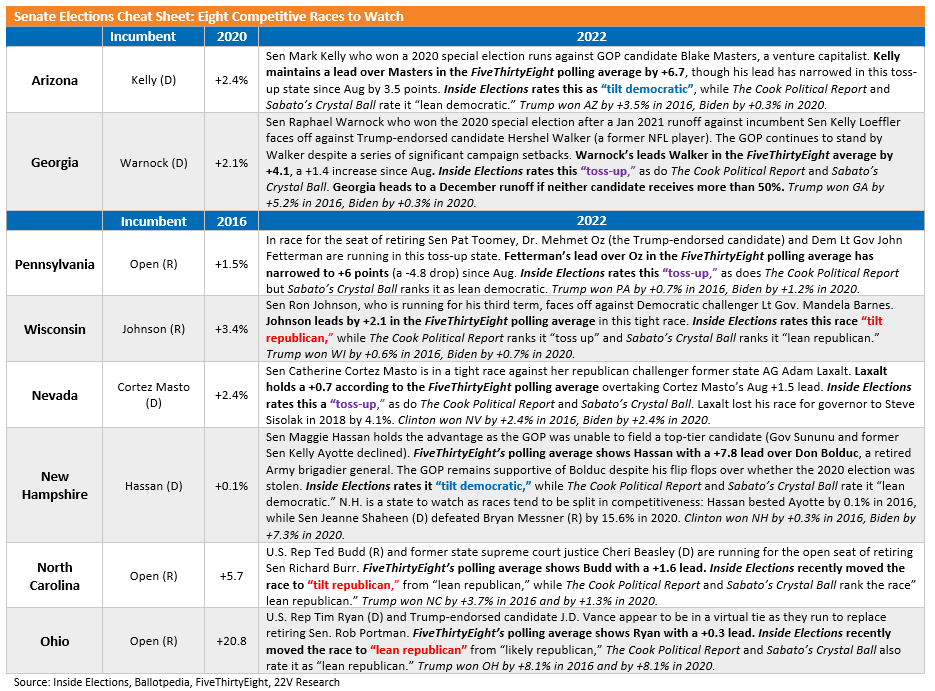
While these macro-political issues likely will dominate voters’ moods in a month, social issues including abortion, crime, and immigration could be more direct drivers of turnout on November 8 in many elections. The following table updates work we have maintained since our inaugural midterms report last May.
OUTLOOK
Because we are followers of trends which have not moved significantly since our last note, we are not changing our call for divided government with narrow margins of controls in both Chambers of Congress. Based on the current polling data, we maintain Democrats are likely to continue their slight majority in the Senate while Republicans appear poised to retake the House. Since the beginning of the midterm season, we have been closely watching six toss-up states: Arizona, Georgia, Pennsylvania, Wisconsin, Nevada and New Hampshire. As trends in Ohio and North Carolina began to shift in Democrats’ favor in August, we added Ohio and North Carolina to our watch list.
The table below is a ‘cheat sheet’ for tracking these key Senate races. We highlight past elections results, current polling trends, and the ratings of polling experts for how these toss up races may break. With less than a month until election day, each race demonstrates why it remains in the general tossup category. Obviously in a 50/50 Senate where the vice president is the tie breaker, neither side can afford to lose any of these races. With so many close races at play, it is highly likely that we might know the outcome for a few weeks following election night.