
Summary
China macro
- Beijing is unlikely to announce major stimulus or policy loosening in Q4 sufficient to offset weak domestic demand. The continued disinflationary impulse from China is a silver lining for the Fed and ECB, who can keep thanking Beijing for making their inflation fight easier.
- Speculation that Xi Jinping will pivot away from the zero-Covid policy at the 20th Party Congress (starts 16 October) is too optimistic. Containment policies will remain tight at least through mid-2023, dampening demand, particularly in consumption-related sectors.
- China’s property sector downturn will continue well into 2023. While Chinese central and local authorities have loosened housing policies, there is no appetite for a major bailout of property developers, whose debt problems will continue to weigh on property investment and related sectors such as construction.
- Slowing growth in advanced economies is now starting to hit China’s export sector. This leaves government-directed infrastructure investment as the main demand driver for China in coming quarters, but here too there are headwinds, including default risks for local government financing vehicles.
- Beijing will be relatively tolerant of RMB gradual depreciation against the dollar – particularly after the Party Congress – but look to manage the pace and introduce two-way volatility using a variety of administrative and macro-prudential tools.
US-China relations
- While the risk of a US-China conflict over Taiwan is very low, Taiwan will remain the most serious flashpoint in the relationship, and Speaker Nancy Pelosi’s August visit has left a higher baseline level of tension.
- The passing of US midterm elections may revive chatter about US tariff reduction on imports from China, but sizeable tariff relief is very unlikely.
- A potential meeting between President Biden and President Xi Jinping at the G-20 Leaders’ Summit in mid-November will not yield concrete deliverables. Bilateral engagement is focused narrowly on avoiding a crisis or miscalculation on Taiwan or Ukraine.
- Q4 will see US-China tech competition continue to intensify, including further tightening of US export controls in the chip sector and potentially new scrutiny of outbound investment. Both Washington and Beijing are scaling up domestic industrial policies, with risks for the efficiency of the global trading system and major questions as to effectiveness.
- Notwithstanding broader tensions, Washington and Beijing are likely to complete a pilot inspection of US-listed Chinese stocks and avoid a messy unwinding of Chinese ADRs.
This report marks the launch of 22V’s China Strategy offering, which will cover China’s macroeconomy and financial sector, domestic political issues relevant to markets, as well as the US-China relationship and other geopolitical themes. Our aim is to produce not only great analysis on these topics, but also the best “synthesis,” in two respects.
First, we aim to capture the interaction between economics, politics and geopolitics. This is essential for understanding China’s outlook and the implications for global markets. In my career covering China’s markets in the government and the private sector, I have found it be the area where conventional China analysis – which often treats these as separate siloes – posts its biggest misses. As just one example, many analysts refused to believe at the start of the year that Beijing would be willing to tolerate the damage to its economy from maintaining the Zero-Covid strategy, failing to appreciate the political incentives for Xi Jinping – a blind spot that continues today.
Second, our China research will also plug into the broader research capabilities of 22V — including quant and strategy analysis, US economic analysis, and Washington policy research – to uncover how China fits into broader global themes and vice versa.
We will have succeeded if clients with a sophisticated view of China as well as those with more indirect exposure find our research useful and actionable. To that end, I welcome your feedback and the chance for an introductory call or meeting.
A busy policy calendar in Q4
This inaugural report examines a busy upcoming quarter for policy both for China domestically and for the US-China relationship, including China’s 20th Party Congress (starts 16 October), US midterms (8 November) and a likely meeting between President Biden and President Xi at the G-20 Leaders’ Summit in mid-November. The central question is whether these events hold the prospect of improving a dim outlook for China’s economy and for US-China tensions. The short answer is “no,” for several reasons:
- Beijing’s continued caution around the pivot away from zero-Covid
- Little political appetite for a major bailout of private property developers, whose woes will continue to drag down investment
- Broader policy stasis between the Party Congress and the March 2023 National People’s Congress (NPC), when China’s leadership transition concludes.
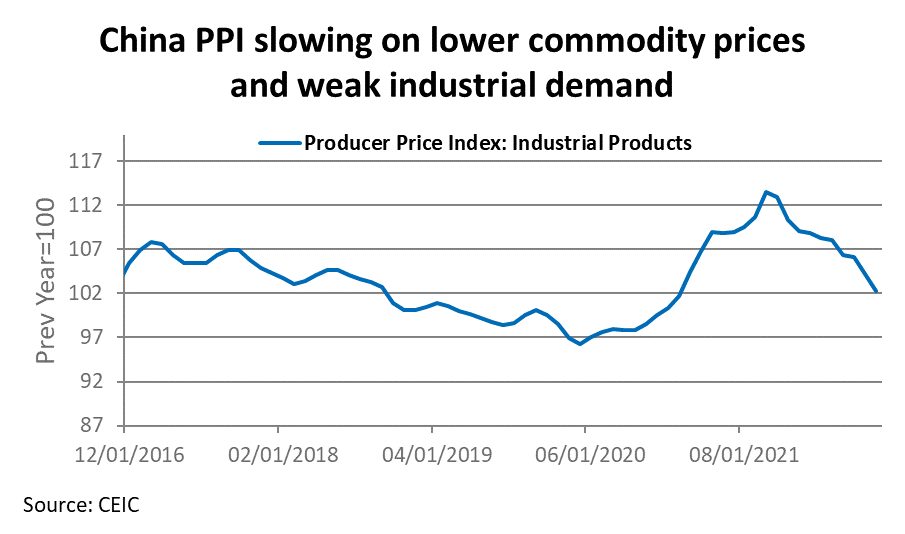
There is a silver lining here, at least on the growth side. Weak demand from China, largely due to zero-Covid and the property downturn, has helped keep a lid on global energy and other commodity prices even amid the disruption from the Ukraine crisis— thus aiding the Fed and ECB in their respective fights against inflation. US officials are, under their breath, grateful that Beijing has not done more to stimulate growth.
The good news/bad news story heading into 2023, alluded to in the title of this report, is that inflation hawks will be able to keep “thanking Beijing for nothing,” as there is little to suggest an end to the disinflationary impulse coming from China. If anything, risks for China’s growth are tilted towards the downside. If inflation in advanced economies does show signs of receding in coming months, weak demand in China will increasingly be perceived as a liability rather than a relief valve for the global economy.
Party Congress unlikely to bring strong pro-growth signals
We will have much more to say about the long-term implications of the upcoming Party Congress next week. The Congress formally marks the start of Xi Jinping’s unprecedented third five-year term as General Secretary of the Central Committee of the Chinese Communist Party (CCP), and more broadly his further ascent as the most powerful Chinese leader since Mao. The main watchpoint will be the degree of pragmatism vs. politicization that Xi maintains in everything from the policy agenda he outlines in his main speech to the quality of the leadership team that he installs around him. This balance will be key to assessing risks of economic stagnation and further geopolitical tension in the years ahead.
Keep your pants (and masks) on
In the near-term, the most important question impacting the outlook for China’s economy will be whether Xi signals a shift away from China’s zero-Covid policy. Speculation to this end is already mounting, as there is a strong temptation for analysts and markets, desperate for policies to shift, to over-interpret any nuance from Xi. The optimistic argument is that with his third term secured, Xi will have less riding on maintaining zero-Covid and can turn his attention to fixing the economy.
We are deeply skeptical of this narrative. The pivot away from zero-Covid will likely begin only after the March 2023 NPC meeting and be very gradual, with containment policies staying tight throughout next year. The key reasons are as follows:
- Xi and the CCP have cast China’s success limiting deaths from Covid as proof of the superiority of China’s governance system over the West’s and a testament to Xi’s leadership. Xi and the CCP leadership will view embarrassing setbacks — such as a surge in deaths —as damaging to their longer-term political legitimacy.
- China’s leadership transition is not complete until the March NPC meeting, when key government positions are announced. Until then, policy will be in stasis, with new leaders not yet fully in their jobs and incumbent leaders looking to secure their legacies. This is not an environment to roll out anything as complex or risky as a pivot from zero-Covid.
- China has much more preparation to do before it is ready to handle a surge in cases. This includes fully vaccinating the elderly population, stocking up on therapeutics, and making further investments in hospital capacity, particularly in poorer provinces. Beijing is unlikely to feel a minimum level of confidence in these steps until roughly mid-next year.
- Beijing’s communication challenge will be immense. No government, even Taiwan’s, has pulled off a smooth transition to “living with Covid” and Hong Kong’s ham-handed approach was a disaster. China’s population lacks acquired immunity and many citizens will likely be deeply fearful of catching Covid, both in terms of illness and the risk of forced quarantine/hospitalization. Simply put, a sudden surge in cases, without sufficient preparation and communication, could easily create its own economic and political shock from a panicked population — one that China’s leadership will be keen to avoid.
For all these reasons, a shift in language on zero-Covid at the Congress — if it comes at all — will likely only be the rhetorical start of a pivot that doesn’t gather steam until next spring at earliest and proceeds in a highly cautious manner (monitoring this pivot will be a central theme of 22V’s China coverage in coming months). Covid policies for the bulk of 2023 and perhaps beyond will consist of high frequency mass testing in major cities, targeted and even broad lockdowns when necessary to prevent an explosion of cases, and marginal loosening of external and internal movement restrictions.
These conditions will continue to weigh on the demand side of the economy – especially consumption and services – with the severity of the impact depending on the extent of outbreaks (see chart below). Notwithstanding the hit to global supply chains from Shanghai’s two-month lockdown earlier this year, the rollout of mass-testing should enable local governments to avoid major supply-side disruptions. In short, the net impact will continue to be disinflationary.

No big bailouts in real estate
The other key drag on growth this year has been the property sector. Chinese authorities have rolled out a slew of loosening measures over the last several months, especially at the local level. These mainly aim to make it easier for households to buy and finance housing. But the crackdown on leveraged property developers, which started in 2019, has fundamentally disrupted the sector’s financing model and the broader growth slowdown has exacerbated the downturn. Only a bold policy move will quickly reverse the vicious cycle in the sector, and it isn’t coming (at least anytime soon).
Private developers face a wave of maturing debt obligations and lack of financing from creditors (bonds markets as well as banks) and from households who have now shunned advance purchases of homes. Developers’ difficulties completing contracted projects is undermining confidence in housing as an asset class, with “mortgage strikes” this summer now also a sensitive social-political issue for Beijing.
While the central government has recently taken some steps to aid developers, such as credit enhancements for their debt, these measures are targeted at completing specific projects – and limiting public unrest – rather than restoring broad faith in developers’ creditworthiness. Beijing does not have the political appetite for any kind of major bailout for private developers, and local governments don’t have the necessary financing for a rescue.
The period from now through March will see additional incremental loosening measures that muddle-through in the hope of a recovery next year. Even after property sales eventually rebound, property investment will lag for several more quarters as developers use sales proceeds to pay back debt before making new investments. When investment does pick up it will be with a fundamentally different model, with a much larger role for state-owned developers and slower growth, due not only to tighter debt limits but to reduced housing demand from China’s worsening demographics.
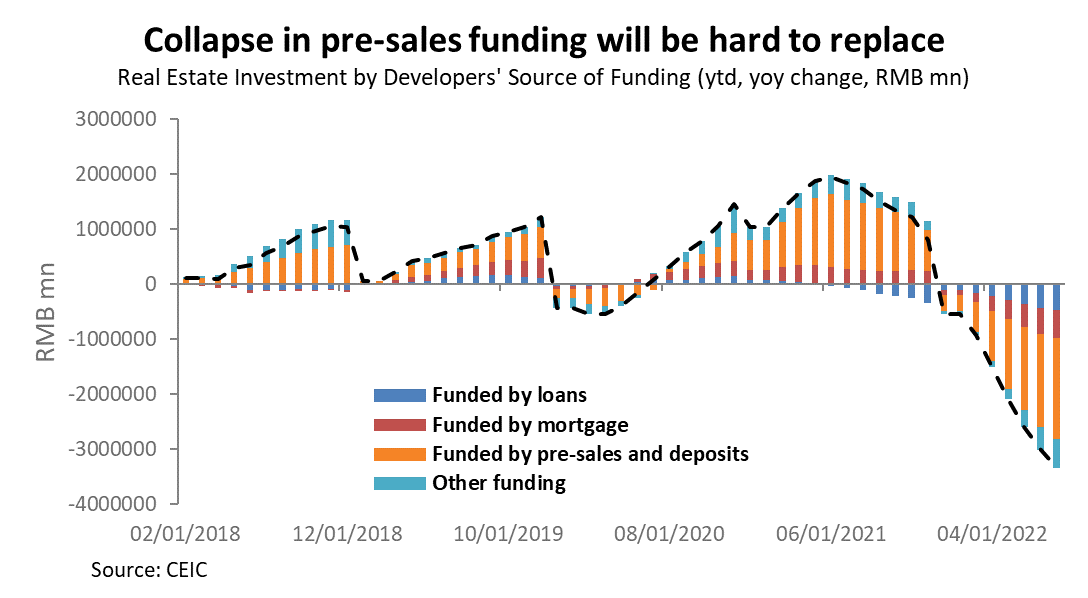 In the meantime, the sector’s downturn will continue to ripple through related sectors, including construction, housing-related consumption (such as appliances), and local government finances, which have been battered by weak land sales. Indeed, one of the key downside risks for China’s economy over the next several quarters is the prospect of increased defaults among local government financing vehicles (LGFVs). The main risks for LGFVs are likely to be confined to less economically important provinces, where debt loads tend to be worse, but a failure in a key hub would be dangerous for financial confidence and investment.
Infrastructure can’t do it all
With consumption and housing investment weak, demand this year has relied on government-directed infrastructure investment and strong growth in exports, which in turn has supported private manufacturing investment. But with advanced economies slowing, export growth slid to 7% y/y in August from 18% in July. That, in turn, will likely drag down manufacturing investment.
That leaves infrastructure investment has the main demand driver for China over coming quarters. However, with local government finances strained by the property downturn and recent tax cuts, there isn’t much more lift that infrastructure can provide. If anything, China faces a potential fiscal cliff in Q4 2022 and Q1 2023 unless Beijing announces an acceleration or increase in local debt quotas for next year. Signals as to a potential announcement will be key watchpoint for the end-October Politburo meeting on the economy.
US-China: I know what you did last summer
Turning to geopolitics, the US and China managed to avoid having Speaker Nancy Pelosi’s visit to Taiwan in early August turn into a full-blown security crisis. However, her trip has resulted in a higher baseline level of tension for the Taiwan issue and a further erosion of guard rails in the US-China relationship.
Parsing Taiwan’s role in US-China tensions requires holding two somewhat contradictory ideas at once:
- First, the risk of US-China military conflict over Taiwan remains very low, at least for the next several years. While Taiwan is the most sensitive geopolitical issue for Xi, he will not risk his broader global ambitions for China by invading Taiwan unless he believes it is absolutely necessary or imminently achievable. There are no indications that Xi has crossed this threshold, though it will be important to watch his wording on Taiwan during the Party Congress.
- Second, Taiwan will nonetheless continue to be the most serious flashpoint in the US-China relationship, making cooperation more difficult and strengthening hawkish voices in both Beijing and Washington.
Beijing accuses the Biden administration of playing fast-and-loose with the One China Policy and was deeply disappointed that the president did not do more to personally dissuade Pelosi from making her visit. The Biden’s team response is to tell Beijing that it is exaggerating shifts in US policy, but also that China’s own saber-rattling has compelled stronger US support for Taiwan.
Both parties in Congress have seized on Taiwan as an attractive issue to generate press, with little regard for the risks. Rep. Kevin McCarthy has already pledged to follow Pelosi’s precedent and visit Taiwan if he becomes the next Speaker. The Taiwan Policy Act, proposed by Senators Bob Menendez and Lindsey Graham, cleared the Senate Foreign Relations Committee last month and contains a number of measures deeply sensitive for Beijing. Coming weeks will be an important test for how much weight the Biden administration uses to try to water down or delay the bill, whose prospects are uncertain.
Biden-Xi summit: feeling for the bottom
A serious blow-up over the Taiwan Policy Act could potentially scuttle the first in-person meeting between Biden and Xi, at the G-20 Leaders’ Summit in Bali on November 14-15. However, the two sides will likely avoid that outcome, as both leaders see value in maintaining their channel of dialogue and avoiding serious miscalculation over Taiwan as well as Ukraine.
But that is the current state of the US-China bilateral relationship: the goal of bilateral engagement is crisis-avoidance and not much else. Beijing and Washington each see little room for cooperation and are focused on pursuing their global rivalry through domestic industrial policies and on courting third countries. In this environment, a low-key meeting between Biden and Xi should be considered a positive outcome. Do not expect concrete deliverables.
The passage of US midterms could reopen the public and private debate with Biden’s cabinet over reducing tariffs on Chinese imports – a topic that Biden could conceivably raise with Xi. However, a major reduction in tariffs on China remains very unlikely, given modest benefits for US inflation and the political risks for Biden of looking weak on China trade.
Both sides on the offensive in tech competition
National security concerns, especially in technology competition, continue to subsume the broader trade relationship. On the “defensive” side:
- As signaled in a speech by National Security Advisor Jake Sullivan in mid-September, the Biden administration is taking an increasingly aggressive approach to export controls on China, explicitly seeking to maintain “as large a lead as possible” – not just a relative advantage – in “foundational” technologies such as advanced semiconductors. The coming quarter could see that approach translate to formalized restrictions on sales to China of advanced AI chips and of design and manufacturing equipment used to produce chips at 14 nanometers or below.
- The Biden administration could also announce an executive order establishing a new screening mechanism on outbound direct investments in China (some venture and PE financing could be affected but most portfolio investment would not). This initial foray would likely to have a light touch, focusing on establishing a monitoring mechanism at the Treasury Department, but restrictions on outbound investment will likely scale up over time.
The “offensive” side of technology competition is domestic industrial policy, where both countries have reached inflection points:
- In the US, the recently passed CHIPS and Science Act and the Inflation Reduction Act contain expansive investments in areas of strategic competition with China, particularly semiconductors and clean tech.
- In China, reducing reliance on the US in critical technologies, especially semiconductors, has become an all-consuming focus for Xi. The Party Congress is likely to emphasize Beijing’s mantra that China must equally balance between “development” and “security” – an important sign that growth has fallen further among Xi’s priorities relative to political and geopolitical concerns.
Despite very different tools and political-economic systems, both governments are increasingly emphasizing “resilient” economies and supply chains over economic efficiency – and often invoking strikingly similar language. The clear loser here is the efficiency of the global trading system, particularly in areas of strategic competition, but there are also risks for each economy and questions about the effectiveness of industrial policies.
In China’s case, the risk is that the pursuit of self-reliance exacerbates government distortions in investment and business decisions at a time when China badly needs to boost productivity. In the US, the main threat is poor execution that hurts key industries without achieving true resilience. Washington’s bureaucracy is not well structured to execute ambitious industrial policy, and there is still no internal consensus on the overarching goals – for example, “onshoring” of critical supply chains vs. “friendshoring” that brings in key allies.
Chinese ADRs: watch the pilot
The one area in which I am cautiously optimistic is the ability of the two sides to reach an agreement on audit regulation that avoids the mandatory delisting of Chinese ADRs under the Holding Foreign Companies Accountable Act. The key watchpoint is the outcome of a pilot program now underway in Hong Kong, where US regulators from the Public Company Accounting Oversight Board (PCAOB) are inspecting the audit papers of several US-listed Chinese firms.
While it is certainly possible that the pilot could fail – the main risk being that Chinese regulators balk at providing US regulators with information considered sensitive –getting to the agreement to launch the pilots was likely the hardest part. The US-China rivalry means that the era of blockbuster Chinese IPOs in the US is over, but a messy unwinding of current listings seems unlikely.

