
SUMMARY
Polls are imperfect. Sampling errors and outright deception are part of the explanation but so too is the fact that voters change their views, and a few don’t decide until they cast their ballot. We’ve long thought trends in survey data are the most useful information gleaned from polling. If there’s value in that observation, then the polling trends indicate a narrowly divided majority in both chambers of the upcoming Congress. As we write this note, there isn’t enough convincing information to change our call of August 11 for a status quo Democratic-controlled Senate and a retake by Republicans of the House of Representatives.
FiveThirtyEight recently updated its Election 2022 Outlook and their most likely outcome is consistent with ours. However, they rank Democrats maintaining control of both chambers as the second most likely scenario whereas we remain of the view that the second most likely outcome is that Republicans retake both chambers. It’s worth noting that according to their model the unified Democrat scenario is only one percent more likely than unified Republicans.
Americans Are Feeling Slightly Better of Late
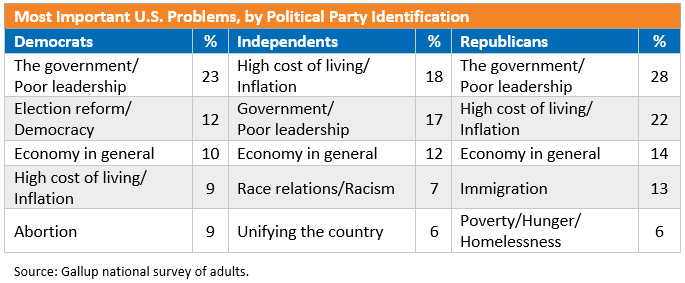
Economic and governance issues remain top concerns of Americans in Gallup’s work this month, with other social issues rounding out the top five. Only among Democrats is “abortion” still a top problem. FiveThirtyEight yesterday also offered analysis on how the issue will play in the midterms. Like any single issue, they caution that a topic that generates turnout isn’t necessarily a predictor in a race or congressional balance of power. Crime and immigration are other trending social issues given to the same analysis. Perry Bacon Jr. also opined on this cause/effect dynamic earlier this week in the Washington Post: “Polls Can’t Predict Elections in Swing States.”
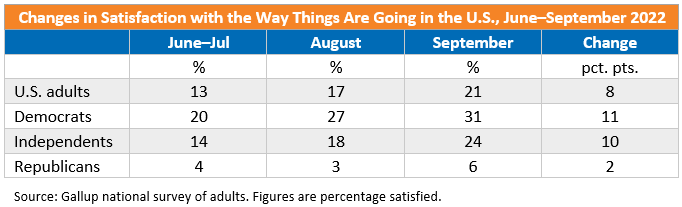
American respondents to polls generally are feeling better about conditions in the US. We guess the July/August equity market uptick, congressional accomplishments displacing the usual political rancor in DC, and on-going pandemic recovery may be contributors. We also would anticipate global inflation-fighting, natural disasters, and a return to partisan dissonance leading into and likely coming out of the midterms could sour attitudes this quarter.
The following graphic shows first-term presidential approval ratings in the September before midterms and the net gain/loss of House seats going back to Jimmy Carter. Since then, only George W. Bush gained lower chamber seats after first-time midterms. Tax cuts and a commander-in-chief rally helped the Texan buck the trend.

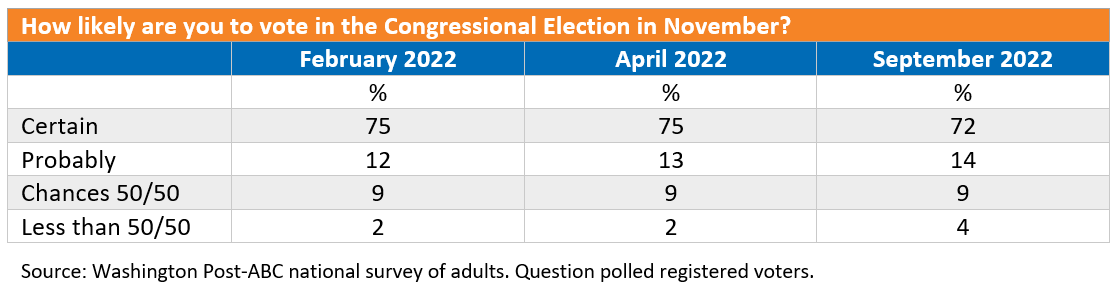
We run the following table only to show that registered voter intensity for the midterms may have peaked according to a recent survey. What remains to be seen is whether a particular voting faction is cooling and whether that’s a disproportionate regional phenomenon affecting national averages. We’d also be curious if this slight change is a pause or the beginning of a late-stage 2022 midterms trend, and whether it is soon to be confirmed in other survey results.
The dean of elections analysis, Larry Sabato at the University of Virginia, recently observed that 40 post-Civil War midterm elections in US modern history isn’t a rich sample size. He validates the notion of a close balance of congressional power regardless of final outcomes. Just as some Americans came to view accumulated pandemic relief as too much too soon, so did many see the Supreme Court’s Dobbs decision as policy overreach.
Crystal ball-gazing aside, Washington’s divisions next year will accurately reflect the country’s multi-year mood. And although polls are imprecise predictors of outcomes, they can also illuminate respondents’ mindset over time. It’s probable that macro risks will dominate policy discussions, headlines, and Americans’ perceptions as monetary policy adjustments of 2022 possibly evolve into fiscal challenges if not outright risks. Despite collectively feeling better about the state of the nation now than at the start of this year, US and global monetary policy outcomes will influence public sentiment. Even in a recession scenario, many Americans would likely prefer a moderate policy agenda to one(s) far to the left or right. Finally, macroeconomic, and geopolitical risk are unlikely to be removed from the public’s view finder any time soon.

