

EU trade commissioner Maros Sefcovic is currently in Beijing trying to convince the Chinese government to enter into a kind of “managed trade agreement” that would restrict the level of Chinese exports of especially hybrid vehicles and other manufactured goods to the EU. The visit represents the last opportunity to reach an agreement between the EU and China, ahead of the 15-16th of October Council of EU leaders meeting in which these are otherwise likely to adopt a more confrontational EU trade approach to China.
Recalling however that the EU has threatened such trade actions before and failed to deliver, and that China were relatively easily able to establish trade escalation dominance over Donald Trump after Liberation Day in April 2025, it is not the base case that Beijing will simply accept the new demands from Brussels without first testing the political cohesion and economic willingness of the EU to confront China.
While a rapidly escalating repeat of the US-China trade confrontation if April 2025 remains extremely unlikely, the probability of a gradual – to a degree managed – escalation in the EU-China trade confrontation is now a very real risk. The joint statement released today from the Beijing meetings however suggests that consultations will continue for now and at least until EU leaders have had a chance to politically evaluate the outcome and prospects.
At its core, the EU’s trade complaint against China is “quite Trumpian”, and focused on the very large bilateral trade deficit, concentrated in cars, machinery and other manufactured goods running at around €100bn/quarter, or as EU politicians like to frame it “more than €1bn/day” (figure 1). The EU argument is that this trade outcome has arisen from systematic Chinese subsidies and other practices against the spirit and letter of the WTO.
Figure 1 EU – China Goods Trade Balance By Goods Category, Q1 2021 – Q2 2026 (€billions)
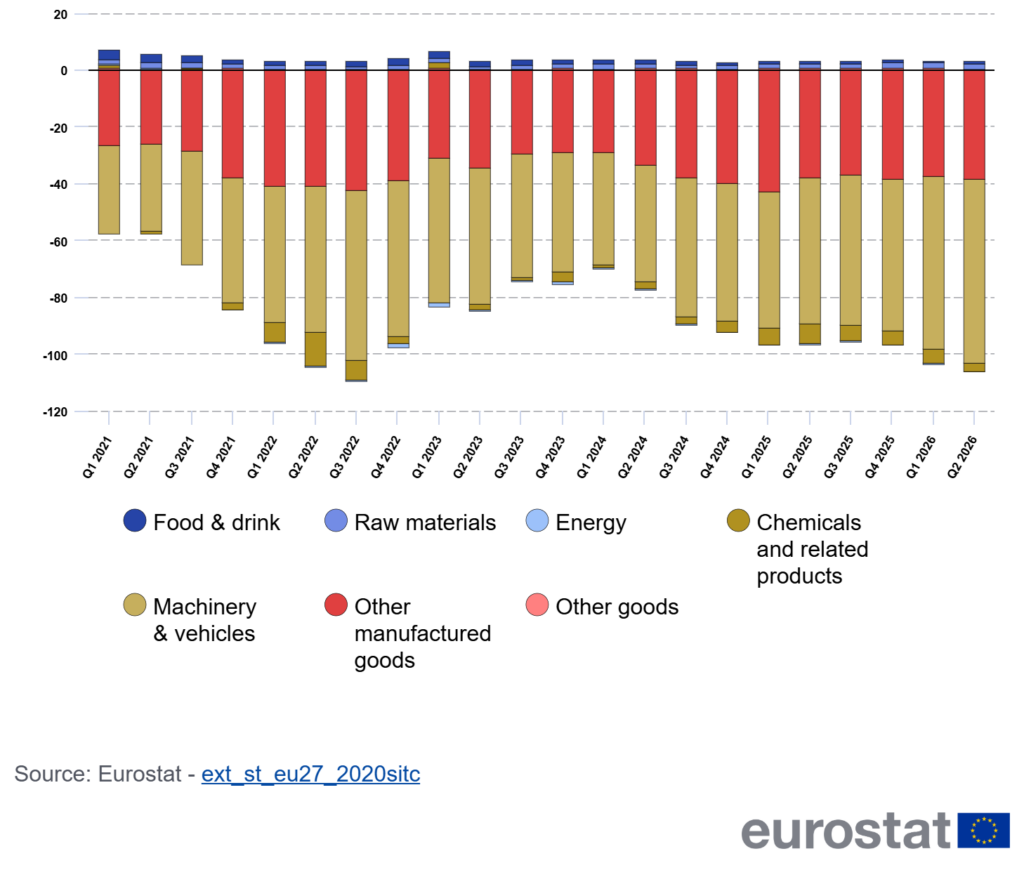
China’s rapid accent up the technological ladder, today posing a very direct competitive threat to the EU, but also third country export markets, across the entire range of manufactured goods, makes the current trade status quo no longer acceptable for especially Germany.
German firms have in recent decades invested heavily in China, and until recently earned a lot of money in the Chinese market, meaning that Germany was always willing to accept relatively unrestricted access for Chinese firms to the EU market. It was after all a “win-win trade relationship” for Germany, both exporting and importing intensively to China. Until today therefore Berlin has always blocked a more forceful EU trade policy vs. China, advocated by other member states and especially France.
A combination of China’s increasingly over-supplied and competitive home market, and Chinese firms’ successful strategy to increase global exports of especially core German products like cars, has now changed the German calculus. The Federation of German Industry (BDI) in late September published a new position paper, for the first time explicitly accepting that a trade strategy with China resulting in “near-term costs” would be preferable to the status quo prevailing in the longer run. Combined with the political challenges facing Chancellor Merz after regional election losses, this has shifted Germany’s position on trade with China far closer to the more confrontational position of France.
Reflecting this shift in the German position, France and Germany last weekend published a joint paper on Chinese trade, clearly timed to provide political ammunition for Sefcovic in Beijing. Substantively, the paper proposes two fundamental shifts in the EU’s approach to trade, focused on giving the EU a credible “second strike retaliatory capability”.
First, it calls for expanding existing EU trade defenses (safeguards, anti-dumping, etc.), and not just adding EU bureaucrats to bring more cases, but legally enable cases to cover “sector-wide trade disruptions” rather than narrow categories of goods as seen until today in EU anti-dumping cases against for instance Chinese EVs. This could in particular unlock wider-ranging traditional EU trade actions against China on broad categories of chemicals, rather than just individual compounds.
Secondly, France and Germany proposes new trade tools that would empower the European Commission to demand that EU companies diversify their supply chains away from a single dominant supplier (in China), and would create a new “instrument for decisive and systemic reaction”—e.g. a retaliation tool—that would “allow for a decisive and systemic reaction to cases where third countries seek to undermine the restoration of a level playing field and fair market conditions by political or economic means.” The aim here is to allow the EU to rapidly retaliate in a surgical and proportional way to Chinese escalation, in the hope that this would deter Beijing from acting in the first place.
To make the rapid reaction mechanism credible, France and Germany further propose important procedural shifts to, unlike today where a qualified majority must endorse retaliation, enable the Commission to deploy the rapid reaction mechanism unless a qualified majority of member states are opposed.
The Franco-German paper does not equal EU policy, but should help make it clear to Beijing that “this time is different” and that the EU’s is now serious in wanting to change the bilateral trade relationship. The recent calling of early elections in Spain, currently China’s arguably closest trade ally inside the EU, may shuffle Beijing’s opportunities to sow division among EU members, but it remains unlikely that China will simply accept the EU’s demands.
The new EU-China Trade and Investment Consultations, of which Sefcovic’s visit is part, may therefore be headed for stormier waters. The EU will hope that the combination of its new upped political stance and the domestic economic crisis in China, making access to the EU market more important for China, will lead to a new understanding.
The “Joint Statement at the Second Regular Meeting of the China-EU Trade and Investment Consultation Mechanism” released earlier today, available on the MOFCOM website, offers some hope that consultations will continue and ultimately prove successful.
The statement includes a joint “an understanding on hybrid vehicle trade in compliance with WTO rules” – this could mean tariff rate quotas (TRQs) for such vehicles – and a commitment that “China is willing to continue facilitating export licensing approvals for rare earths and permanent magnets to Europe through the “green channel” mechanism”. Hybrid vehicles and rare earth are among the most contentious issues, so this suggests that something of substance has been agreed.
The statement released by MOFCOM is though at the same time sufficiently vague that the actual degree of progress cannot immediately be discerned, and the question now becomes if this will prove sufficient for the EU leaders meeting next week. Maros Sefcovic is a seasoned political operator, so his signing up to a joint statement of this nature suggests a modest degree of optimism is warranted.
What is clear from the statement is that contentious issues have been discussed and “understandings reached”, meaning that the EU-China trade relationship has not deteriorated to the point where “auxiliary offsetting goods purchases” (e.g. like Chinese commitments to buy U.S. soybeans, or in this case Airbus’es) is the most concrete outcome of the dialogue.
Whether however these understandings will substantively change the EU-China bilateral trade relationship and balance in key specific sectors, however, remains to be seen. EU political leaders will get their say next week, but it does suggest that any escalation in the EU-China trade confrontation has at least been postponed.
The devil will as always in trade negotiations be in the details, but the EU’s October deadline has come, and will likely be exceeded. This should at a minimum be good near-term news for EU and Chinese firms dependent on bilateral trade and supply chains for critical minerals.
Jacob

