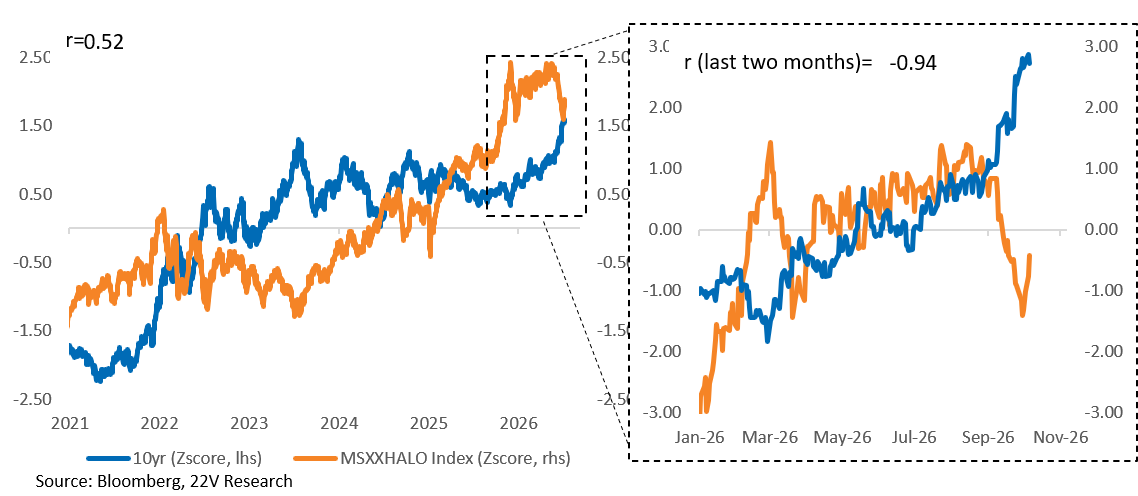
DAILY STRATEGY: Starting with Mark to Market – Our call now is that bond vol has peaked and is likely to move lower. Bond Vol has declined this week and if that continues would help Risk-on factors. Unfortunately, we are less confident bond vol will decline if kinetic activity in the gulf increases again. Most clients we talk to believe escalation in the gulf is coming and the news flow is moving in that direction. That makes pressing a lower bond vol call tough.
We Are Negative on Non-AI Cyclicals (Banks, Retailers, Industrials, Transports) but now is not the time to press shorts in those stocks. The recent drawdown in Non-AI Cyclicals, into what will be another strong earnings season with the Fed shock behind us is the driver of the improved short-term risk reward for non-AI cyclicals.
The post-earnings period should offer a better opportunity to re-engage on the short side. Longer term, our call remains that economic growth WILL slow adding a headwind to non-AI Cyclicals. When inflation finally moves lower and the Fed stops hiking or is biased to cut, that will be the time to be long small caps and non-AI Cyclicals on a medium-term basis (8-12 months).
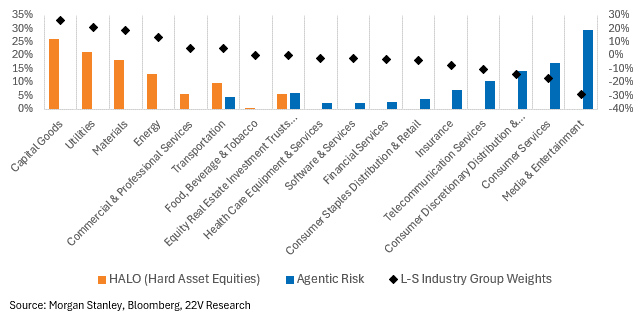
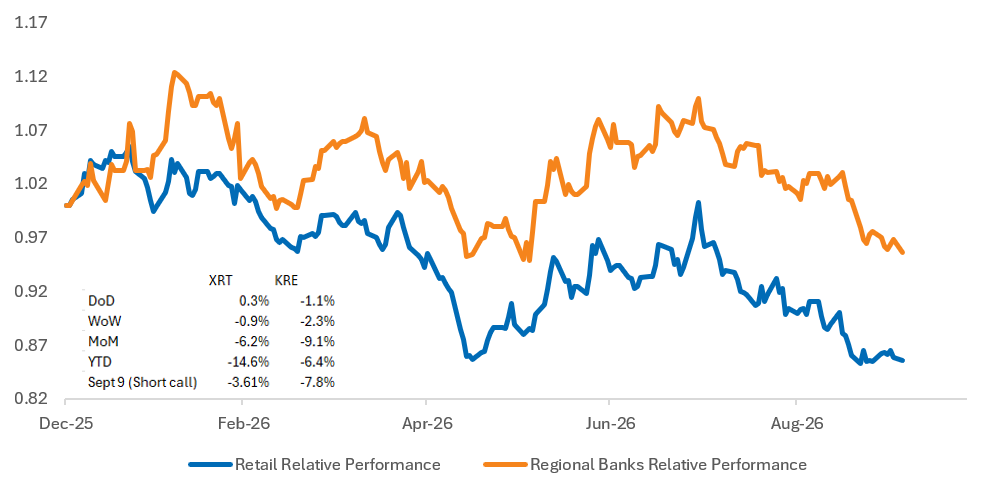
Many Non-AI Cyclicals have bounced recently, but not all. Regional Banks (KRE) and Retailers (XRT) continue to underperform. We missed the idio risk from consumer AI agents, which pressure margins by lowering switching costs and finding deals. Positioning for bounces in non-AI Cyclicals requires finding stocks with less risk from AI agents – look for Cyclicals with more exposure to heavier physical assets (“HALO”). This theme was popular as a hedge against AI disruption earlier this year. It serves a similar purpose now by being less susceptible to consumer agents and has the right Cyclical tilt for the macro backdrop.
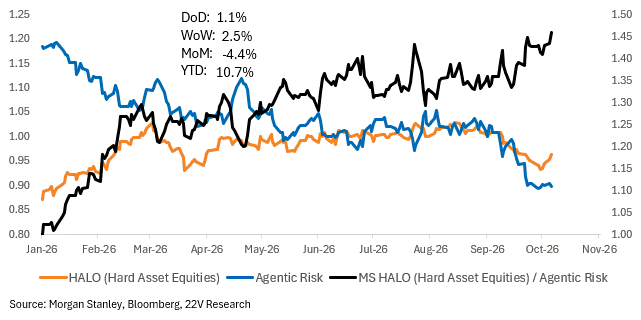
Morgan Stanley’s HALO basket (MSXXHALO) has been rebounding since the labor data, outperforming the S&P 500 and outperforming MS’s AI agent risk basket (MSXXARSK). FYI, the industry group exposures are helpful proxies for where AI agent risk is and isn’t.
Bill Hebel, 22V Financials analyst, gives his take on AI agent risk to Banks, including relative winners within the group. Bill’s most valuable add is by finding relative winners. Drawing on his buy-side experience, he combines deep ownership of his models with a stock picker’s skepticism to identify subtle shifts and mispriced opportunities before consensus.
From Bill on consumer AI agents…
“Adoption is a behavioral finance problem. It hinges on whether banks would allow agent access, whether people would trust agents with lower-stakes tasks first (like cancelling unused subscriptions), the added fraud risk of hacked agents, and who makes customers whole after a loss. They expect some portion of deposits to eventually move, but not zero impact is not the same as big impact: banks will defend themselves, and since it’s a spread business, any higher deposit costs would likely be passed through as higher loan pricing. Their view is that deposit optimization will be one of the slower-growing agentic use cases until clearer frameworks and
Bill upgrade KeyCorp and M&T.”
For investors looking for a more defensive name with earnings upside and strong credit and interest rate risk management profile, we would recommend MTB.
On Key…we’re ahead of consensus for the next 2Q’s and have one of the largest PTPP beats relative to our coverage for FY’27. As such we’re upgrading to Sector Outperform.”
Charts…
Non-AI Cyclicals that have AI agent risk, like Regional Banks (KRE) and Retailers (XRT) continue to come under pressure despite a more constructive macro backdrop. Focus on the non-AI cyclicals with less exposure to AI agent risk, like HALO (hard asset, limited obsolescence).
Source: Bloomberg, 22V Research