

This report updates the signals on China’s outlook from our proprietary China Economic Sentiment Series (CHESS) tool. CHESS uses LLMs to assess the sentiment of Chinese economists writing in the domestic financial media and in analyst reports. The result is a quantitative and visual expression of how views toward the economic and financial outlook are evolving.
China’s macroeconomic environment this year has been very subdued, with strong exports only partially offsetting the impact of weak domestic demand. Our annual China investor trip last month found few expectations of major stimulus coming along anytime soon (link HERE).
In recent weeks, however, Beijing has stepped up the pace of incremental policy support:
- Financing for the “six networks,” an AI-focused infrastructure program announced last year, finally started to translate into activity on the ground in September. This was likely one factor behind a decent PMI reading for China last month.
- On September 29, PBOC announced a mortgage interest subsidy to help revive property demand, and a series of actions to further boost financing for the “six networks.” (see our write-up HERE).
While some analysts refer to these moves as a “mini-pivot,” our own take has been skeptical. We see the actions as too small and too narrow to revive property or provide a meaningful boost to growth. The latest signals from our CHESS tool, which compiles the views on economic commentary within China, echo that cautious view.
- Stimulus Expectations Have Barely Budged
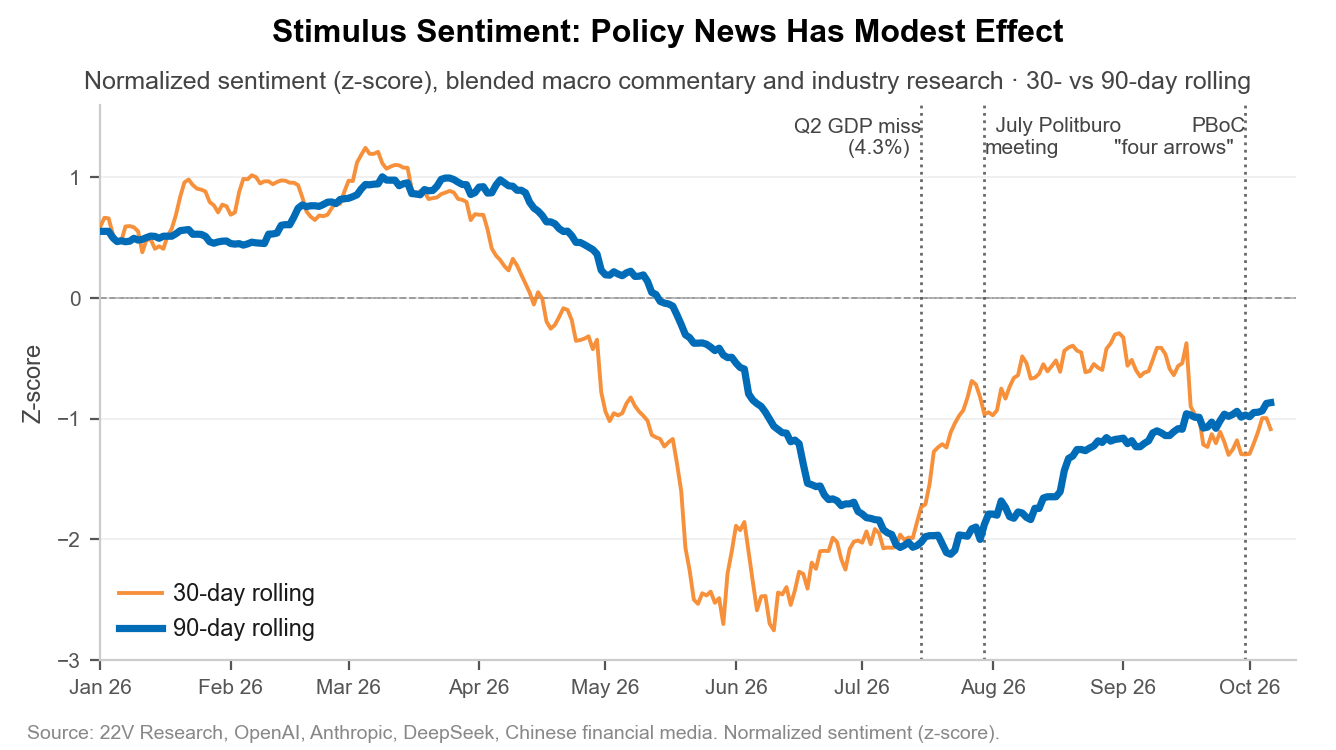
In the chart below, we show analyst sentiment towards the stimulus outlook: our usual 90-day rolling average (blue line), along with a shorter 30-day rolling average (orange line) to better capture reactions to specific announcements.
Stimulus expectations increased in mid-July after a very disappointing Q2 GDP release, which fed hopes that the end-July Politburo meeting on the economy would bring more pledges of support. The very incremental signals from that meeting failed to provide a lift, and stimulus hopes have since drifted lower again. Thus far, the reaction to the PBOC’s September 29 announcement has been quite muted.
- Household Demand is Depressed
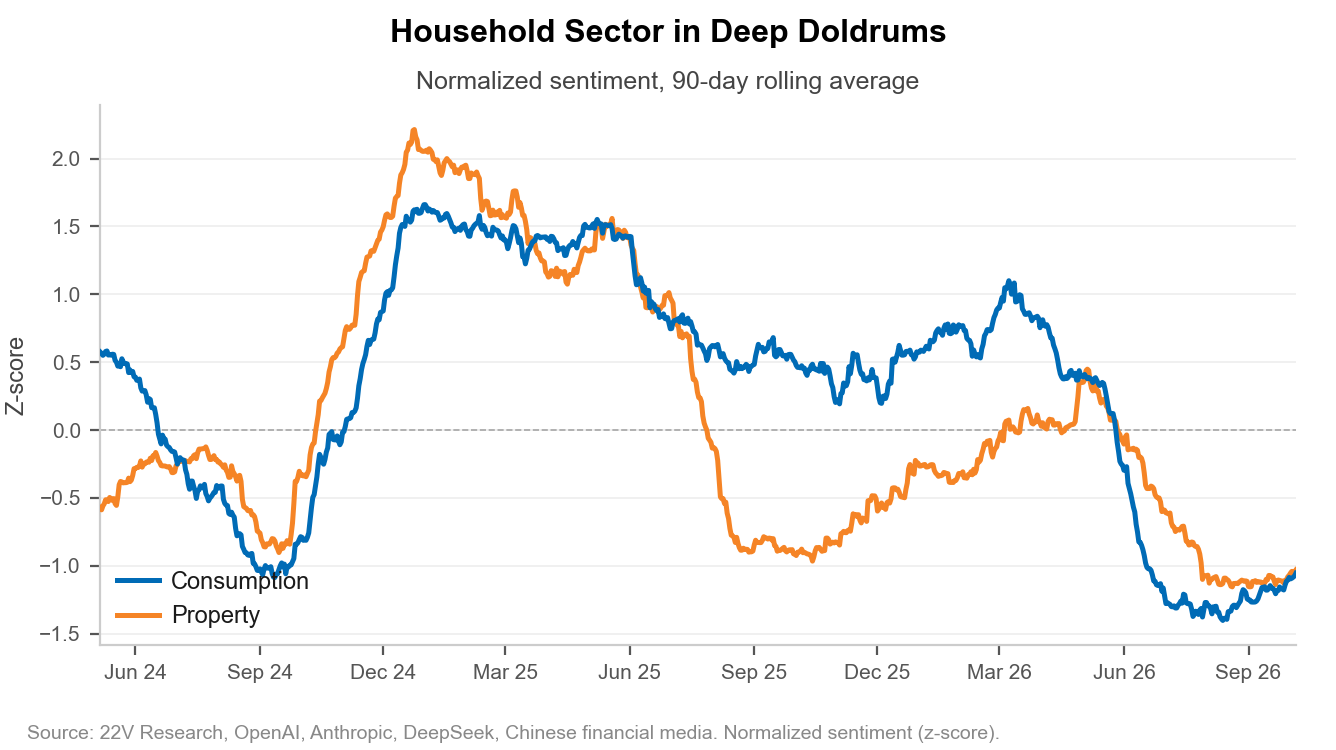
The weak state of private sector demand underscores why more policy support is critical. Demand from the household sector, in particular, is in rough shape. In the chart below, we show analyst sentiment towards consumption (blue line) and property (orange line). Both remain stuck at their lowest levels since before China’s September 2024 policy pivot.
Our analysis has centered on the weak labor market as the key reason why household activity is depressed. That calls for stronger fiscal policy to boost job and wage growth.
- Exports Are the Bright Spot
As has been the case all year, the main support for growth is the external sector. Analyst sentiment towards exports thus far remains quite positive. One of our main watchpoints in the weeks ahead is the state of China-Europe trade relations. The EU’s lead trade official, Maroš Šefčovič, is in Beijing this week to float proposals – such as voluntary export restrictions on hybrid vehicles – to head off protectionist measures coming from Brussels. Chinese interlocutors on our trip were skeptical that the two sides will avoid a “slow-burn trade war” starting this fall but did not view it as a major threat to China’s overall export sector.
In the meantime, analysts have become less positive about the impact of Beijing’s “anti-involution” campaign, which had been an area of enthusiasm since summer of 2025. The campaign seems to be losing momentum and efficacy. A key reason is that lack of demand-side support to the economy, which limits the efficacy and political will of efforts to constrain new supply. 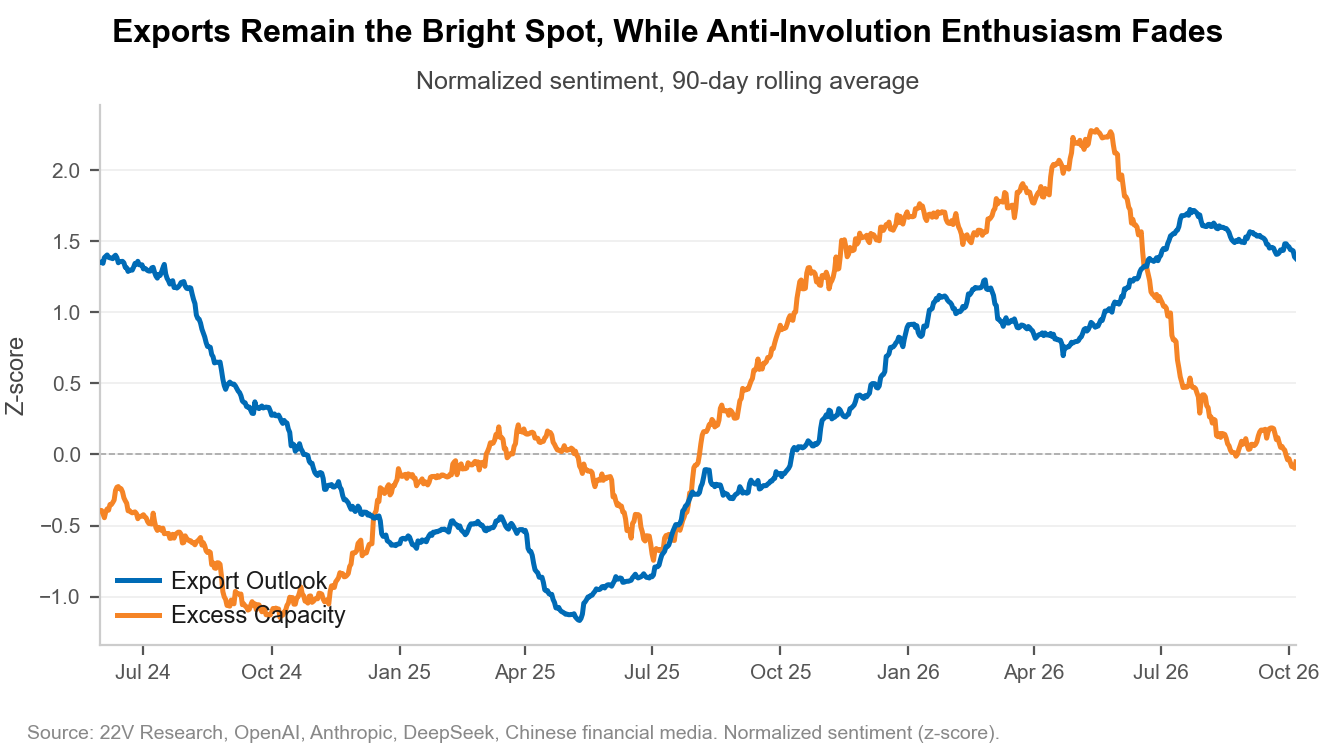
- Bottom Line: Macro and Equity Market Outlooks are Subdued
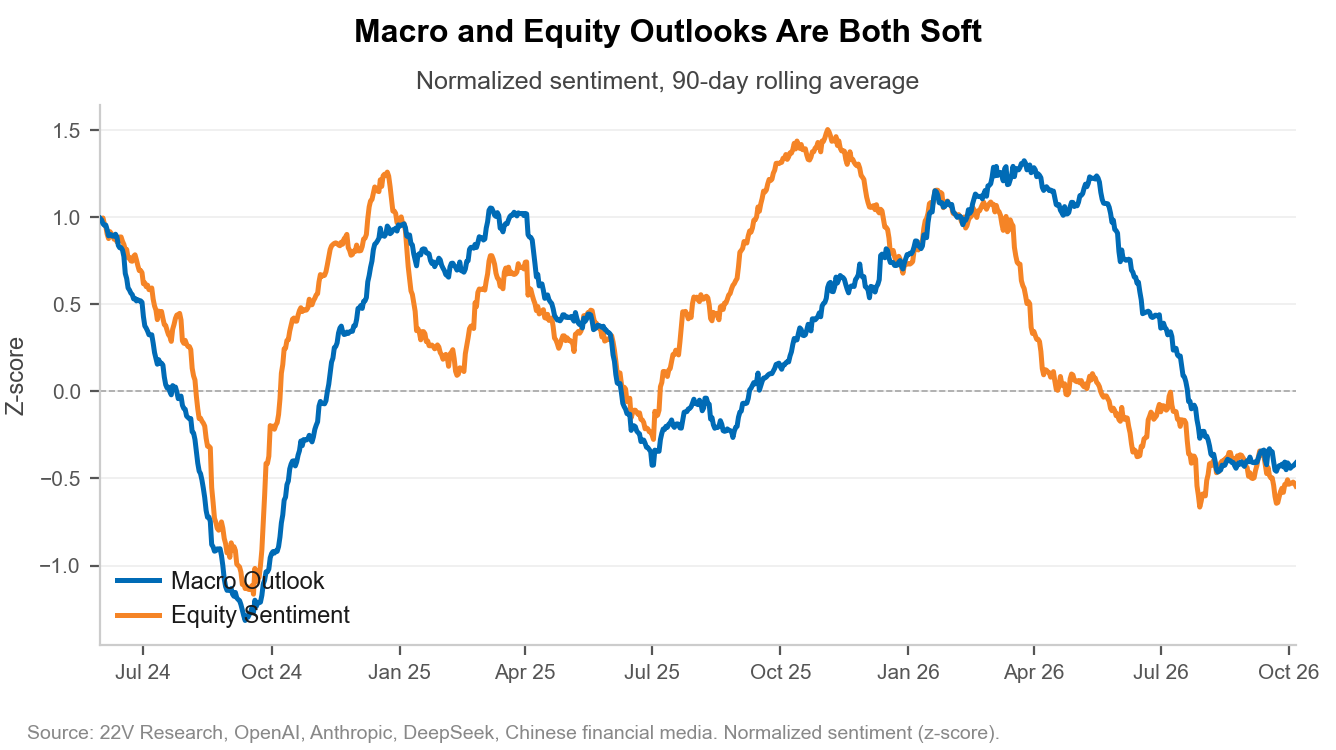
Exports are too small of an economic base to carry overall growth, and especially to drive an improvement in the labor market. The result is that analyst sentiment towards growth is net negative, measured against its historical average.
Analyst sentiment toward the equity market started to decline earlier in the year and has continued to drift downwards. The excitement in the equity market focuses on high-profile tech IPOs, of which more are coming in H1 – likely to include Moonshot AI (maker of the Kimi model), memory chipmaker YMTC, and AI national champion DeepSeek. However, a weak demand outlook limits the hopes for broad profit growth.
Near-Term Watchpoints:
- October 19, China Q3 GDP: Unlikely to move the needle on stimulus
- October 15-16, European Council summit, Brussels: European leaders will meet to determine next steps in the China trade dispute
- October 19-22, Financial Street Forum in Beijing: Policy color from officials and economists
- Late October, Q4 Politburo Meeting on the Economy: Unlikely to bring major new measures, as planners have turned attention to 2027

