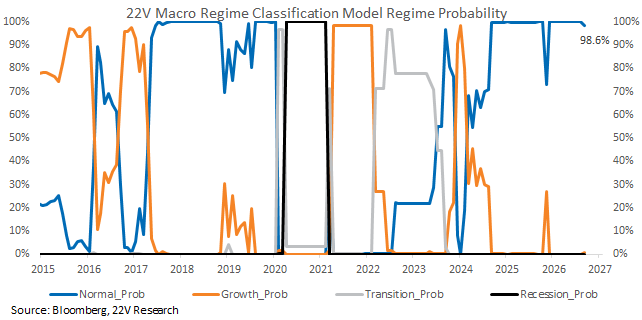
Rising Treasury yields and tighter financial conditions have pressured risk assets, but our Macro Regime Classification (MRC) model continues to indicate a stable Normal expansion. This regime has persisted for more than 2.5 years, with its probability changing only marginally despite the surge in yields and recent market volatility.
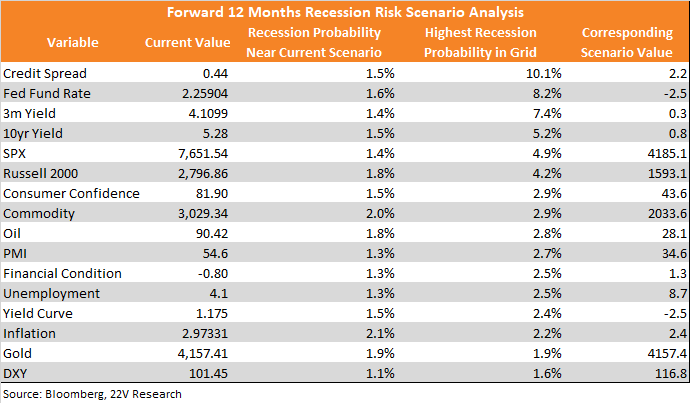
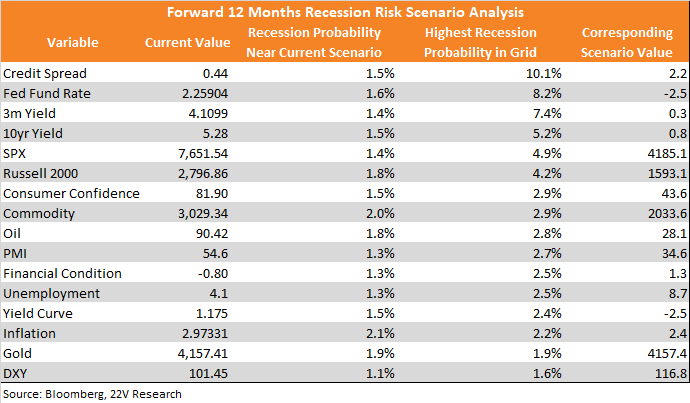
To assess whether further macro shifts could alter that backdrop, we combine a Bayesian vector autoregression (BVAR) with our MRC framework. The BVAR projects macroeconomic variables jointly, capturing their historical relationships rather than assuming they move independently. We then translate these conditional forecasts into regime probabilities over a 12-month horizon. For now, a recession happening in one year is very low, with the highest probability only 10.1% if credit spreads widen sharply.
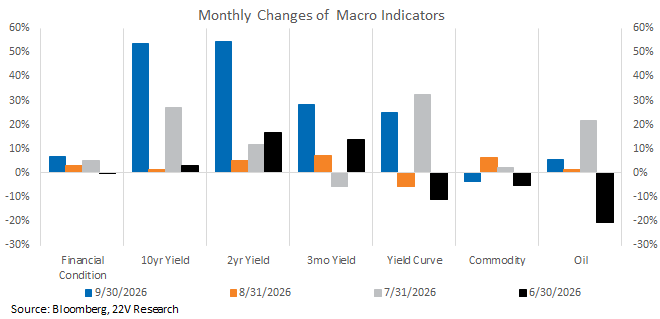
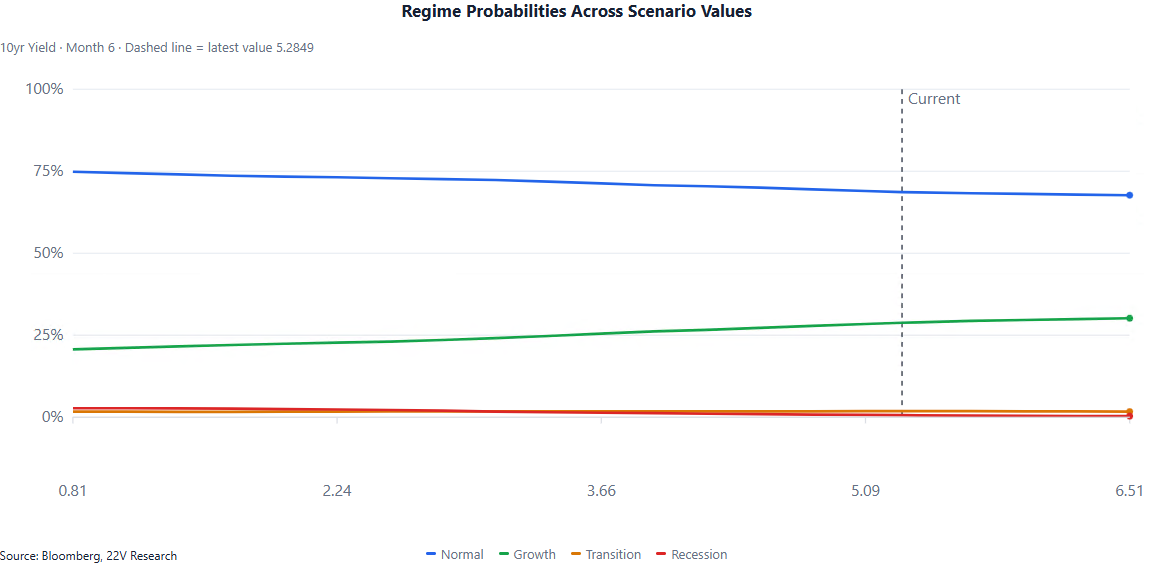
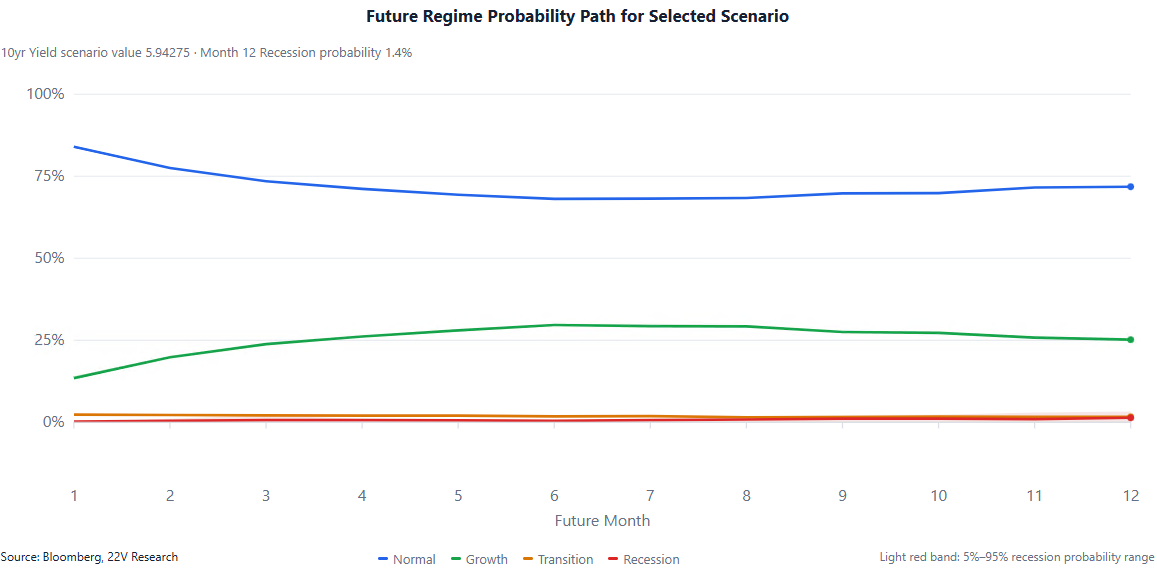
U.S. 10-year rising 53bps in September to 5.28% has been a major macro concern. Nevertheless, other macro data is stable to better over the same period, leaving the odds of being in a Normal economic expansion the dominant projected regime over the next six months (probability is around 70%). Even under scenarios where yields approach 6% leave the one-year regime outlook relatively stable. The results suggest higher yields alone are unlikely to derail the expansion.
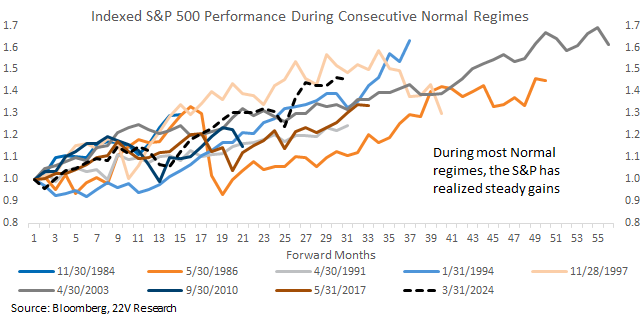
For equities, these findings suggest the downward pressure on equities should be a short-term phenomenon rather than a long-term turning point. Historically, stable Normal expansion backdrops have supported an upward trend in S&P returns, making continued regime stability an important counterweight to concerns surrounding the Fed rate hiking cycle.
Macro Risk from Rising 10yr Yield Remains Limited: Rising 10-year yields and tightening financial conditions have put pressure on risk assets recently. Other macro data have been stable, however, and based on our Macro Regime Classification (MRC) model, the macro backdrop continues to be best classified as one of a Normal expansion regime. That has been the dominate regime for more than 2.5 years.
It is important to understand how forward macro readings may impact the regime classification. Macroeconomic variables rarely move in isolation. Changes in interest rates, inflation, employment, financial conditions and market prices occur together and influence one another over time. So, we have added a Bayesian vector autoregression (BVAR) to model these relationships and to generate joint monthly forecasts.
This forecast framework also allows us to ask conditional questions, such as how other macro readings may evolve if 10yr yields or credit spreads reach a specified value next month. The model adjusts the other variables according to their historical relationships and carries the resulting paths forward over a 12-month horizon. So, scenarios describe conditional outcomes rather than causal effects.

We then feed each projected macro path forward 12 months to our Macro Regime model to get the probability of being in each regime a year from now. This enables us to turn macro scenarios into a view of how the economic regime may evolve. For now, a recession happening in one year is still a very low risk, with the highest probability only at 10.1% if credit spread (measured as Moody Corporate BAA – AAA spread) rise sharply from current 0.44% to 2.2%.
Over the past few months, yields and financial conditions have tightened alongside a backup in oil prices, driven by geopolitical uncertainty. Those have been the macro swing factors with the greatest impact on equities. Yield changes have been especially dramatic with the 10yr yield climbing 53bps in September to 5.28%, the highest level in two decades.
Based on our scenario analysis model, the impact of 10yr yield changes on the forward 6 month macro regime is limited. The odds of being in a Growth regime increase as 10yr yield rise, but the probability of the Normal regime continuing remains at ~70%. This means that taking the co-movement of other macros variables with 10yr yield moves into consideration, the regime is still likely to be at normal expansion.
Even if 10-year yield climb near 6%, the forward one-year regime path is still relatively stable. Growth regime probability rises while recession risk remains low. The impact from rising yield is more near-term than long-term.
The stable forward macro regime is important for risk assets. Investors are concerned about tightening financial conditions and a growth slowdown as the Fed starts a hiking cycle, and S&P return has slowed recently as well. If macro backdrop stays one of a Normal expansion, the recent headwinds should be a near-term pressure than long-term turning point, as the S&P performance have been trending higher in historical stable Normal expansion backdrops.