

I scored the PCE Price data release this morning as somewhere between in line (my take) and somewhat friendly (respecting that the market might process it slightly differently). Maybe the second interpretation is part of the equity firmness. I am not sure.
But the beat / miss aside, it might be timely to reiterate that the underlying trend of inflation appears still to be too high. The 12-month change of the Core PCE Price Index is running at 3%. And the Market Price Only (MPO) Version of the Core implies an underlying rate closer to 3.2%, because non-market prices tend to rise in real terms over time. Let’s split the difference and say the 12-month rate there is 3.1%.
I no longer believe there is really a case for swapping out the lagging government measures of average rents for my proxy of marginal rents, because the gap in the inflation rate there has narrowed a lot, and because the higher precision offered by the government data is now therefore more important. Perhaps we can chop off 40 basis point for tariffs and 20 basis points for energy, which would get us to 2 ½%. But the second one is a bit dubious, because I agree with analysts who have pointed out that this energy shock is reversing less quickly than earlier ones have. Netting out the AI effect, which results from a demand boom, is probably a bridge too far.
As a cross check on my guess of the underlying inflation rate I can take a look at how the MPO version of Core Services inflation is tracking. The 12-month rate there is 3.4%, which maps to underlying services inflation of 3.7%, given the trend term in non-market prices mentioned above. To reiterate, this takes the lagging government measures of rents, which are included, at face value. If we presume that the trend in goods price inflation, ex-tariffs and ex-AI is zero, simply because globalization is in retreat so deflation is no longer likely, then we back into an inflation rate of 2.75%.
These numbers would look somewhat more benign if I were to do the calculations with shorter-term rates of inflation, such as 3- or 6-month. Because of this, I am comfortable with the idea that underlying inflation might be running at 2 ½%, even though I realize there is probably (not certainly) residual seasonality in these data. But that still leaves it about 50 basis points too high at a time of full employment.
The Fed needs to be fighting inflation here. There is no formulation of the conventional reaction function that would imply otherwise. This probably means they need to contain (real) aggregate demand growth to 2% or less, depending on how productivity and labor force growth evolve. I agree with John Williams that they can be deliberate about the timing, because the gap here is not yawning. But the focus remains clear.
With the revisions and August now in
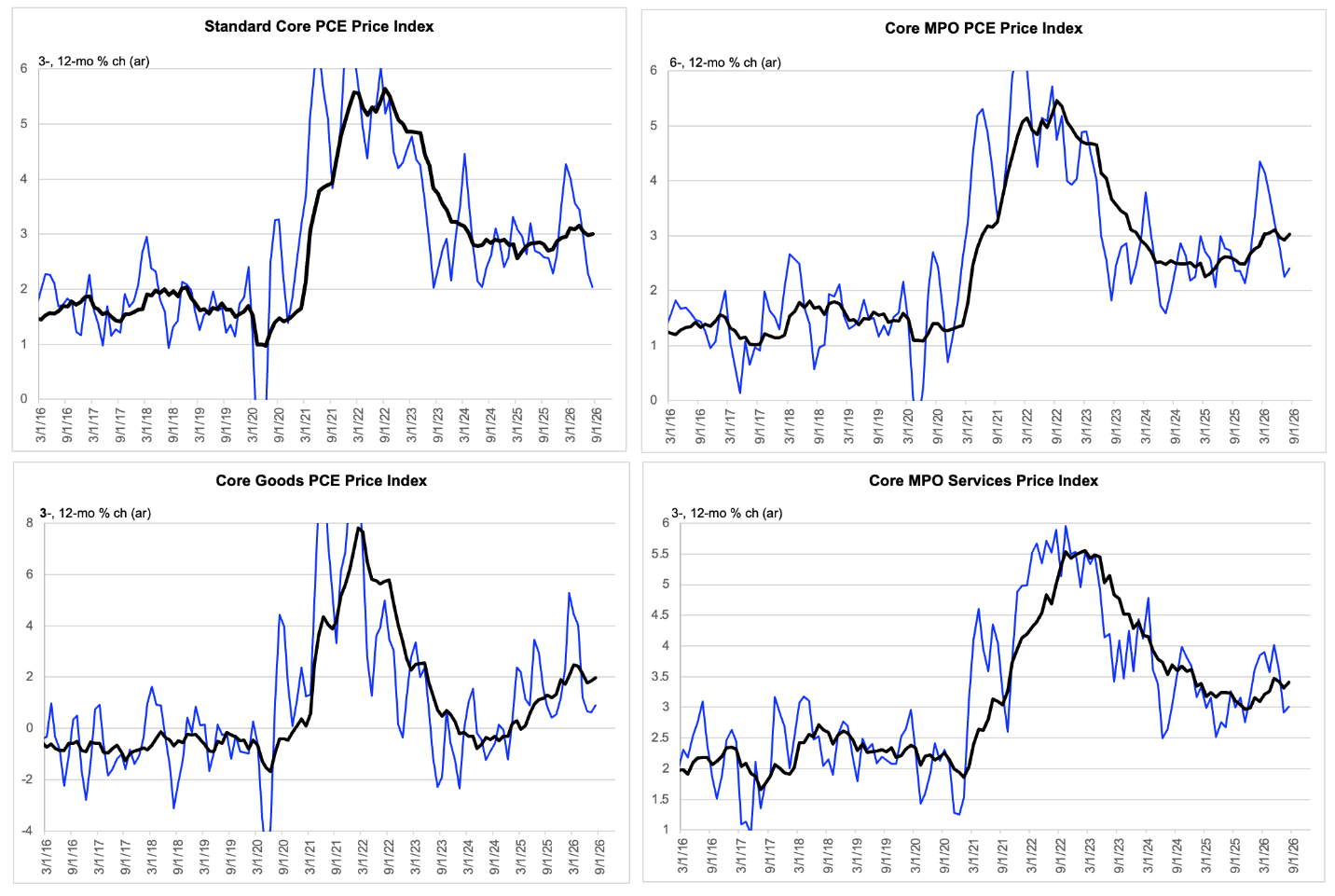
Data are actual to August.

