Back Economic Research

August Core PCE and Revisions Come in Dovish but Still Plenty of Heat

Published on September 30, 2026

∙ Download the PDF Report

By

Peter Williams

August Core PCE and Revisions Come in Dovish but Still Plenty of Heat

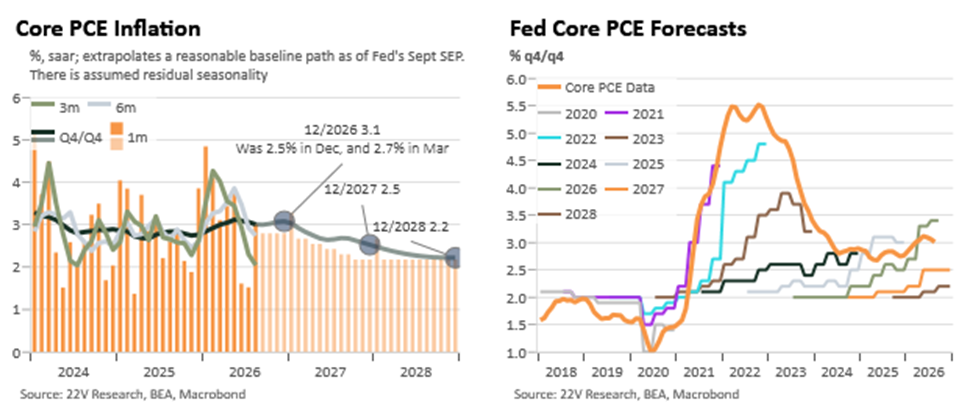
  • The August core PCE print and historical revisions to that data (details from the BEA here) both came in somewhat more dovish than expected. This was due to larger than expected downward revisions to non-market services prices that tend to be more opaque and less cyclically relevant than other areas.
  • These revisions should mechanically take the Fed’s ’26 core PCE forecast down to roughly 3.1%.
  • Given the non-market sources of these revisions and the Fed’s general knowledge of them at the September meeting, beyond attenuating October hike odds, we wouldn’t place too much emphasis on this print for the Fed.
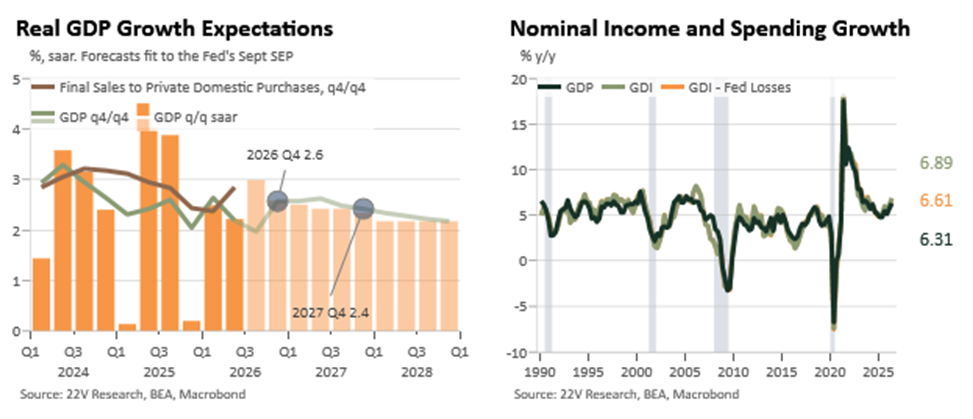
  • Real GDP growth was notably revised higher in ‘26H1 and should mechanically raise the Fed’s forecast for this year by at least 30bps to 2.6% with upside risks.
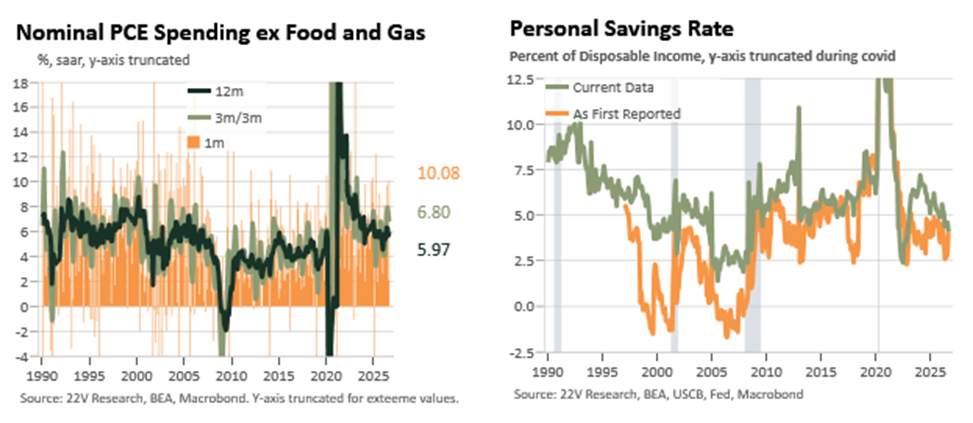
  • Nominal spending trends remain very strong and after a bit of summertime slowdown August’s PCE spending data grew at an almost 11% m/m saar pace. Nominal core spending is growing at or above 6% in recent months.

A More Dovish than Expected PCE Revision Won’t Shift Fed Policy Baselines Near-term

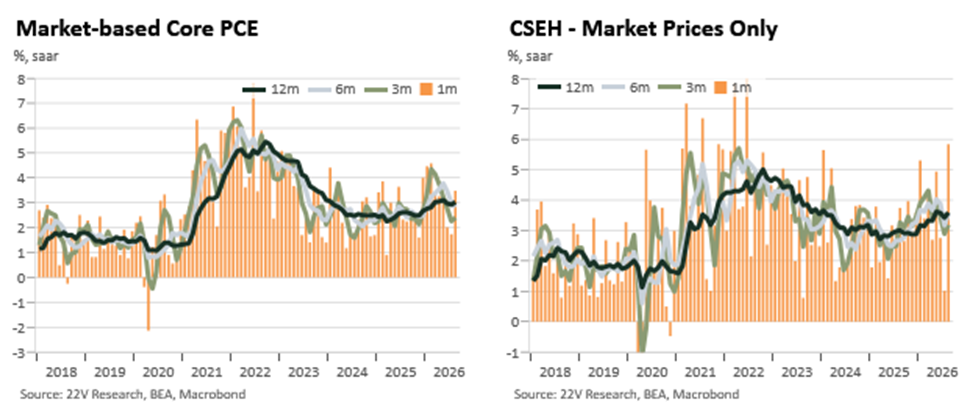
Parsing the core PCE data for August and the broader recent trends is notably complicated by the benchmark revisions. Those revisions were driven by shifts in the noisy non-market categories which do matter because they impact topline inflation reads but are also less cyclical and noisier and often given a bit less weight than the signal from the market-prices only components of the PCE data. The revisions were notably larger than expected with our read of consensus expected a 3.2% post-revision core PCE print and we got 3.0%.

For core PCE excluding non-market prices, the revisions are basically a wash but the recent topline prints had also been a bit less problematically hot (not that 3% is a great inflation number). August’s core services ex housing and non-market prices, sometimes cited as the least noisy cyclical signal in the inflation data, was the hottest m/m print since summer 2022 and has shown much less disinflationary progress (in that it has moved notably higher) than other measures across the last few years when making allowances for tariffs and the war.

Fed officials have not been particularly clear if their Sept SEP forecasts included the revisions, but it seemed unlikely that they had with 3.4% as their baseline. They would have been aware of them, which means that their policy action reflected something like the 3.2% consensus and staff estimates for core PCE. Given the broader cyclical shifts at the Sept meeting it seems highly unlikely to me that the Fed would have not hiked if it had this data in hand at the time of the meeting given the underlying changes in the outlook and risk balance. I would similarly discount those who are saying that inflation is now at target based off the past 3m of core PCE data, which does look much more benign now at a topline level but residual seasonality concerns, temporary disinflation from tariff refunds, and shifting inflation risks should add great caution to that short-term good news.
The Growth Data is Unambiguously Hotter

The activity side of the August data and positive revisions across recent history paint notably modestly picture of the economy. Real GDP growth in Q2 was revised up to 2.2% from 1.5%, and Q1 was revised up from 1.2% to 2.5%. Nominal growth remains too strong overall, even though it is largely expected to cool some from its current pace as the year goes on although nowcasts for Q3 suggest a bit of caution on that point. Given that the labor market data don’t point to substantial negative revisions, these figures imply notably stronger productivity growth in recent quarters and attenuate, although not fully eliminate, some of the cautions there.

After a somewhat slower summer, personal spending was extremely strong in August. Nominal core spending growth saw a roughly 10% m/m saar pace and is growing at or above 6% on a trend basis. This pace of growth seems inconsistent with inflation’s return back to target over time barring a move higher in productivity growth to its fastest ever sustained pace, given that labor supply growth is so slow at the moment.

The income data was also revised up by a bit more than 1% cumulatively across its recent history, with much of the growth rate revision farther back in time given the source data which is incorporated into the benchmark revisions. The main effect of this was to substantially raise the savings rate across 2023-25. This chronic pattern of lagging upside revisions is one of the reasons we have been and remains very cautious, bordering on actively hostile against, savings rate based views of an inevitable consumer retrenchment. Current nominal earned income growth is notably slower (4-4.5%) than spending trends but consumer credit and net worth trends do not suggest that that is unsustainable over any reasonable forecast horizon and much of the gap may be closed by revisions in time.
DISCLOSURES AND DISCLAIMERS

Analyst Certification

The analyst, 22V Research Group, primarily responsible for the preparation of this research report attests to the following: (1) that the views and opinions rendered in this research report reflect his or her personal views about the subject companies or issuers; and (2) that no part of the research analyst’s compensation was, is, or will be directly related to the specific recommendations or views in this research report.

Analyst Certifications and Independence of Research.

Each of the 22V Research analysts whose names appear on the front page of this report hereby certify that all the views expressed in this Report accurately reflect our personal views about any and all of the subject securities or issuers and that no part of our compensation was, is, or will be, directly or indirectly, related to the specific recommendations or views of in this Report.

22V Research (the “Company”) is an independent research provider. The Company is not a member of the FINRA or the SIPC and is not a registered broker dealer or investment adviser. 22V Research has no other regulated or unregulated business activities which conflict with its provision of independent research.

22V Research, LLC is a professional services and independent publication organization. 22V Research, LLC is not a securities broker-dealer, not a member of the Financial Industry Regulatory Authority (FINRA), not a registered investment advisor (RIA) and not a member of SIPC.

Securities transactions, when offered, are offered by 22V Securities, LLC through LPS Capital, LLC. Certain employees of 22V Securities, LLC are dually registered as securities representatives of LPS Capital, LLC or Analyst Hub Securities, LLC. 22V Securities, LPS Capital and Analyst Hub Securities are members FINRA, SIPC.

https://brokercheck.finra.org/

Current Ratings Definition.

SECTOR OUTPERFORM: An “outperform” rating anticipates the company will outperform the S&P Regional Banking Index (peer group).

SECTOR PERFORM: A “market perform” rating anticipates the company will perform in line with the S&P Regional Banking Index (peer group).

SECTOR UNDERPERFORM: An “underperform” rating anticipates the company will underperform the S&P Regional Banking Index (peer group).

Limitation Of Research And Information.

This Report has been prepared for distribution to only qualified institutional or professional clients of 22V Research Group. The contents of this Report represent the views, opinions, and analyses of its authors. The information contained herein does not constitute financial, legal, tax or any other advice. All third-party data presented herein were obtained from publicly available sources which are believed to be reliable; however, the Company makes no warranty, express or implied, concerning the accuracy or completeness of such information. In no event shall the Company be responsible or liable for the correctness of, or update to, any such material or for any damage or lost opportunities resulting from use of this data. Nothing contained in this Report or any distribution by the Company should be construed as any offer to sell, or any solicitation of an offer to buy, any security or investment. Any research or other material received should not be construed as individualized investment advice. Investment decisions should be made as part of an overall portfolio strategy and you should consult with a professional financial advisor, legal and tax advisor prior to making any investment decision. 22V Research Group shall not be liable for any direct or indirect, incidental or consequential loss or damage (including loss of profits, revenue or goodwill) arising from any investment decisions based on information or research obtained from 22V Research Group.

Reproduction And Distribution Strictly Prohibited.

No user of this Report may reproduce, modify, copy, distribute, sell, resell, transmit, transfer, license, assign or publish the Report itself or any information contained therein. Notwithstanding the foregoing, clients with access to working models are permitted to alter or modify the information contained therein, provided that it is solely for such client’s own use. This Report is not intended to be available or distributed for any purpose that would be deemed unlawful or otherwise prohibited by any local, state, national or international laws or regulations or would otherwise subject the Company to registration or regulation of any kind within such jurisdiction.

Copyrights, Trademarks, Intellectual Property.

22V Research Group, and any logos or marks included in this Report are proprietary materials. The use of such terms and logos and marks without the express written consent of 22V Research Group is strictly prohibited. The copyright in the pages or in the screens of the Report, and in the information and material therein, is proprietary material owned by 22V Research Group unless otherwise indicated. The unauthorized use of any material on this Report may violate numerous statutes, regulations and laws, including, but not limited to, copyright, trademark, trade secret or patent laws.
