

There are a lot of moving parts in the upcoming release of the PCE price data for August, mainly because of the scheduled methodological changes and revisions that people have been talking about for a couple months now.
I tried to distill all that complexity down to a sense of how the 12-month rate of underlying goods and services price inflation might look if the consensus estimates for both August and likely revisions were to be realized. The basic conclusion was that inflation would appear meaningfully too high and for reasons that could not be dismissed as transitory. That was hardly some novel insight. The point was more that not that much would change.
But on Wednesday, I guess the first item of business will be to figure out if the data were warmer or cooler than expected. And on this point, I think it is probably wise to skip – for this month – the usual fine slicing of the detail (in the consensus) view and limit ourselves to the higher-level aggregates, simply in the interest of containing complexity and avoiding some dumb calculation error.
So, with that in mind, let’s start with what we think we know – about what consensus is expecting. The monthly change of the Core PCE Price Index is expected to be +27 basis points, please forgive the usual false precision. And the Market Price Only (MPO) version of that is expected to be slightly firmer because financial services prices are expected to be soft, although there is a bit of dispute around that, so please don’t hold me to the basis point on even where consensus is. Because housing (or rents) are known to have been quite soft (in rate of change terms) during July, this means that the Core PCE excluding housing is expected to be quite warm. Ok, that is quite straightforward. There is a good chance the analysts were again quite close, so the beat or miss might actually be hard to sign, which in turn would make it not that important.
Let’s ask a more limited set of questions — about consensus — this month
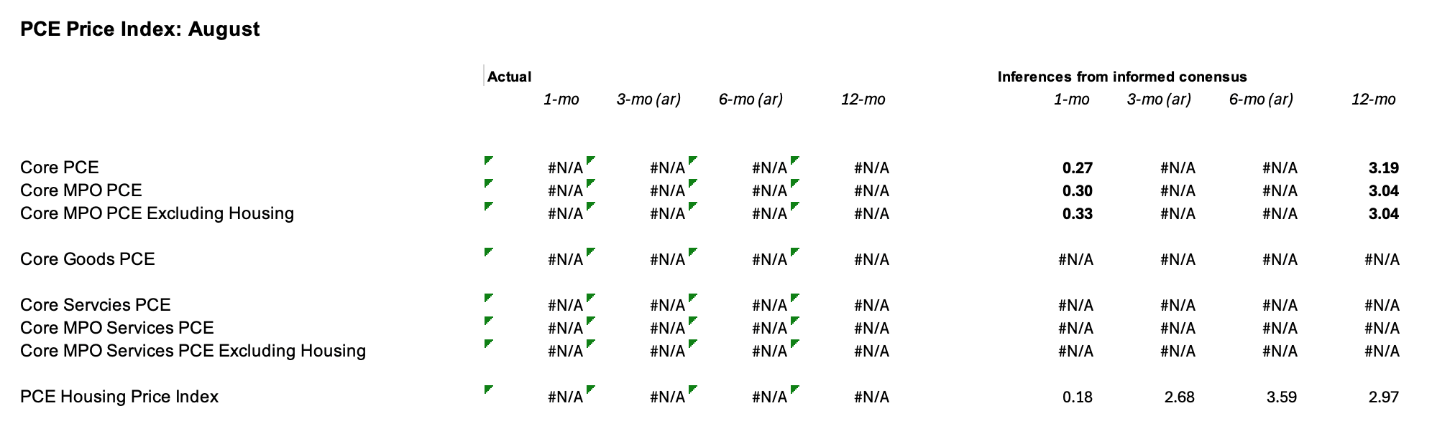
Consensus estimates shown on ride side of the table incorporate effects of expected methodological changes on both the August result and the data through July, affecting the 12-month rates.
There is more wood to chop in the effect of the revisions. So far as I can tell, the consensus has the 12-month change of the Core PCE printing 20 basis points lower in August than it would have without the revisions and methodological changes.* And that is incorporated in the right column of the right side of the table above. (The left side will populate when the data come.) There is some dispute around that estimate because the analysts are not sure exactly how the revision to the financial services prices will play out in real time. Maybe some of the effect of the revised methodology comes in the contemporaneous month or maybe it will show up fully only in the more seasoned vintages. Because of this dispute, and because I think it is best just always to bracket the effect of those financial services prices, I will be paying more attention to the beat or miss in the MPO version of the Core, expressed as a 12-month rate of inflation. With a bit more precision, I think the consensus there will be for a gain of 3.04% (false precision). And keep in mind that any beat or miss there will be concentrated in the MPO version of the so-called SuperCore, services excluding housing. The reason is twofold. First, the consensus is most likely to be very close for housing and goods, as always. And second, the effect of the methodological changes are concentrated there, as is the uncertainty around them. There is less uncertainty in the MPO than in the standard services measure, as discussed above. But even with that, this point still holds.
Once we get past the beat or miss discussion, we can shift back to the fine slicing and dicing of the underlying detail to see how the picture looks in absolute terms, away from the beat or miss. But it is probably wise to be careful about the sequencing of our efforts here.
* I notice some analysts like to compare the unrevised data in July with what the expect post revision in August. I think such a comparison is not that relevant, because everybody knows the revisions are coming. Again, sequencing.

