After 3.5 Years, a Regime Shift in Rates Markets
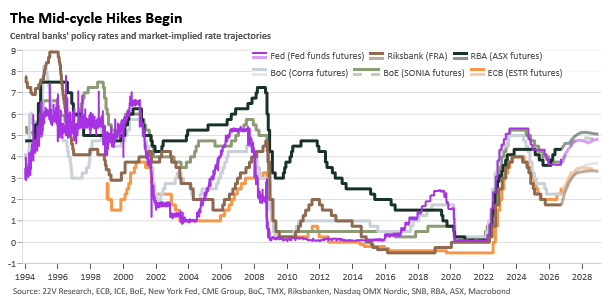
Market pricing now effectively assumes that the Fed will undo nearly all of its rate cuts from the ’24-25 easing cycles with 5 total hikes priced. Realizing even the more hawkish sets of dots would be consistent with a substantial rally in bonds and likely risk assets, particularly for equity internals. It will be a sign of inflation fighting success (or a lucky string of benign prints) for the front-end to return to trading with labor market and growth surprises rather than inflation and a currently open-ended chase for ‘appropriately restrictive,’ after getting through the upper end of neutral rate views later this year.
Perhaps the title of this note is a bit obvious when rates have moved so far so fast, but the distinct shift in the drivers of rates is worth highlighting and keeping in mind going forward.
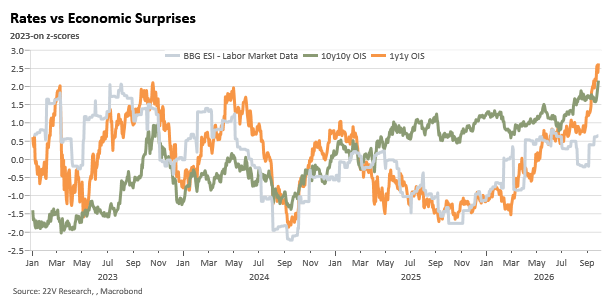
The top chart below is one of my favorites of the past couple years and I have sent it out on occasion. It shows that near-term policy rate expectations (1y1y swap rates) have largely moved in line with labor market surprises since 2023. Before that inflation had been the dominant driver but once we got the peak of the hiking cycle the dynamic shifted and this held through both rounds of cuts in ’24 and ’25 as well as the mild cyclical rebound since the turn of the year. Over this time, longer-dated rates had been increasingly separated from movements in near term rates on a fairly steady path higher since the election in 2024. LT rates seemed to be increasingly moving in response to post-covid structural shifts and a higher view of neutral while the front-end was continuing to play a clear cyclically stabilizing role around a too benign, 3.5% or so, neutral rate assumption (one could also observationally equivalently say that LT rates were going where they needed to in an attempt to provide some degree of counter-cyclical restraint given the Fed’s impact on the front-end).
That dominant relationship still held until the July FOMC meeting when the whole rates complex began its sharp move higher, led by the front-end. The recent move in rates seems to be reflecting a shift back to inflationary concerns, the impacts of the AI boom, and a broader rerating higher in views of neutral or appropriate policy over a cyclical horizon.
- With rates markets having priced in 5 cumulative (inc. Sept) hikes now, we have clearly moved past most views of baseline policy outcomes, allowing for strong odds of a much more notable into more clearly restrictive territory. The Fed could get pulled towards or past current market pricing with further upside inflation surprises, relative to the Fed’s fairly benign forecast, and a urate at or below 4% in ’27.
- That risk assets have held up as well as they have in the face of this move higher seems consistent with the idea that we are largely seeing a repricing higher in neutral and appropriate policy, given the various shocks, strong growth data, and lack of sufficient disinflation, rather than outright cyclically risky policy.
- The increasing asymmetry of rates markets to oil price moves, with much greater upside correlation than downside, seems consistent with a recognition that the previous level of rates was not sufficiently restrictive to prevent second round effects and that those effects are not made better by small declines in oil so long as it remains well above pre-war levels (>80$). The market has also likely internalized that the feared growth impacts of the first round of the war never really showed up in the US growth data, requiring proof of downsides now rather than assuming them.