

And so it begins for the ECB, where three of the five executive board members – Philip Lane in May 2027, Christine Lagarde in October 2027 and until now Isabel Schnabel in December 2027 – are scheduled to step down in 2027. The ECB and IMF have announced that Isabel Schnabel will now step down on January 3rd 2027 to become the IMF Financial Counsellor and Director of the Monetary and Capital Markets Department.
This sets in motion the political jockeying among euro area member states for what will now with near certainty be a “package deal” for all three positions, including who the next ECB president will be, likely announced by the end of this year.
Given the political and economic outlook for the euro area for the remainder of 2026 and 2027, the main point from this now accelerated personnel change at the ECB in light of who the likely candidates will be is that a high degree of monetary policy continuity will persist in the euro area.
The early announced departure of Isabel Schnabel has already kicked off the political positioning among EU leaders trying to place “their man or woman” in line for the top job(s) at the ECB, as shown by the immediate declaration by Dutch prime minister Rob Jetten that former Dutch central bank governor Klaas Knot “would be a near perfect fit” for the ECB presidency. For his part, Spanish prime minister Pedro Sanchez described his man Pablo de Kos as having “the leadership, also the capacity and the knowledge” to lead the ECB.
As discussed in an earlier note, these are de facto the only two clear candidates for the ECB presidency, former Dutch central bank governor Klaas Knot and former Spanish central bank governor Pablo de Cos (full disclosure, Klaas Knot is currently, like myself, affiliated with the Peterson Institute in Washington, D.C. and Pable de Cos was, prior to taking his current position at the BIS, affiliated, like myself, with Bruegel in Brussels).
Either candidate is likely to continue the current data dependent, but nonetheless inflation anchoring focused (e.g. mildly hawkish) policy of Christine Lagarde. The changing of the guard at the ECB is hence not likely to mean any real changes to ECB monetary policy.
As both the German and French representative will exit the ECB Executive Board in 2027, it is certain that the two non-presidential appointments will be from the euro area’s two largest economies, while in the end the next ECB president will not. With already having the presidency of the European Commission, Germany cannot also claim the ECB presidency.
Timing-wise, with Schnabel leaving on January 3rd 2027, euro area leaders must now take a fast decision before the end of the year, leaving de facto only three Eurogroup meetings of finance ministers and three leaders’ meetings at the European Council to come up with the desired package of three names (figure 1).
Figure 1: European Leaders’ Meetings Between Now and End October 2027
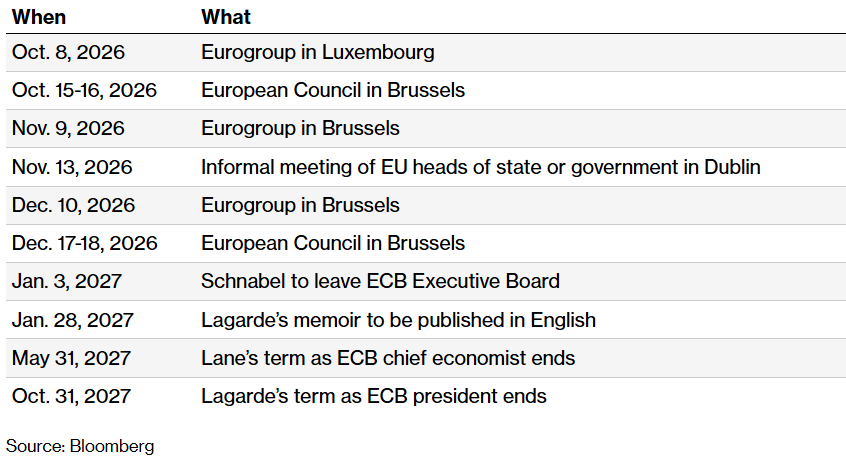
It is likely no hindrance for a decision to be taken that the time pressure to find a solution has now been upped a bit by Schnabel’s exit. In fact, since the really big political issue before EU leaders between now and year-end will be agreeing on a new 7y EU budget for 2028-2034 with the ECB presidency really only the (small) dessert, being able to horse-trade politically also with key European level jobs in the mix is likely to make a decision on both by Christmas more likely and now the base case outcome.
On the issue of whether Christine Lagarde leaves the ECB before her term ends or not, these recent developments make this somewhat irrelevant. As a decision is now likely to be taken on her successor anyway well before the French presidential elections, and as noted her departure isn’t likely to really change euro area monetary policy, it is not likely to matter much for any European leader whether she stays until the end of her mandate on the 31st of October or not.
One can argue that a person publishing her memoirs in January is likely to leave office around the same time and hence ahead of October 2027. On the other hand, one may similarly argue that someone who has just published their memoirs is unlikely to proceed to take another high-profile international job, like for instance running the WEF. In short, likely only Lagarde herself right now knows what she will do, but it will now no longer matter for European politics or monetary policy, so speculation about the precise timing of Lagarde’s exist seems analytically superfluous.
Germany will not, for reasons described, throw its hat in the ring for the ECB presidency, but Berlin will no doubt be the decisive vote on who gets the job, and on much else in how the next long-term European budget is likely agreed by year’s end. Reports of Chancellor Merz’s imminent demise are, per my note earlier this week, off the mark, and in fact, the German chancellor will enter the crunch Brussels talks in the coming month from a position of relative political and economic strength.
First of all, he is staying around the leaders’ table, unlike the departing Emmanuel Macron, and will not be on the ballot in 2027 like Giorgia Meloni, Pedro Sanchez and Donald Tusk. Among the large EU member states, Friedrich Merz is in other words the continuity leader, who will be able to credibly cut political deals with other leaders, who knows that they will be dealing with him for several years yet until late 2028-2029.
Secondly, the German economy is recovering at a politically opportune time for Merz in late 2026, just at those of other large euro area members disappoint. As illustrated in the OECD’s interim Economic Outlook, published earlier this week, Germany will in 2026 and 2027 – unlike it 2025 when it was the large member GDP growth laggard – likely grow faster than the euro area as a whole, and faster than both France and Italy (table 1). Berlin’s fiscal stimulus is in other words starting to work.
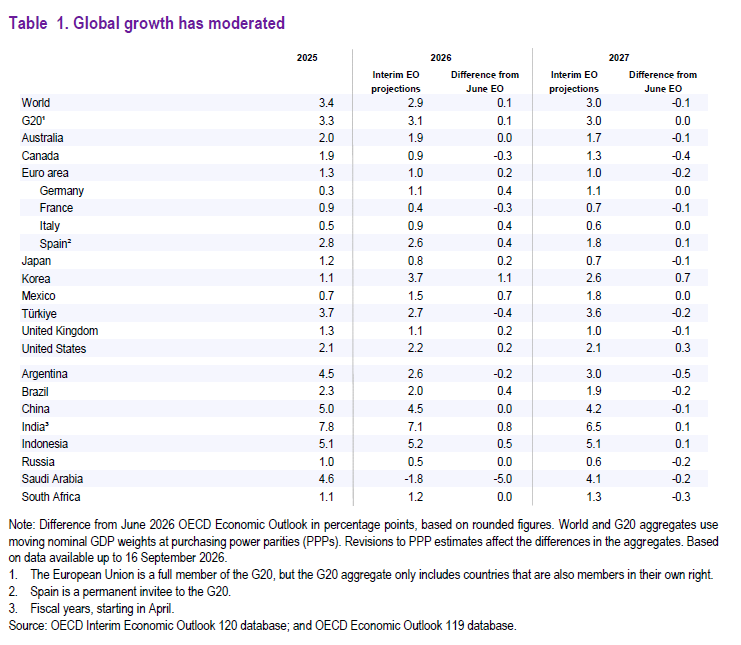
Now growth rates in Germany, or the rest of the euro area as a whole, are at just over one percent a year hardly awe inspiring, but in political negotiations it is typically relative strength that matters and Friedrich Merz will enter talks with the rest of the EU from such a position of relative strength.
Expect therefore – once the political dust has eventually settled at 5am some morning in Brussels – that Berlin in the end will secure the ECB president it likes, and get a new EU budget to its (and other frugal members’) liking.
Jacob

