

Main point: An improvement in America’s external accounts – along with depressed sentiment – forced me out of my paper short in the dollar earlier this year. I am hardly a dollar fan, but this issue remains daunting for dollar bears.
The current account deficit is never market moving these days. I vaguely remember hearing while in college that it was relevant during the mid-1980s, when the dollar was overshooting because of the so-called Reagan-Volcker policy mix of loose fiscal policy and tight money. And veterans of the 1987 stock market crash remember the G7 release regarding the dollar that began with “regrettably.” (h/t former boss) But those were different times. Or at least one hopes. So, I am not going to comment on the beat or miss from the Q2 release this morning.
However, after having caught the initial move lower in the dollar during 2025, I was a bit surprised by the improvement in the state of America’s external accounts and therefore backed away from the (paper) short in the trade weighted dollar. And I remain daunted by that condition, as I describe in this note.
Surprisingly less bad
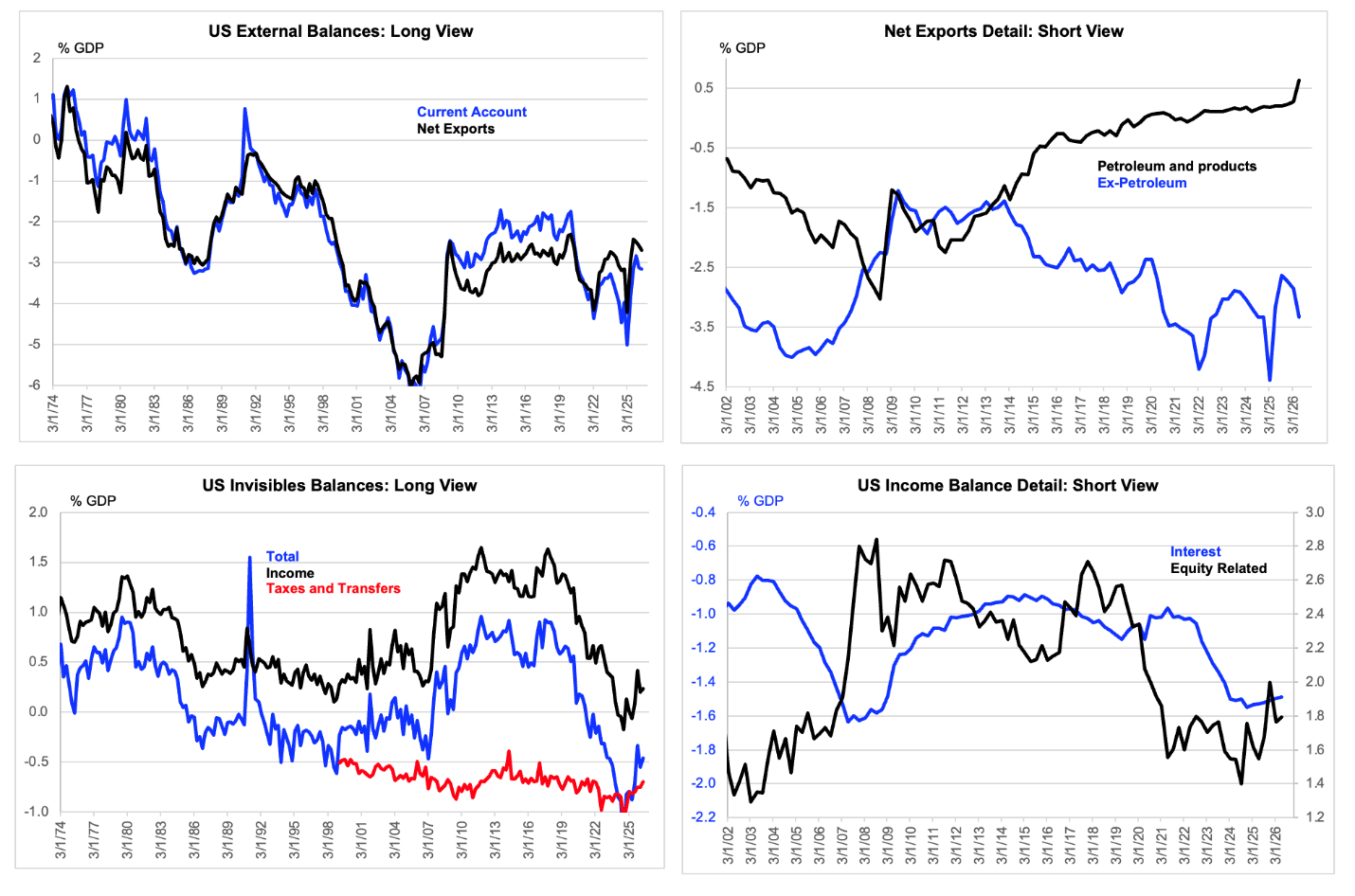
Data are actual to 2026 Q2.
From the interim lows in early 2026, the Fed’s trade weighted dollar has rallied about 3%, while carrying generally positively. The shorts have hardly been crushed, on average, but the dollar has stopped underperforming. Not even “the house” could prevent this slight uptick. But joyful taunting and extreme schadenfreude aside, I do think Bessent is more likely to stick with his defense of the yen than he was to stick with his defense of the bond market. The bond market was a no hoper because that price is just too important to macro. The more important the price, the more General Equilibrium is to call the tune.
The chart above shows the main trends in the current account. In my view, four items are particularly worth highlighting. First, the current account deficit is quite small relative to the fiscal deficit, not shown. And it is for this reason that the US continues to run a healthy (although no longer elevated) surplus in the private sector financial balance. That balance stabilizes the cycle, puts upward pressure on r* and supports the dollar through those channels.
Second, the net exports component of the current account is being supported by the radical recovery in America’s energy net exports balance. For fans of purchasing power parity, that balance is not that important. But the more conventional take is that goods trade internationally in imperfectly competitive markets, involving downward sloping demand curve. And if that is the framework, then manna from heaven in the form of an improved energy balance should move the equilibrium external value of the dollar higher. God knows how to quantify that, but it strikes me as quite relevant.
Third, note that the non-energy balance is not severely depressed by historical standards, despite the boom in AI which is sucking in high tech equipment. One implication of this is that the US current account deficit is liable to improve dramatically if that boom were to end. Its ending would hurt the dollar through other channels, but it is still striking that the non-energy balance is not worse.
Finally, the US continues to run a surplus on its investment income account. Some of this is probably fake, reflecting transfer pricing distortions, which depress recorded net exports and inflate overseas earnings. But that distortion is a wash within the current account balance, which is the more salient point.
Neither bullish nor bearish, just context
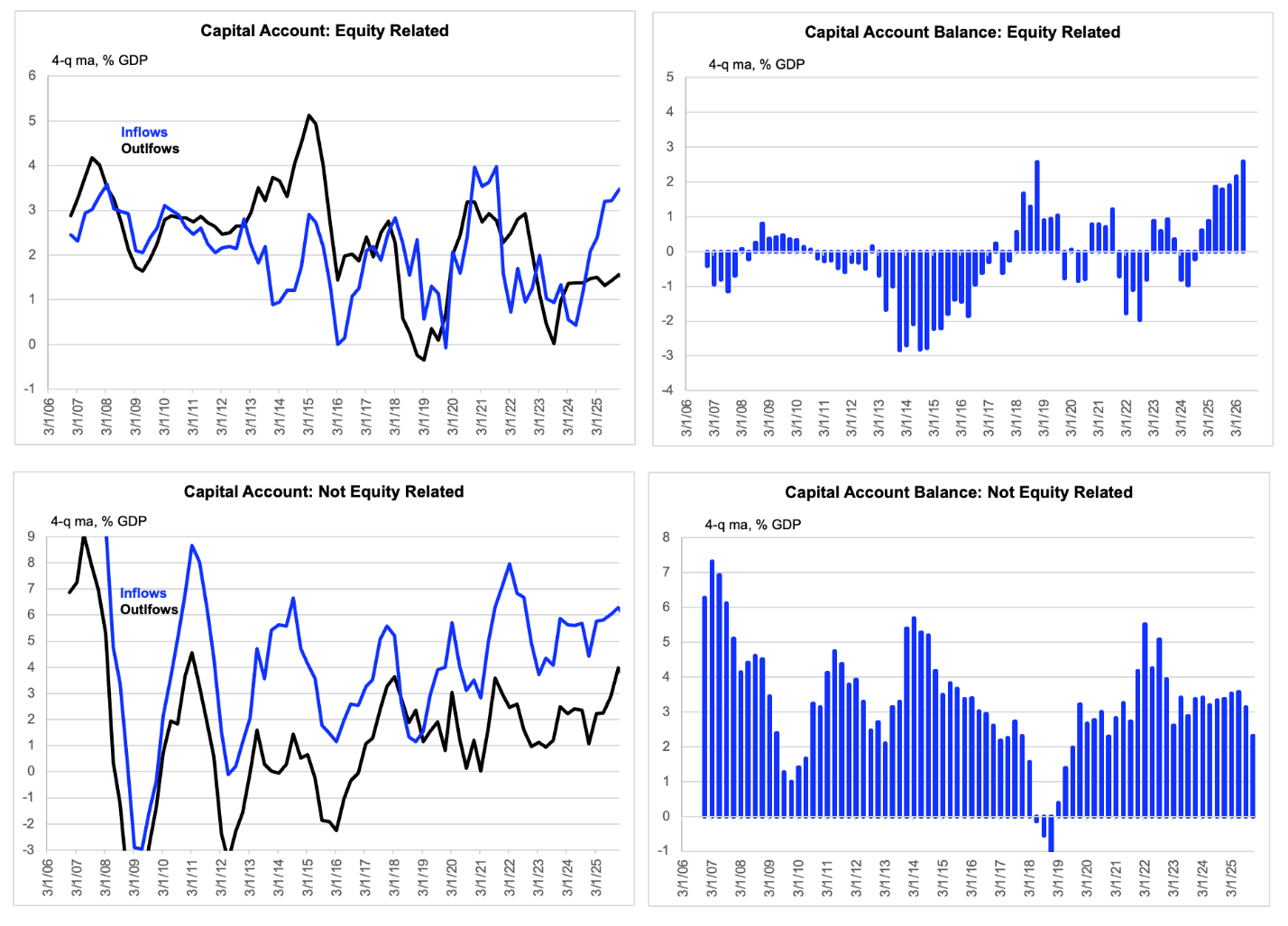
Data are actual to 2026 Q2. Equity related flows include foreign direct investment.
That is the gist of the argument, but I will complete my coverage of the external accounts with some brief comments on the capital account and the net international investment position, the data for which was also updated to today.
The current account deficit is increasingly being financed by equity-related inflows, which I doubt comes as a surprise to anyone. Non-equity related flows, which are basically fixed income, especially these days, have moderated, but remain substantial. My point here is not that capital inflows are bullish the dollar. They are merely a reflection of the current account balance and are neither bullish nor bearish when taken in isolation. It just happens to “fit” that equity related flows have strengthened. And I think it is fun also to point out that the idea of foreigners selling US fixed income is overstated. If they were to sell, that would be a big deal, because America needs the money and there would be a big repricing without it. So, again, I am not trying to sound dollar-bullish here. It is just another example of how folks are willing to believe things that are seemingly not so. Separately, beware the analyst who looks at one side of an accounting identity and pronounced ex cathedra this is the one that matters!
The surging net external debt has been mostly valuation effects, and it has recently paused
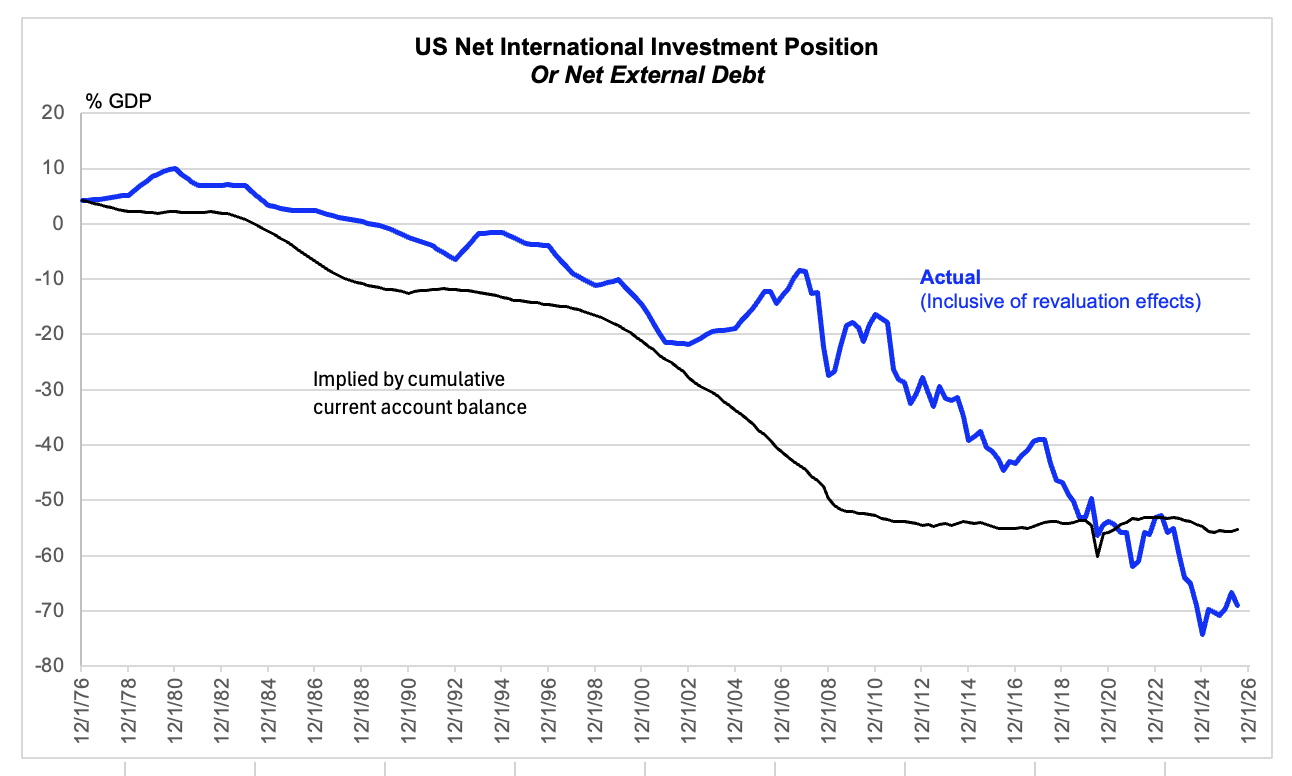
Data are actual to 2026 Q2.
The net external net has risen dramatically since the depth of the Global Financial Crisis (GFC), because the dollar has been strong and – more t the point – because US equity prices have outperformed. By some accounts, the official data here overstate the net debt by missing that international investors in the US have not owned the market and have in fact been invested in laggards. In any event, it is somewhat interesting that the net external debt has recently stabilized. And if the current account balance were to remain where it is, there would be little reason to expect the net external debt to rise much from here. Higher interest rates would favor some widening of the current account deficit, even if the net exports were to remain stable. But that is not a particularly fast acting force. I concede it bears important on the longer-term outlook. And this is more a case of holding off on the negativity for now than getting enthusiastic about the dollar.
Net external debt detail
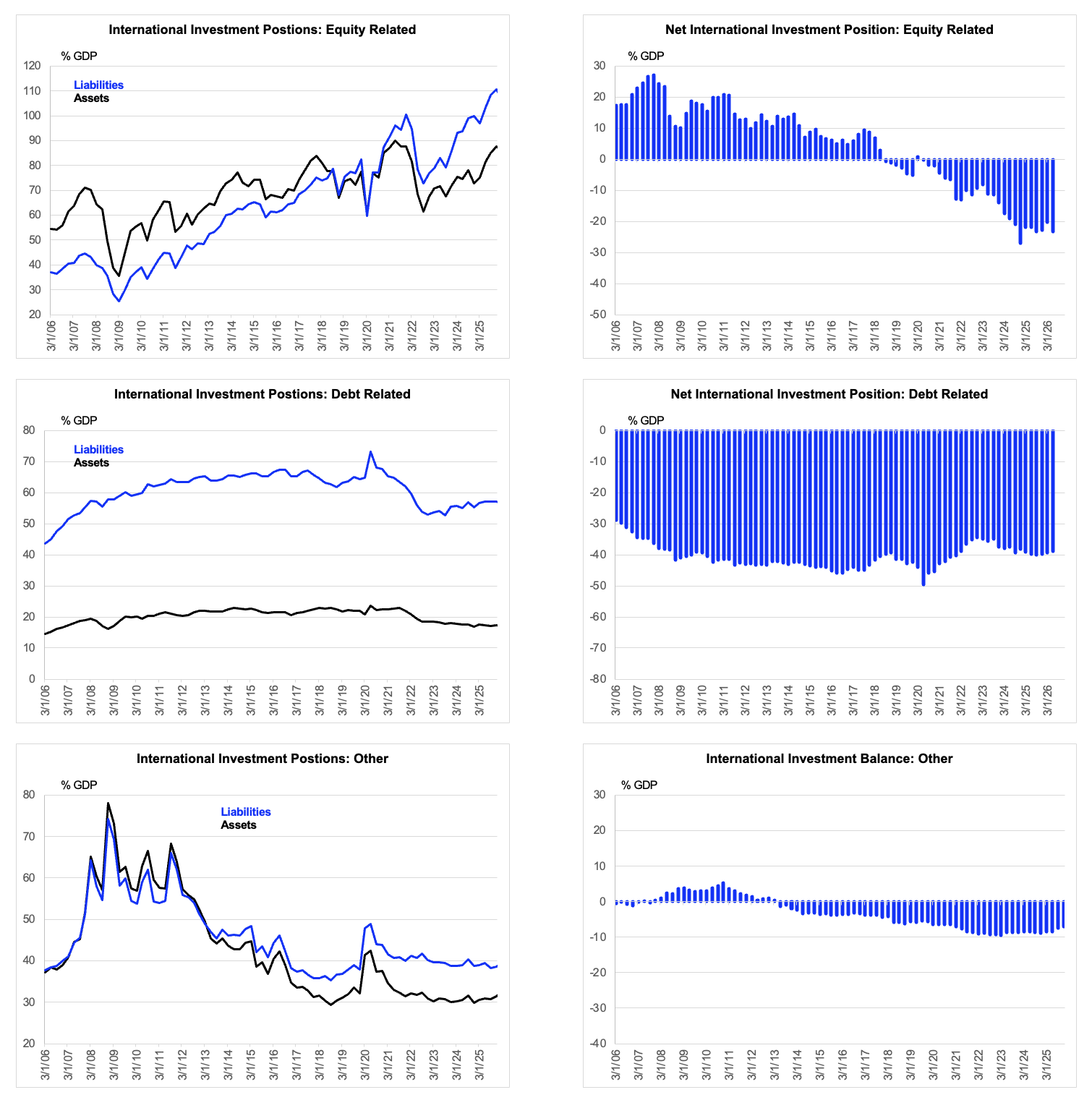
Data are actual to 2026 Q2.

