

Bottom Line: Long Risk-On
Despite Risk-on factors typically facing more headwinds relative to Risk-off in a tighter financial conditions backdrop, we remain long because 1) Momentum and Growth factors, which have unusually large exposure to AI beneficiaries, currently have extreme overlapped with Risk-on factors. We are long AI winners, Momentum and Growth factors. AI exposed companies’ earnings are likely to hold up as non-AI related Cyclicals EPS slow on a RELATIVE basis. Thanks to the MILD restraint applied to economic growth by the Fed. 2) In 2Q, high Price Momentum names had a record high EPS beat rate (85.2%) and a record low median excess return for beats (-2.4%). The median excess return was UNSUALLY poor. That is highly unlikely to repeat.
Relevant News: AI Exposed Multiples
Across a curated universe of 81 AI capex-exposed companies spanning 12 market segments, next-Twelve-Months (NTM) EV/EBITDA multiples are compressed by an average of 26.1% from their peak levels earlier in the year. Earnings growth over the same period increased. FY2 EBITDA consensus estimates rose by an average of 12.3% (with NTM EBITDA up 20.8%) and that Valuation is more attractive relative to history. The 81-company group trades at an average NTM EV/EBITDA of 14.9x, which is 1.14x their pre-2026 historical average (13.4x between 2022 and 2025).
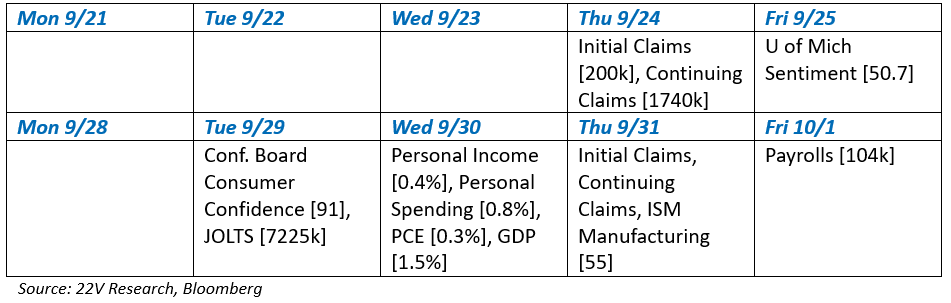
Things to Watch [Consensus, Results]:
Strategy:
Remain Long Risk-On Factors Due to Strong Fundamentals & AI Exposure– (HERE)
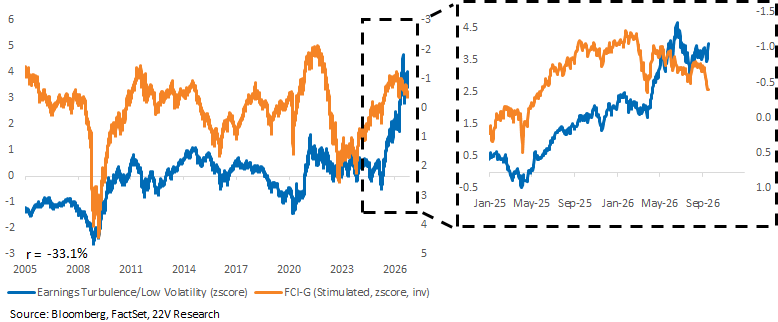
There has been a divergence with historical pattern at the factor level. Earnings Turbulence outperformed Low Volatility post the Fed meeting even as financial condition tightened meaningfully. Historically tightening financial conditions are a tailwind more to Low Volatility given risk factors relative performance is negatively correlated with the FCI-G Index. The risk-on outperformance is also diverged from factor return post historical first Fed rate hikes.
China:
Trump-Xi Summit: Why the Taiwan-for-Iran Trade Won’t Work – (HERE)
22V’s China team is skeptical that this week’s Trump-Xi summit will produce a “grand bargain” linking Chinese cooperation on Iran with US concessions on Taiwan. The two issues are highly complex, mutual trust is limited, and the two leaders operate on very different timelines: Trump has a near-term interest in de-escalating the Iran conflict, while Xi views Taiwan as a long-term, core national priority rather than a transactional bargaining chip. Trump also faces constraints on Taiwan from Congress, US allies, and concerns around TSMC and semiconductor supply chains. Meanwhile, Beijing has little desire to put itself at the center of the Iran conflict and currently faces less urgency from high oil prices than Washington does. The team would not be surprised to see the US announce some form of Chinese cooperation on Iran, but they would be cautious about interpreting it as a major shift. Xi is also likely to press Trump to continue delaying a pending US arms sale to Taiwan; another pause is plausible, but the team would view it as a temporary postponement rather than evidence of a broader geopolitical bargain.

