Back Economics

Backing further away from marginal rents

Published on September 22, 2026

Download the PDF Report

By

Gerard MacDonell

The idea that slow marginal rent inflation would be followed by a steep deceleration in the measures of average rents in the official price data was helpful. However, it seems now to be well past its use-by date. So, from here on in, we should probably stop dismissing those government rent data as mere laggards and replacing them with our sense of how marginal rent inflation is tracking. The main reason is that the apparent gap between marginal and average rent inflation has narrowed a lot. So now, there is probably more to lose from the slippage between how marginal and average rents are measured than there is to gain from the presumed lead provided by marginal rents.

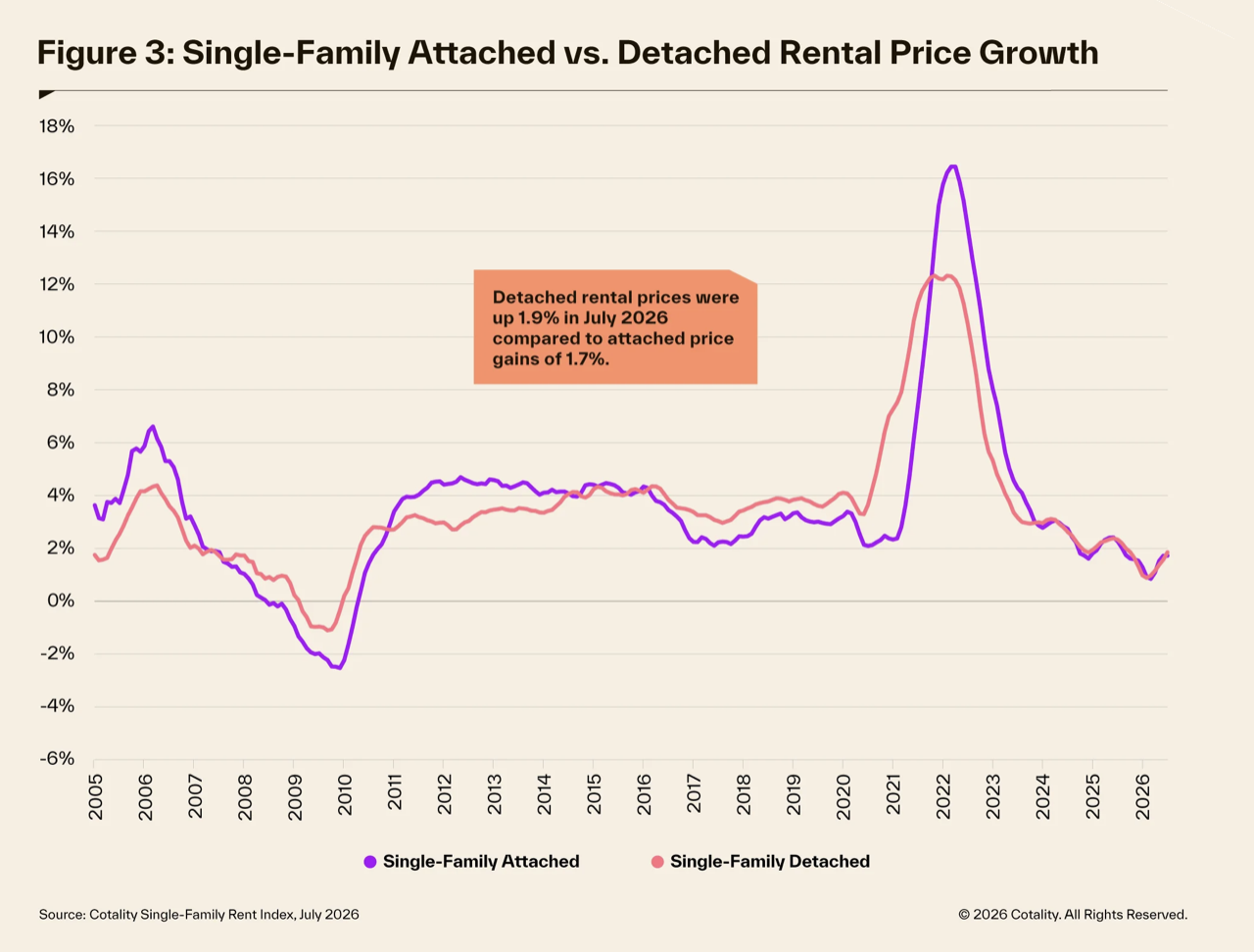
I have been edging in this direction for a while, mostly because the official measures of average rents have indeed decelerated steeply, just as the earlier hypothesis (which was hardly some brilliant insight) predicted. And most recently, the various private sector proxies of marginal rents have begun to hook higher. For example, the 3-month rate of change in the seasonally adjusted version of Zillow’s Observed Rent Index (ZORI) has accelerated 200 basis points, 3 ½%, since January. I mentioned that in an earlier note, although I fear I may have misreported it as the 12-month change. And late last week, Cotality reported that the 12-month rate of change in their Single Family Rent Index (SFRI) has picked up to 1.8%. The chart below shows that headline inflation rate split between attached and detached, but it is actually easier to read than the Cotality depiction at the top of their report. To me, that chart has too many lines.

Marginal rents have perked up, at least a bit...
Source: Cotality as linked above.

I do not know what the short-term rates of change in the Cotality are, but their report mentions that sequential rent growth has recently returned to “seasonal patterns,” which I think means that it is running at a normal pace in seasonally adjusted terms. I prefer to monitor these measures of marginal rents, rather than forecast them. But my own bias is to take this normalization idea seriously because I do not see a strong case for rent growth to remain durably depressed. It appears to have fallen below normal in the wake of a wave of multifamily completions, and it may well have since renormalized. The government measures of average rents have also renormalized recently, although from the opposite direction.

Given that the lead-lag relationship here now seems to be less important, differences in how marginal and average rents are measures loom a bit larger in relative terms. For example, the BLS’s so-called “experimental” measure of marginal rents very clearly leads their experimental measure of average rents, which is helpful from the perspective of method, because it tells us to watch the marginal when there is a large gap. However, both the experimental marginal and average rent metrics use an hedonic adjustment that is slightly different from that used in the official government statistics. So, for example, the BLS’s experiment measure of the average is very tightly correlated with the official measure of the average when measured as inflation rates. But there is a gap there that averages about 50 basis points over time, which pollutes the marginal measures as well. When the leading marginal measure is running 500 basis points below the lagging official measure, quibbling over such precision misses the point. But that is no longer the case. So, I will quietly return to just taking the government measures roughly at face value as a measure of what is actually going on.

Changing the subject slightly away from method and toward speculation, it does seem as though the idea that the CPI will now be biased downward relative to the PCE Price Index because of the higher weight it assigns to rents is now less compelling. If the Trump Administration were to fiddle with the CPI to make inflation look lower, that might mess up the TIPS market. But that is separate. The rents issue is now a lesser reason to expect the CPI to track a bit low relative to “true” inflation.

Some might put this whole discussion much more briefly. This issue is just far less important than it was. That too would be fair.

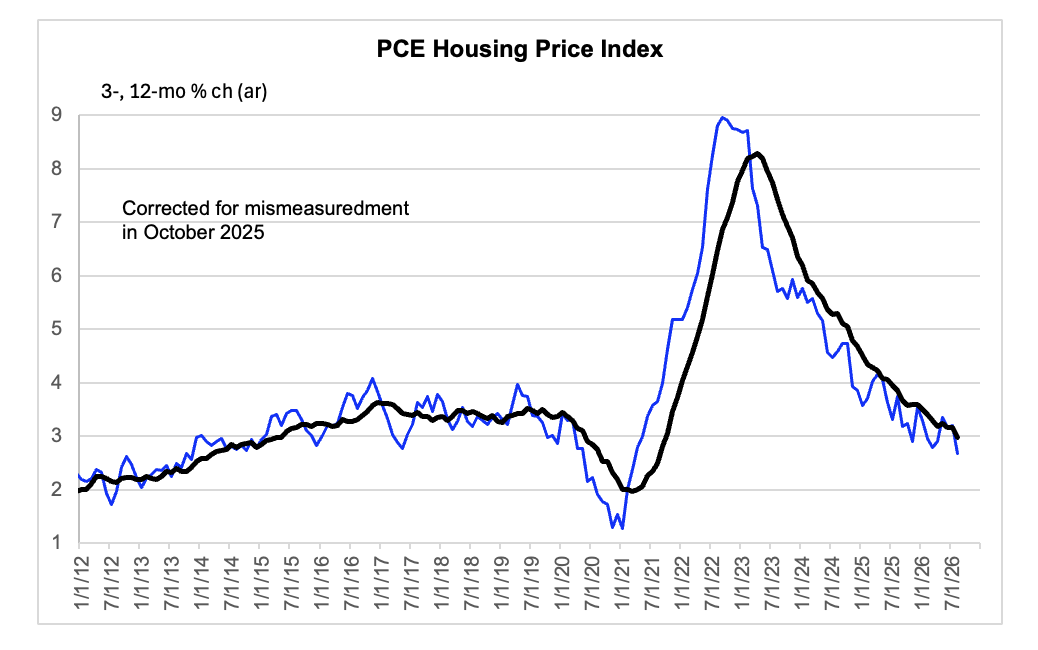
… although this is the main source of the convergence

(between average and marginal)
Source: BEA, FH calculations
Data are actual to July and effectively actual to August because the inference from data in the CPI release is very tight.


DISCLOSURES AND DISCLAIMERS

Analyst Certification

The analyst, 22V Research Group, primarily responsible for the preparation of this research report attests to the following: (1) that the views and opinions rendered in this research report reflect his or her personal views about the subject companies or issuers; and (2) that no part of the research analyst’s compensation was, is, or will be directly related to the specific recommendations or views in this research report.

Analyst Certifications and Independence of Research.

Each of the 22V Research analysts whose names appear on the front page of this report hereby certify that all the views expressed in this Report accurately reflect our personal views about any and all of the subject securities or issuers and that no part of our compensation was, is, or will be, directly or indirectly, related to the specific recommendations or views of in this Report.

22V Research (the “Company”) is an independent research provider. The Company is not a member of the FINRA or the SIPC and is not a registered broker dealer or investment adviser. 22V Research has no other regulated or unregulated business activities which conflict with its provision of independent research.

22V Research, LLC is a professional services and independent publication organization. 22V Research, LLC is not a securities broker-dealer, not a member of the Financial Industry Regulatory Authority (FINRA), not a registered investment advisor (RIA) and not a member of SIPC.

Securities transactions, when offered, are offered by 22V Securities, LLC through LPS Capital, LLC. Certain employees of 22V Securities, LLC are dually registered as securities representatives of LPS Capital, LLC or Analyst Hub Securities, LLC. 22V Securities, LPS Capital and Analyst Hub Securities are members FINRA, SIPC.

https://brokercheck.finra.org/

Current Ratings Definition.

SECTOR OUTPERFORM: An “outperform” rating anticipates the company will outperform the S&P Regional Banking Index (peer group).

SECTOR PERFORM: A “market perform” rating anticipates the company will perform in line with the S&P Regional Banking Index (peer group).

SECTOR UNDERPERFORM: An “underperform” rating anticipates the company will underperform the S&P Regional Banking Index (peer group).

Limitation Of Research And Information.

This Report has been prepared for distribution to only qualified institutional or professional clients of 22V Research Group. The contents of this Report represent the views, opinions, and analyses of its authors. The information contained herein does not constitute financial, legal, tax or any other advice. All third-party data presented herein were obtained from publicly available sources which are believed to be reliable; however, the Company makes no warranty, express or implied, concerning the accuracy or completeness of such information. In no event shall the Company be responsible or liable for the correctness of, or update to, any such material or for any damage or lost opportunities resulting from use of this data. Nothing contained in this Report or any distribution by the Company should be construed as any offer to sell, or any solicitation of an offer to buy, any security or investment. Any research or other material received should not be construed as individualized investment advice. Investment decisions should be made as part of an overall portfolio strategy and you should consult with a professional financial advisor, legal and tax advisor prior to making any investment decision. 22V Research Group shall not be liable for any direct or indirect, incidental or consequential loss or damage (including loss of profits, revenue or goodwill) arising from any investment decisions based on information or research obtained from 22V Research Group.

Reproduction And Distribution Strictly Prohibited.

No user of this Report may reproduce, modify, copy, distribute, sell, resell, transmit, transfer, license, assign or publish the Report itself or any information contained therein. Notwithstanding the foregoing, clients with access to working models are permitted to alter or modify the information contained therein, provided that it is solely for such client’s own use. This Report is not intended to be available or distributed for any purpose that would be deemed unlawful or otherwise prohibited by any local, state, national or international laws or regulations or would otherwise subject the Company to registration or regulation of any kind within such jurisdiction.

Copyrights, Trademarks, Intellectual Property.

22V Research Group, and any logos or marks included in this Report are proprietary materials. The use of such terms and logos and marks without the express written consent of 22V Research Group is strictly prohibited. The copyright in the pages or in the screens of the Report, and in the information and material therein, is proprietary material owned by 22V Research Group unless otherwise indicated. The unauthorized use of any material on this Report may violate numerous statutes, regulations and laws, including, but not limited to, copyright, trademark, trade secret or patent laws.