

September FOMC Preview: Time to Get Going
- Barring a surprisingly dovish turn, the Fed will hike in September (80% or so odds), pencil in one more for 2026, and see the long-run dot continue its slow-moving drift higher.
- Our baseline is that the Fed hikes in Sept, Dec, and, with lesser conviction on timing, again in ‘27H1.
- The labor market looks stable, and may arguably be starting to gradually improve, growth is solid-to-strong, the consumer has been remarkably robust, the AI boom rolls on, supply shocks continue hitting the global economy, and financial conditions remain easy overall. In this backdrop, the center of FOMC has gradually lost confidence that policy is at an appropriate stance to ensure disinflation back to target over an acceptable time horizon.
- Chair Warsh will frame the hike as getting policy into a more appropriate position given the topline strength of the US economy and paying back some of the insurance cuts of last year.
- Upside surprises to core inflation in the coming months could pull the tentative three hike baseline fully into this year. Through 2027 rates risks seem right tail skewed.
- In the event the Fed does not hike I would expect to see sharp twist steepening and likely risk off price action as the market seems to have shown a preference for at least a bit of counter-cyclical, cyclically extending policy.
The Basic Policy Debate Centers on Inflation Risks and When We Should Try to Return to Target
There are broadly speaking 3 main, roughly evenly sized (the doves the smallest), groups at the Fed now. The hawks, a growing number obviously still inclusive of those who dissented or said they would have in July, believe that policy should be less supportive than it currently is and that the inflationary outlook and risks have not sufficiently improved to be consistent with what they see as the somewhat growth supportive policy stance. The centrists seem to be increasingly accepting the plausibility of future hikes but not the necessarily the necessity of them yet. Waller, and to a lesser extent Williams, has articulated a degree of data point dependence which frankly seems far from optimal or robust policy making. The dovish cohort has been much less vocal in recent months but what have heard and can infer from their structural views and reaction functions suggests that they are not likely to truly support moving policy to a more restrictive place any time soon given the forecast implications their low neutral rate views have over the medium-term.
The June and July Minutes both emphasized six key factors in driving the FOMC’s assessments of policy baselines and risks. While these have not universally moved in a hawkish direction over the summer, the key data-driven ones have and the right-tail risks to the others seem increasingly elevated given the broad policy and macro backdrop.
- The first three are (explicitly linked together as key inflationary drivers and risks in the June Minutes) were lingering effects of tariffs, supply chain disruptions from the war, and the strong demand related to AI investment. None of those have seen their inflationary risks improve since earlier in the summer.
- Financial conditions remain supportive of demand, even if they are a bit less easy than they had been. This is clearly one area where indirect impacts of AI are playing a generalized role. On top of that Warsh highlighted the return to easing, if not perhaps outright easy, credit conditions and increased loan demand the recent SLOOS surveys have shown.
- There is a nearly universal assumption across the FOMC that the labor market is “quite stable” at present, and slightly less universally held view that it is not a source of inflationary pressures. The data supports at least this conclusion clearly enough, although there are some growing signs that there may be renewed improvements in the cyclical composition of hiring and some, but far from all, wage growth measures. If the labor market is not just bouncing around 4.1-4.3% but rather slowly starting to retighten that makes future underlying disinflation much harder to achieve (underlying as somewhat distinct from supply shock driven pass-throughs).
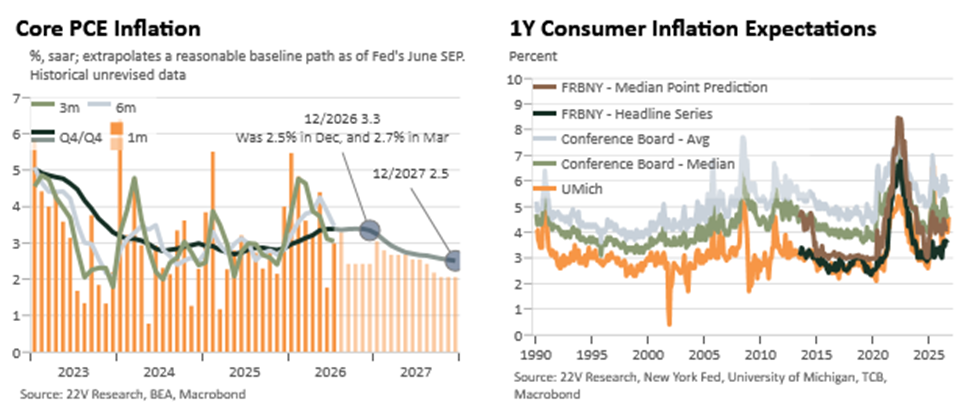
- Inflation expectations remaining anchored is the final and essential ingredient which allowed for the risk management cuts of the past few years which took place despite elevated inflation. As Warsh noted at Hackson Hole though, “the thing about market measures of inflation expectations in economic history is that they tend to look strong and durable until they don’t… It’s the Fed’s job to make sure that inflation expectations do not get unanchored.” Much of the post-covid academic and policy research shows that short-term inflation expectations matter as much or more than long-run ones for forecasting inflation; something the RBA highlighted in its recent Minutes[1], staff across the Fed system, and prominent outside academics. .
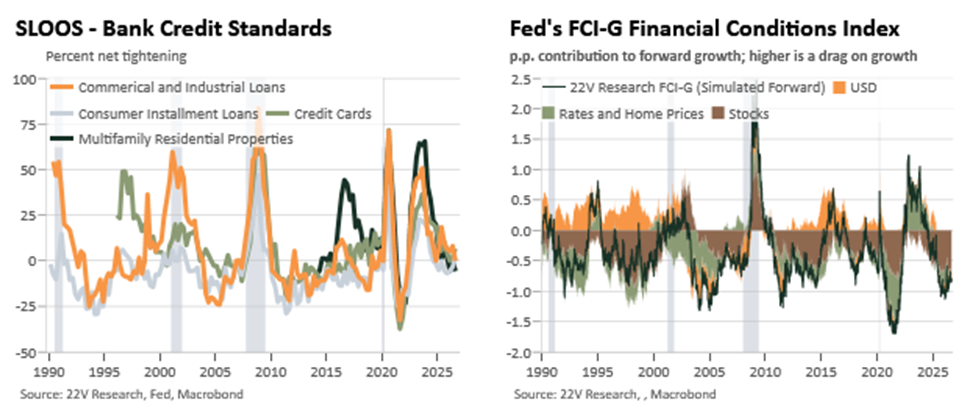
SEP Will Show a Stable, Bit Too Hot, Economy
Since the June meeting, the incoming data has been largely supportive of growth on net. While there is some evidence that consumer spending saw a local peak in June, it has not slowed much, and the overall GDP growth picture remains a solid one. If the growth forecasts move higher I would expect this to largely be a result of the broadening out of the AI boom and recent reacceleration in manufacturing activity with consumer spending still solid.
- The growth forecast for 2026 may shift up a 1/10th to 2.3%, this fairly inconsequential shift would depend on how strong of tracking estimate submitters pencil in for Q3. Beyond that there seems little reason to expect any notable shifted to the medium-term outlook but the risk skews towards a bit higher as increasing evidence of mid-cycle reacceleration grows.
The story of the labor market is a bit messier given whipsaws and revisions in the topline payrolls numbers. One suspects the more dovishly inclined might just describe it as meeting expectations given the continued sluggishness of job churn metrics, fairly soft wage growth, and low pace of overall job gains. but it is hard to argue with the basic fact that the unemployment rate is dropping and 0.2pp below where it their forecasts form June expected it to be at this point in the year. At Jackson Hole, Chair Warsh told us that shifting labor supply is “barely growing” which means that “monthly job gains are naturally going to run low” and makes the generally sluggish pace of payrolls growth fairly irrelevant in most Fed officials assessments barring very extreme moves.
- The unemployment rate medians for 2026 will drop down to 4.1% from 4.3% in June and stay there over the next few years.
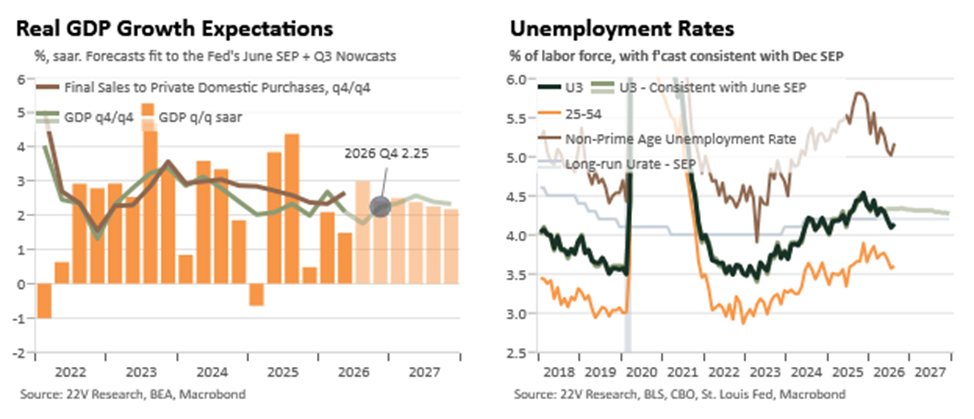
On inflation, the Fed has mixed views about interpreting the data but the recent data flows seems unlikely to have meaningfully shifted forecasts from this point; the real shock higher was in the winter and spring. The data in hand over the summer would point to either the same 3.3% or just a tenth higher at 3.4%. The looming and widely discussed revisions to the PCE data will plausibly be at least partially incorporated into the SEP; hopefully Chair Warsh will make this analytical point clear at during his press conference. Estimates for the impacts of the revisions range from 3.1-3.3% but without the data in hand I suspect most officials will be skeptical of fully incorporating estimated values in their baselines. The salience of these revisions is also somewhat attenuated by the fact market-prices only core services ex housing (getting into the weeds of the exclusionary measures cited by the Fed) is likely to be revised up.
- On net, I expect the median core PCE forecasts for 2026 to be unchanged at 3.3% but risks seem moderately skewed to the downside given possible incorporation of the expected revisions.
- The 2027 core PCE forecast shift up a 1/10th to 2.6% and 2028 will be unchanged at 2.1%. The new 2029 forecast will show a finally at target baseline. These revisions reflect the impacts of less-disinflationary-than-hoped for recent inflation prints, increasing right tail pressures from the war and AI boom, and the stabilizing, perhaps retightening, labor market. Tighter monetary policy offsets some of these concerns.
The Dot Plot and the Right Tail
With the economy running somewhat stronger than expected, the labor market now certainly stable with some Fed officials hinting and data hinting at possible signs of cyclical retightening (makes sense over time if growth is running above potential), and additional right tail concerns on inflation mounting over those basic facts which will makes disinflation slower from here, short-term inflation expectations moving higher again, the continued and building disruptions from the war, and inflationary impacts from the AI boom, the hawks seems to be winning out.
The reaction function laid out most explicitly by the center of the Committee was that of Waller, who said that he was willing not to hike but any surprises above the disinflationary baseline would need to be met with a hike. As noted above this seems like far from optimally robust policy making. For the hawks the case for 2-3 hikes by early next year seems clear enough and only after moving into a more clearly mildly restrictive territory will it be time to wait and learn how the economy responds to the bevy of shocks hitting it. It is possible that one or more of the doves dissent but my baseline is that none do (formally, 1-2 may keep a dot plot with no hikes at all in it) with the center of committee persuading them of the near-term need for less restrictive policy even if their longer-run views eventual cuts a necessity.
Given increasing rhetoric around the need to return inflation much closer to target over an acceptable medium-term (12-24 months) timeline from many, the actual risks to the policy rate remain right tailed versus the Fed’s baseline. Current pricing is incorporating some of this skew with the ~3.5x hikes priced in; the Atlanta Fed’s option implied distribution shows that markets currently only price a 40% chance of rates at or below the median 4.125% I expect to be penciled in during next summer; for the end of 2026 pricing is much more symmetric as risks build over time.
- The 2026 dot will show 2x hikes. Away from the median 2-3 will be at 3x hikes, 4-5 at 1x hike, and there may be a few shadow dissents from the doves who do not change their submissions and keep a no hike/cut baseline.
- For 2027, the median like shows unchanged policy (4.1%) but there will be a few above that with a longer tailed distribution below. Many Fed officials likely are open to a cut later in the year but with still above target inflation in the forecast, growth above potential, and the unemployment rate at or a bit below views of its long run level, such a quick pivot seems more of a risk than a baseline.
- For 2028, the median dot shows 2x cuts back to 3.6% with the distribution largely echoing views on neutral. The same holds for the new 2029 submissions.
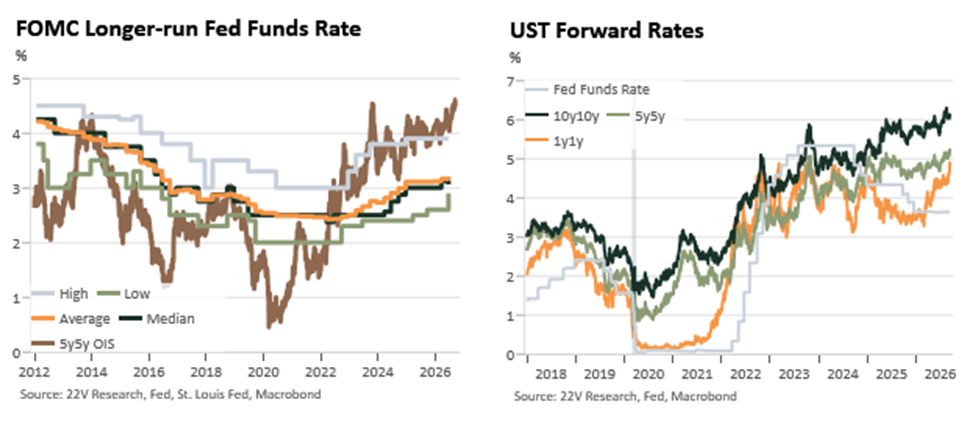
- The long-run dot will almost surely see its average value continued its slow drift higher. Whether or not the median moves up seems somewhat difficult to say given the current clustering of so many r* submissions at 3% with a long tail above that but the gradual shift higher still seems inevitable as the economy shows little evidence at 3.6% policy rates that the stance of policy is in aggregate particularly restrictive.
“Members also noted staff research that indicates short-term inflation expectations matter for inflation dynamics even when longer term expectations are anchored. They observed that both findings imply that a more pre-emptive approach to monetary policy might be appropriate when the economy is subject to capacity constraints and adverse supply shocks.” ↑

