

AI principals’ caution of technological systemic risk they helped create and develop arrives after years of policy lag and quarters of tech control breaches. The unlikely Amodei/Altman/Muck alliance leaves Washington incapable of ignoring overdue frontier model governance and safety policy intervention. Complex critical questions will slow policymaking even as the call for action from informed, personally invested private experts suggest known and imagined danger requires haste.
Sidelined willingly by campaign finance contributions intended to assure inaction, Congress inherits a commotion that will agitate policy lag like no other issue. The overlap of technologists once buying policy inattentiveness is now increasingly cautioning against inaction should sober lawmakers. Different from the data centers topic, federal government’s unencumbered authority to impose safety and governance standards leaves Congress and the White House no safe harbor from responsible action. Time will be a factor enabling voluntary agreements until legislation is possible, which I gauge December at soonest but more feasible in 1H27 absent a systemic catastrophe. Obviously, policy failure remains an option. But agentic risks seem akin to medical and financial comprehensive risk episodes or cycles.
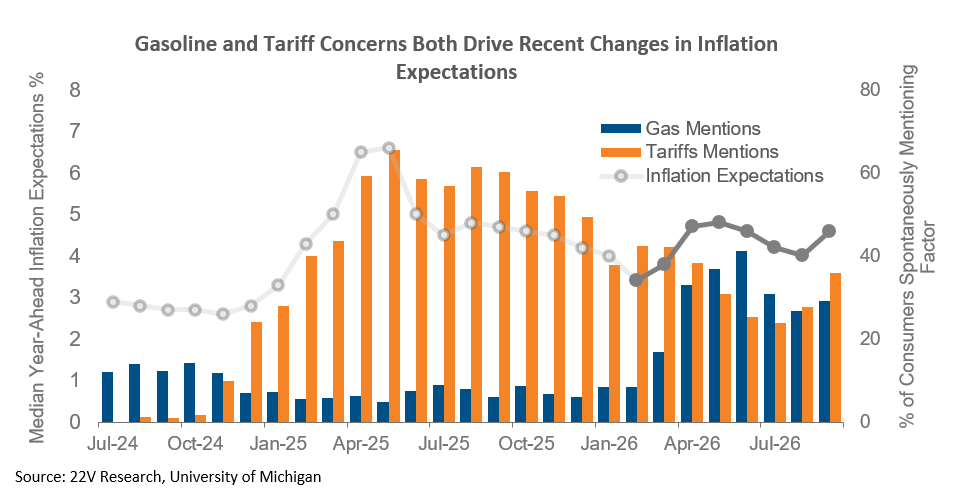
Unthinkable even last Friday, AI managed to relegate the midterms to a second-tier matter. Daily household economics and headlines nonetheless imply economic perceptions dominate voters’ preferences this year. Replicated from University of Michigan consumer sentiment survey data released on Friday, the following graphic tracks respondents’ mentions of tariffs and gas prices as components of overall survey inflation expectation readings. Poll respondents also highly rank reveal the fortitude of democracy and foundational principles as motivational this election. Former federal judge Michael Luttig last week opined the seating of the 120th Congress constitutionally set for January 3, 2026, as a larger threat to the US than Election Day (HERE).
OUTLOOK (all times Eastern)
Monday
Prime Minister Carney hosts Canada’s inaugural two-day Investment Summit.
G20 energy ministers’ three-day meeting in the Houston melting pot.
Tuesday
5:00a.m., Germany’s ZEW business conditions and expectations surveys.
10:00a.m., Secretary Bessent briefs the House Financial Services Committee on “the State of the International Finance System.”
Wednesday
European Parliament receives EC President von der Leyen’s State of the Union speech, Strasbourg (Canadian Prime Minister Carney addresses Europarl one day later).
The WTO’s annual trade report.
3:15a.m., the ECB annual research two-day research conference focused on “Geoeconomics and the International Trading System.” (HERE)
2:00p.m., FOMC rate decision (including a new SEP), Chairman Warsh’s presser follows thirty minutes later.
Thursday
12:30a.m., SEMICON India three-day conference, New Delhi (HERE).
7:00a.m., BoE bank rate.
9:30a.m., Senate Armed Services Committee closed briefing on the national defense strategy and its impact on the current US national security posture.
11:00p.m., BoJ target rate announcement process begins.
Friday
NATO Military Committee Conference convenes for two days in foody haven Copenhagen.
6:30a.m., ECB President Lagarde joins ECOFIN (all EU economic and finance ministers) press conference following eurozone finance ministers’ informal meeting.
9:30a.m., Fed Vice Chair for Supervision Bowman discusses US bank stress tests with an audience at Masion House, London.
11:45a.m., Kansas City Fed Bank’s Schmid keynotes the Independent Bankers of Colorado annual convention, Vail.

