

Late last week, US elections veteran, Charlie Cook, confirmed expectations for 2026 midterms results by observing the majority party’s performance outlook ranged between bad and horrible. His intermediate characterization was “very bad.” Cook’s consensus view acknowledges both midterms tradition and sentiment trends in place in the past six quarters. US policy risk implications of course interest investors not looking to expand their worry list. Developments this year tee up the opportunity that some of those risks will not abate regardless of November US election results. Whenever one pegs the current phase of modern US populism (1981, 1994, 2008, 2010, 2016, or now) voter economic discomfort played a role in occasionally dramatic election outcomes and related policy.
No matter the 120th Congress balance of power, a benign political environment scenario seems remote unless one assumes the parties can agree on national security (ending the war) and tighter fiscal policy (concerns expressed a bit in yields) before cherry blossoms bring spring colors to the DC landscape. At least two calendar points would inform investors ability to update this thesis and adjust odds on whether upside positioning on those risks can be fulfilled: December 11 and January 4. Closure of government two weeks before Christmas will test Republicans’ and Democrats’ collective willingness to govern. The 120th Congress by the Constitution is set to be sworn in on January 3, which is a Sunday making January 4, 2027, a market trading day influenced by political intrigue involving the seating of 2026 midterm winners.
BoE Governor Bailey’s speech also last week deftly observed governance principles crucial to the Bank’s dynamic 332 years earning independence and credibility. His comments clearly applied to public institutions globally relevant to functional civics, referencing noted governance philosophers (HERE). Quoting a young Alexander Hamiliton advising General Washington in 1780 on the civic benefits on an independent central bank 86 years after its original charter certainly whetted my appetite, but, of course, Bailey shared several supporting and other related insights. Legitimacy maximizes societal embrace of institutions created legislatively ostensibly to create public goods.
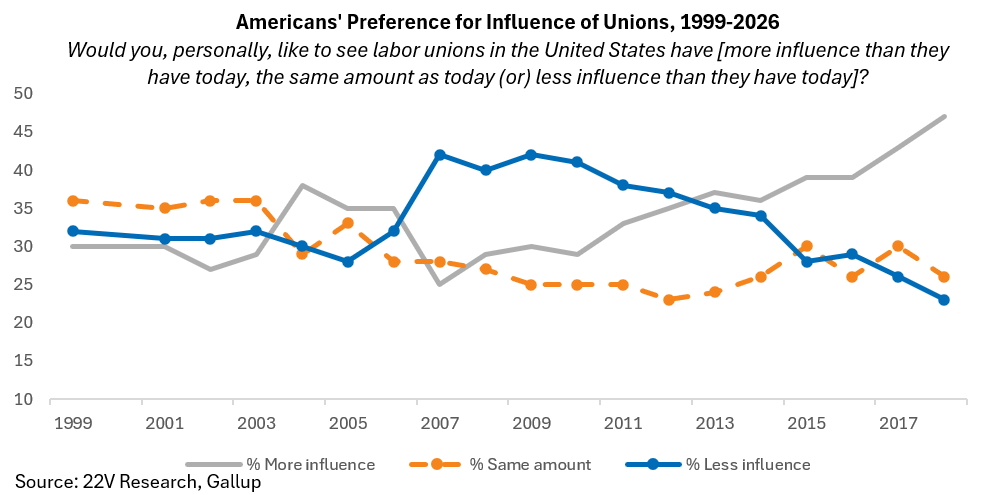
Support for labor organizations gives people a voice, if not influence, in the capital vs. labor national income shares tussle. Populists of all stripes began to express stronger support for unions just as the 2007 credit crunch indicated the GFC. A recent Gallup report (HERE) also includes respondents’ views that their aspiration for more labor union influence will not be realized. While this sentiment may not spill over into the economy, political implications for elected officials seems durable considering the economic backdrop for Americans more reliant on labor for household well-being than capital.
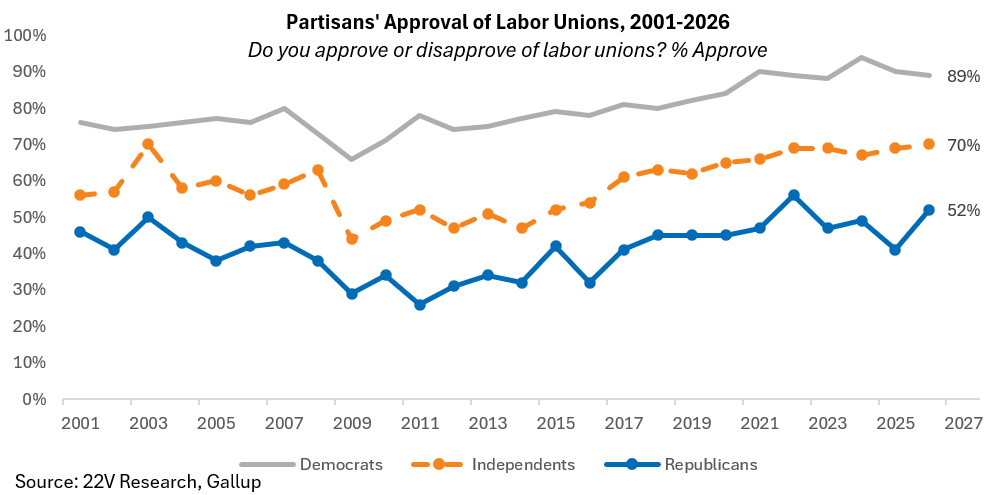
Partisans’ populist appeal anchored by economic conditions naturally invites voter disdain (note the six-quarter spike among self-identified Republicans). Thin voting margins and fraying sustainability of ideological fervency leaves each dominant party vulnerable. This year differs in the causes of popular contempt but not the general animus directed at elected officials centered on socioeconomic conditions. Bailey quoted John Pocock’s warning on populist reactions to outsize public debt: “A political and military regime financed by the public debt implied a danger of rising influence of a financier class, which could exercise power without enjoying a proper and legitimate place in the politics of the country.”
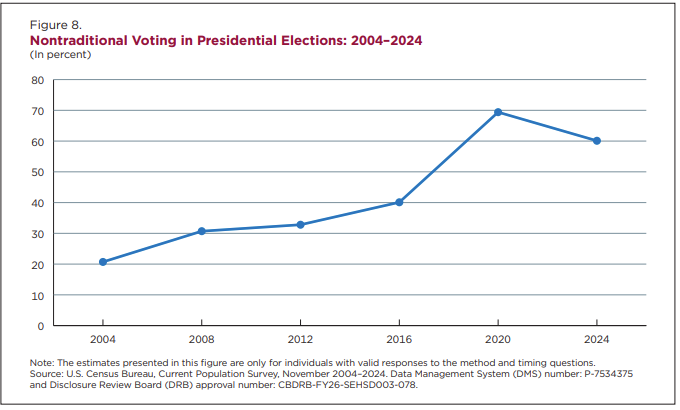
The Census Bureau enjoys unique status in tracking Americans’ habits, including voting. The agency updated the 2024 election database. A section on non-traditional voting tells what is known about voter behavior, including a recently popular topic of mail-in voting (HERE). The next for panels lifted from the report show a steady rise this century in voting from home, a trend this goosed by the coronavirus.
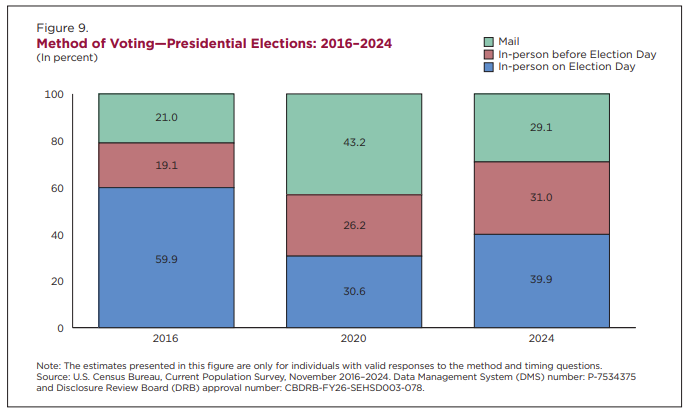
A mix of demography and convenience contribute to mail-in popularity (systemic fraud has never been proven). Busy lives, aged joints, and 4Q20 pre-vaccine isolation rituals seem acceptable reasons for the 2020 anomaly in this admittedly short series. All states and most voters assiduously guard their constitutionally created voting rights and obligations. Data below confirms age and educational attainment are two factors separating nontraditional voters from other cohorts. The disaggregated data are interesting and fulsome in report appendices, yet the significant increases of nontraditional voters last two presidential elections could point to risks of politicians seeking to constrain such balloting.
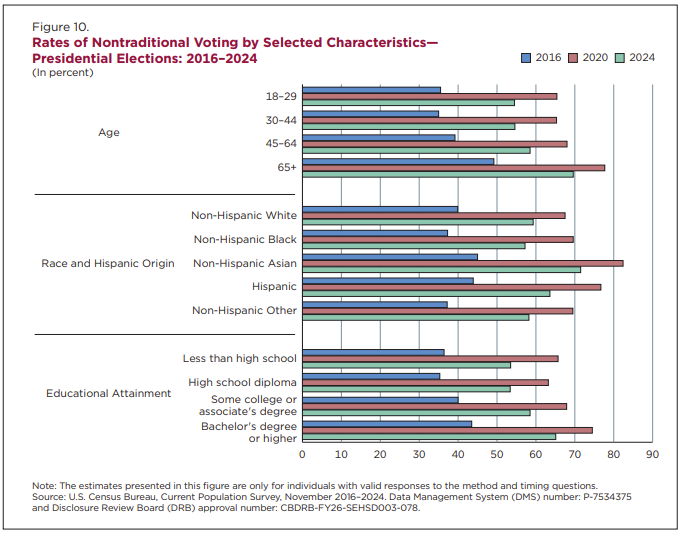
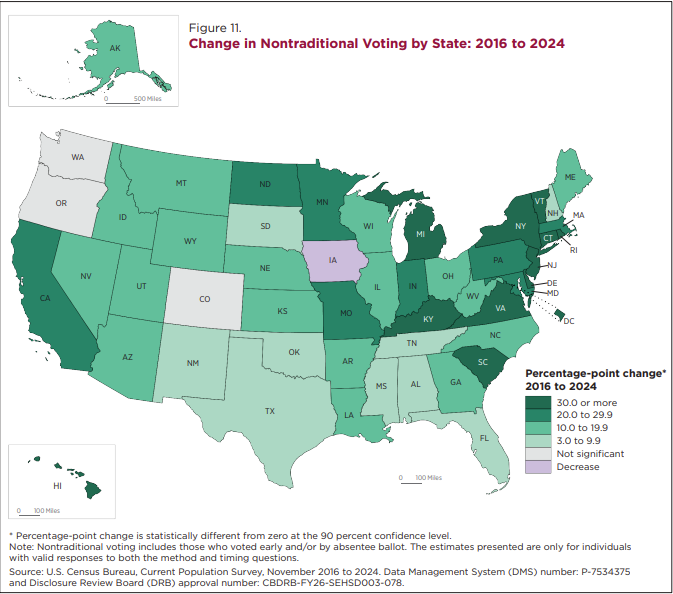
The following heat map reveals the largest nontraditional voting the past two elections occurred in red, blue, and purple states. Democrats and Republicans strategists’ efforts to increase output via this conduit speaks to the value they find in non-Election Day turnout. Attempts to subvert or suppress these flows could backfire by depressing or encouraging turnout contrary to national or individual party contest interests. North Carolina’s secretary of state mailed out all eligible ballots last Friday. I would be surprised if courts or states tolerate intrusion into the unique non-federal function.
Two DC factors outside the monetary policy role of addressing accelerating yields recurred in my conversations with investors the past week. The impact of global pricing concerns not limited to the narrow vector of crude prices and fiscal imbalances. President HW Bush in 1990 lost seats in both bodies of Congress, but support for the former combat pilot and intelligence officer as commander in chief during another war in the Middle East limited GOP electoral damage. That political air cover does not exist today. Even so, Bush dented his party’s enthusiasm by negotiating throughout 2H90 and signing into law a day before Election Day deficit reduction legislation containing small tax increases.
I agree with views identifying market reaction as the more likely catalyst for fiscal consolidation next year. My sense is top-down macroeconomic pressures would overcome bottom-up retail political opposition to forced fiscal retrenchment. Unless resolved in December, which we assign well below 50% odds, debt ceiling adjustments needed by 2H27 could be a tailwind to action. None of this would be easy and downside risk will haunt proceedings as elements of each party seek leverage under the guise of populist appeal. The two highlighted deadlines coming in the next four quarters are directional indicators.

