DAILY STRATEGY: Main Point – Marking to Market Consumer Call (not good for us) – The economic speed limit looks like to be ~2% real GDP growth. Economic growth has been WELL above that, and the labor market is solid. The two sources of economic strength are consumer spending and AI related investments.
Investors are discounting that economic growth needs to slow somewhat to bring inflation down (respecting the economy’s “speed limit”), that the Fed will apply mild restraint to help slow growth (see fed futures), and that consumer spending will do most of the work in that slowdown. Implicit in this discounting is productivity growth NOT improving much from current levels. That assumption could change, but it is not a relevant question for now. The relevant question is what it will take to get inflation closer to target over the coming year.
The new information that helped change our view 1) AI’s expected contribution to economic growth is INCREASING meaningfully. The numbers are staggering (HERE). AI related investments are not a source of slowing. At least over the next two years*. 2) The persistent strength in Consumer spending. All measures of high frequency consumer spending data have reaccelerated (HERE). We are not getting the post tax refund slowing of consumer spending that was expected. In short, the more AI contributes, the more something else needs to slow to respect the economic speed limit. Hence, we see more downside risk to consumer spending NOW and need to adjust our thinking as a result. A slowdown in consumer spending from 2.5% plus to 1-1.5% is likely needed. This assumes AI contributes ~0.5%-1% to GDP.
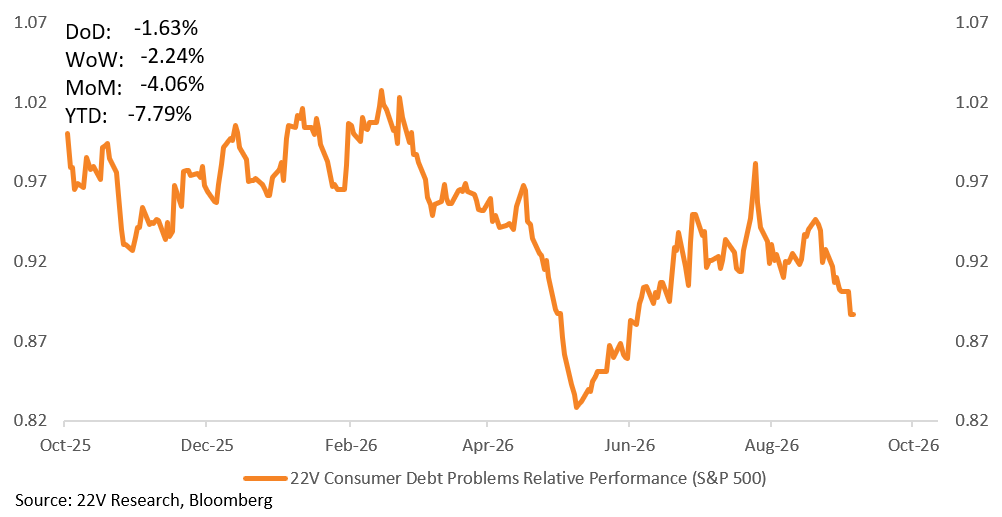
A basket of cyclical consumer stocks with lower interest coverage ratios, higher near-term debt ratios, and greater cash flow volatility is down roughly 8% YTD. And -9.7% since the late July high. Underperforming both the S&P 500 Retail Index and the broader S&P 500. Most of that weakness has occurred since late July. Since late July it has become more obvious that financial conditions need to tighten some to slow economic growth. Investors seem to have internalized that some slowing in economic growth is necessary to respect the economic speed limit.
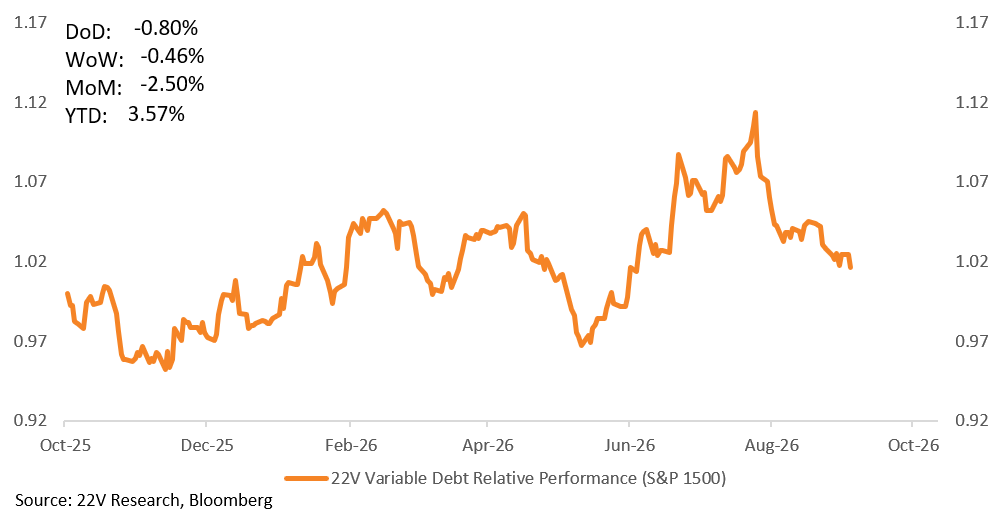
This dynamic is not unique to the consumer. Our Variable Rate Debt basket (MS22VARD Index on bbg which is S&P 1500 stocks excluding Financials with high variable-rate debt exposure and low interest coverage ratios) performed well into late July/early August. That relationship has now reversed. Consistent with our view that some restraint is needed to bring economic growth back toward its roughly 2% speed limit. As a result, companies with greater sensitivity to higher borrowing costs have started to underperform.
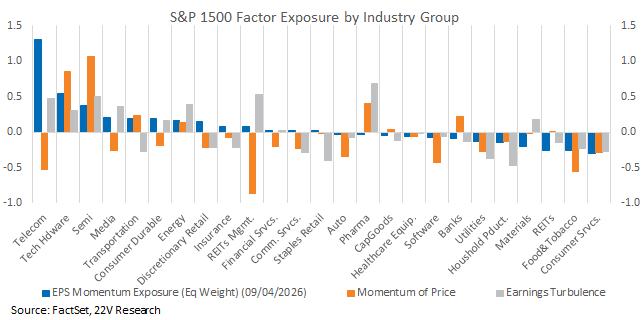
Over the past week Earnings Risk, EPS Momentum and Price Momentum have been the best performing factors. All the factors have significant exposure to the AI buildout, which from an economic and near-term earnings perspective, will continue to be a support for those baskets. They all have negative exposure to Consumer service names. All factors are +2% Long/Short WoW. The size factor is outperforming as well. Small caps have lower EPS expectations than large caps and higher FCI tightening exposure (HERE). Idio is the main driver of the AI buildout names, but from a macro point of view, the backdrop for that group appears more attractive REALTIVE. AI buildout related earnings should hold up as the non-AI related cyclicals areas if the economy slow.
FYI – In late July 10yr yields were not far from current levels. Roughly 4.7% vs current 4.8%. In late July many consumer and debt exposed names were near YTD highs. It’s not that 10yr yields suddenly became much more restrictive as they moved from 4.7% to 4.8%. It’s that the data is more obviously suggesting that the Fed needs to slow economic growth. Rate hike expectations have increased since as the labor market has tightened, consumer spending measures have reaccelerated, and supply constraints (oil prices) look more structural.
*It is true that AI Capex faces some headwinds from higher financing costs, but that is likely to be a beyond 2027 issue. If it remains an issue at all. For the near term, for economic growth to slow toward 2% real, consumer will need to be the source of that slowing. Consumer spending likely needs to fall to the 1%-1.5% range. From the current 2.5%+.
Charts…
EPS Momentum, Momentum of Price and Earnings risk are more exposed to the AI buildout. They all have negative exposure to Consumer service names. All factors are +2% Long/Short WoW.
Our consumer debt basket is made up of the most Cyclical consumer stocks with low interest coverage ratios, high and deteriorating short-term debt ratios, and high cash flow volatility. It is down -8% YTD.
S&P 1500 stocks with high variable debt % and a low interest coverage ratio. The universe is S&P 1500 excluding Financials, to filter out the names where Variable Rate Debt ÷ (Fixed + Variable + Zero Coupon Total Debt) is in top 2 quartiles and EBIT/Interest Expense (LTM) is in bottom 2 quartiles.
Earnings sentiment for the S&P 1500 has moved sharply higher. Retail earnings sentiment has remained muted.
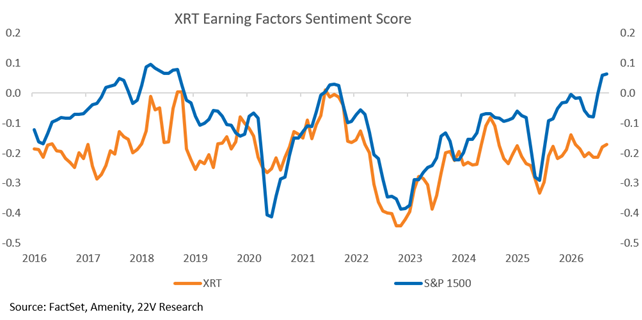
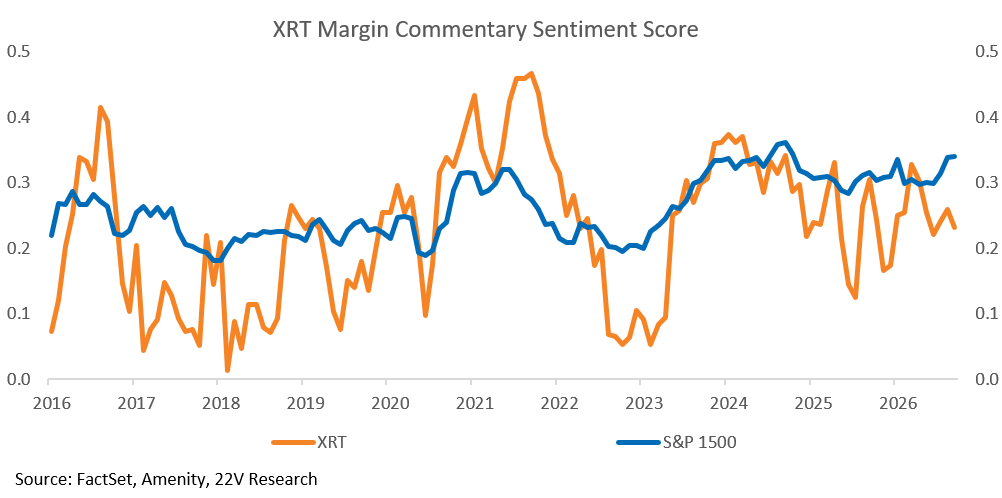
Margin sentiment for retailers has decreased this quarter and is underperforming sentiment for the S&P 1500.